







Breathe London Data Reveals Big Drops In NO2 Pollution During Commuting Hours
Written By

Share
London businesses are starting to reopen and some nonessential workers, who have been working from home, are considering going back into their offices. But what impact might this have on air quality?
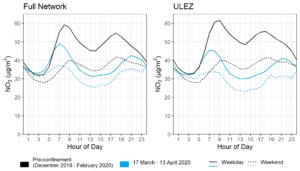
During the lockdown, air quality data from Breathe London shows that harmful nitrogen dioxide (NO2) pollution went down significantly during commute times – 25% in the morning and 34% in the evening.
To help maintain these lower levels of pollution as shops and offices begin to reopen, businesses should allow more flexible ways of working. A new survey confirms it’s what people want.
Less pollution during commute times
Before the lockdown, many people across the city followed similar schedules on weekdays. As a result, the Breathe London network of air pollution sensors often saw daily dips and peaks of NO2 – a gas produced by fossil-fuel combustion that is associated with heart and lung-related health impacts.
In the pre-lockdown patterns, the lowest levels of this pollution measured was in the wee hours of the morning (around 3-4 am), when most people are sleeping. After they wake up and start moving to school and work, many in their fossil-fuel powered vehicles, the monitors saw a pronounced pollution increase. This falls midday, but pollution rises again in the evening to a second spike as folks return to their homes.
After confinement measures went into place, Breathe London data shows that air pollution significantly decreased across the city, including in residential areas, indicating there have been benefits to Londoners’ health even away from busy roads.
To get a better sense of how lockdown and many people working from home was impacting air quality, we then zoomed in on weekday commuting hours. Across Greater London, NO2 pollution decreased around 25% during the morning commute (8-11am) and 34% in the evening (5-8pm). These pollution reductions were even greater in the city centre, where many businesses are located – 31% and 37% respectively in the Ultra Low Emission Zone.
More work flexibility and clean air action
As lockdown eases, people across the UK want more flexible working options and action to lower air pollution.
That’s the gist of a new survey, commissioned by charity Global Action Plan on behalf of Business Clean Air Taskforce, which finds that:
- 87% of those currently working from home would like to continue to do so to some degree.
- 72% of the public believe clean air is more important now because coronavirus can affect people’s lungs.
- 74% want businesses to do more to improve air quality in the recovery.
Not everyone can work from home, so it’s important businesses provide the option for those who can – leaving the roads and public transport available for essential workers to travel safely.
Build back better
Data helps us understand how pollution changes across the city, and Breathe London data shows the confinement measures have helped lessen the pollution peaks typically associated with commuting.
To protect public health and prevent the return of higher pre-lockdown pollution levels, UK employers should build back better and give people what they want by offering more flexible work options.
For more information on how pollution levels changed since confinement measures went into place, please see the full Breathe London analysis.
This was originally posted to EDF Europe.