Climate change solutions
We deliver game-changing environmental solutions that have a real impact for people around the globe.
By David Lyon, PhD
The second annual Appalachian Methane Initiative report offers two different tales for one basin: several operators of higher-producing, unconventional wells have successfully mitigated their methane emissions, while operators of lower-producing conventional wells have disproportionately high loss rates.
According to the study: unconventional wells have an average loss rate of just 0.09%, while conventional wells have an 18.3% loss rate — that’s 200 times higher. This lopsided phenomenon is particularly stark given that conventional wells account for 97% of active wells but just 2% of the region’s gas production and more than 60% of its emissions.
Conventional wells are oil and gas wells that are drilled vertically to tap a reservoir of oil and/or gas. Hydraulic fracturing is sometimes used for production.
Unconventional wells are oil and gas wells that are drilled vertically and horizontally to release oil and/or gas contained within shale rock formations. Hydraulic fracturing is always used for production.
Importantly, operators participating in AMI demonstrate that very low methane intensity is achievable, reinforcing that the region’s emissions challenge is concentrated among higher-emitting, often marginal and conventional wells.
As domestic and international buyers seek cleaner sources of energy, developing accurate, measurement-based inventories for natural gas by region and operator is critical for the integrity of differentiated natural gas markets.
About the study
AMI is a collaborative, multi-year research study designed to understand methane emissions in the Appalachian Basin. It is led by the Energy Emissions Modeling and Data Lab at the University of Texas at Austin, managed by SLR, and consists of four full-member operators, including CNX Resources, EQT Corporation, MPLX and Seneca Resources, as well as two data-contributing operators, Ascent Resources and Expand Energy Corporation. All of the operators have upstream and/or midstream assets in the Appalachian Basin. Together, the operators produce over 50% of the total gas production in the Basin.
Emission profiles in Appalachia can be complicated and complex to measure due to the numerous methane sources, including oil and gas wells, coal mines and landfills, located in mountainous, forested terrain.
The 2026 study integrated multi-scale measurements to quantify methane emissions, including aerial measurements by three companies (Bridger Photonics, Insight M and ChampionX). AMI estimates that the region’s methane loss rate is 0.52% of natural gas production (95% CI: 0.30-0.62%), similar to an analysis of MethaneSAT data collected between 2024 and 2025 which found a loss rate of 0.6%.
The findings reaffirm earlier studies and underscore that the outsized emissions contribution of low-producing, conventional wells in Appalachia may be far greater than previously understood. EDF’s groundbreaking 2022 study found that marginal wells nationally were responsible for about half of all emissions.
Methane waste in Appalachia matters
Considering methane’s potency and warming power, allowing low-producing wells a pass to pollute supercharges climate change in the near term. It also stands to hurt the region’s bottom line.
As global and domestic markets begin to demand cleaner and transparent sources of energy, failing to address the loss rate of methane gas (also known as methane intensity) harms the economic competitiveness of Appalachian energy companies. In a world currently dealing with energy instability, cutting waste and bringing that gas to market can ease supply chain concerns.
Low-producing, conventional wells are a big problem, but also a big opportunity.
The AMI study demonstrates that making significant cuts in methane emissions is possible, but to get at oil and gas industry’s methane problem, we simply cannot afford to ignore such a large source of emissions. Operators of Appalachia’s unconventional wells have proven they can tackle leaks. It’s time for conventional operators to do the same instead of dragging the entire region’s emissions portfolio down with them.
Over the last decade, the number of warehouses across the nation has exploded. In Illinois alone, there are almost 7,000 warehouses larger than 30,000 square feet with a combined area of more than 1 billion square feet. More than one in four people in Illinois now live within half a mile of a warehouse.
The new Illinois Warehouse Boom report examines the impact these truck-attracting warehouses have on communities across the state. The report includes information on the demographics of the communities near these warehouses, while estimating the negative health impacts of living in close proximity to these facilities.
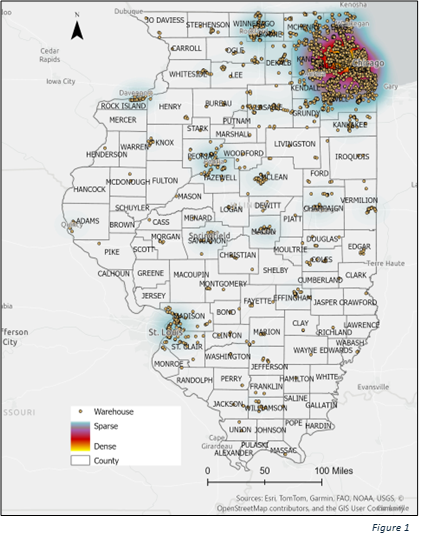
Warehouses tend to be disproportionately located in communities of color, bringing vehicle traffic, mainly made up of polluting diesel trucks. These state-defined environmental justice communities cover 1.3% of the state but contain 41% of warehouses. Our report finds that the mega-warehouses (100,000 square feet or larger), prevalent in these communities, generate an estimated 683,000 truck trips a day.
Medium- and heavy-duty vehicles are disproportionate polluters: Despite only being 7% of on-road vehicles they emit 67% of the transportation sector’s nitrogen oxide emissions and 59% of particulate matter — these pollutants increase instances of asthma, and PM 2.5 alone will result in an estimated $4.8 billion in public health costs in 2026.
Despite the harm warehouses cause to the communities they are sited in, there is currently no method or database to track warehouses. While the U.S. Energy Information Agency contains information on polluting facilities such as oil refineries or power plants; there is no federal or state data base for facilities that attract pollution instead of producing it directly. Due to the lack of regulation, it is extremely difficult to learn the location of warehouses or who operates them. EDF used a private database in the analysis, but private databases tend to be expensive, limited in scope and have burdensome terms of service for sharing data. Therefore, as things currently stand, communities lack the means to monitor the facilities in their own backyard.
To address the pollution and lack of transparency from warehouses, the Clear the Air Coalition, which EDF is part of, is supporting the Warehouse Pollution Reduction Act. The act would address the impacts of warehouses by establishing an Indirect Source Rule — a measure that seeks to regulate facilities indirectly responsible for pollution. In addition to Illinois, other states such as New York, New Jersey and Colorado are considering their own ISR rules.
California has already implemented the policy in the South Coast Air Quality Management District. According to South Coast’s most recent analysis, its ISR program resulted in reductions of 1.5 tons of NOx pollution and 0.33 tons of particulate matter. The program is on track to result in 300 fewer deaths, 5,800 fewer asthma attacks and $2.7 billion in reduced health costs by 2031. The success of California’s program makes a strong case for Illinois to adopt their own ISR.
The key provisions of the Warehouse Pollution Reduction Act are:
Illinoisans are already paying the cost of diesel pollution impacts. It’s time for achievable, life-saving pollution reduction through the Warehouse Pollution Reduction Act.
Co-Authored by Harish Makarim, EDF Legal and Regulatory Extern
Electrification is accelerating across the United States. Homes are switching from gas to electric appliances, electric vehicles are scaling rapidly and new clean energy projects, data centers and manufacturing are facilities coming online. But in many places, long grid connection times have become a major bottleneck that threatens to slow this transition.
This final step in electrification, known as energization, is where delays can block project completion. Even the most ambitious clean energy goals stall when new connections or upgrades take months or years to complete, with upstream upgrades driving a large share of the delay. Energization delays can hold up housing development, prevent EV charging deployment, slow clean energy projects and increase costs for customers and utilities alike.
Rapid energization is not just a technical issue. It is central to making electrification affordable and reliable. If timelines remain slow and unpredictable, electrification will become more expensive, more frustrating and less equitable, especially for customers with fewer resources to navigate delays.
Timeline tracking makes delays visible
Energization delays persist in part because they are often invisible. Customers may experience long waits, but utilities, regulators and policymakers often lack consistent data showing where delays occur, how long they last and who controls each step. In many jurisdictions, energization timelines are not tracked consistently, leaving regulators without a clear view of where delays occur.
Energization involves multiple phases: application review, engineering design, permitting, construction, inspection and final connection. Some of these steps depend on customers or local governments, while others fall under utility control. Without clear tracking, delays are often attributed to complexity even when utility processes are the primary cause. Even steps assigned to customers or local governments are often shaped by utility processes, from application clarity to coordination and review timelines.
Timeline tracking addresses this problem by introducing transparency and accountability. By measuring and publicly reporting how long each step takes, utilities and regulators can identify bottlenecks, compare performance across service territories and focus improvement efforts where they matter most.
California’s Public Utilities Commission recently became the first regulator in the country to adopt energization timeline tracking requirements, recognizing that electrification goals require measurable expectations for grid connection. Other states are beginning to follow. Colorado and Illinois have enacted legislation directing regulators to collect and use energization data, while Washington, D.C. requires tracking of EV charging timelines as part of its infrastructure planning. In New York, Con Edison has incorporated energization timelines into performance incentives for transportation electrification, with broader tracking under consideration. Together, these efforts reflect growing recognition that timely grid connection is critical to electrification.
EDF’s design recommendations for timeline tracking
Timeline tracking is necessary but not sufficient to accelerate energization. EDF’s analysis shows that impact depends on how regulators design these systems. Key decisions about what to measure and how to define timelines will determine whether tracking documents delays or drives improvement.
Grid connections must be faster
Electrification will only succeed if customers can connect to the grid quickly, affordably and reliably. Delays do not just slow projects, they increase financing risk, raise project costs and ultimately show up in customer bills. Energization delays are solvable, but fixing them requires visibility, accountability and intentional reform.
Timeline tracking is a foundational step. By making delays measurable and transparent, it gives utilities and regulators the tools they need to identify bottlenecks, improve performance and accelerate the clean energy transition.
Across major economies, from the U. S. to Germany and India, governments and industry are working to scale low-emissions hydrogen as a substitute for fossil fuels in hard-to-abate sectors such as fertilizers, refining, shipping and aviation.
Low-emissions hydrogen remains a critical option for energy security and deep decarbonization. Yet despite widespread interest and clear use cases, many projects are stalling before final investment decisions because offtake commitments and bankable market structures have not kept pace with market ambitions. Delayed action risks slowing decarbonization and prolonging dependence on volatile fossil fuel markets.
Building on EDF analysis of hydrogen use in US fertilizer and refining markets, this blog outlines four market and policy levers that can help create hydrogen demand even under today’s uncertain conditions.
Book and claim – unlocking demand by separating physical use from climate value
Book and claim systems offer a practical way to address cost premiums in today’s low-emissions hydrogen market. Under this market-based approach, companies with a higher willingness to pay — for example, consumer-facing food brands – cover the added cost of low-emissions hydrogen and claim the associated emissions reductions, helping to meet their climate targets, even if they may not use the hydrogen directly themselves. The hydrogen can then be steered to sectors, such as fertilizer production, that urgently need to reduce emissions but may struggle to absorb the green premium between clean and fossil-based fuels.
This type of book-and-claim system is being piloted in Minnesota, where Pepsi and others can purchase certificates for low-emissions fertilizer made from green hydrogen-based ammonia. Similar accounting systems exist elsewhere. CertifHy – a European voluntary hydrogen book-and-claim system – has been operational since 2018. Renewable electricity markets have used similar systems for decades, through Renewable Energy Credits in the U.S. and Guarantees of Origin in the European Union. These programs offer useful lessons for future book and claim design, including the importance of robust, verifiable and transparent emissions accounting.
Buyers’ alliances: aggregating demand to create bankable signals
Buyers’ alliances are another market-based tool that can help create the early demand signals that producers need to get projects off the ground. By pooling their purchasing power and committing to buy low-emissions hydrogen, companies can give producers and financial backers more confidence to move projects forward.
This approach is already being used across a range of sectors needing to decarbonize. The World Economic Forum’s First Movers Coalition is a leading example, targeting hard-to-abate sectors such as shipping, aviation and steel. In its first five years, the coalition helped generate more than 130 offtake agreements and investments, demonstrating the power of buyers’ alliances to create credible demand signals.
Hydrogen industry members and policymakers can build on this momentum by expanding existing alliances, such as ZEMBA and SABA, while also developing sector-specific initiatives like the alliance for Low-Emission Ammonia-based Fertilizers, launched at COP30. These groups are helping to create the demand certainty that hydrogen producers and investors need to accelerate deployment.
Product standards: mandating demand through regulated markets
Product standards use regulation to create predictable demand for low-emissions hydrogen. The standards can require a certain amount of low-emissions hydrogen to be used during production. For example, the EU has set targets requiring a growing share of industrial hydrogen use to come from renewable electricity by 2030.
Alternatively, a limit might be set for the carbon intensity of fuels or end products, as seen in Colorado’s Buy Clean standard for publicly funded construction materials. This creates predictable demand for low-emissions hydrogen or its derivatives, reducing risk for early projects and encouraging investment.
Public financial support: closing the cost gap to enable demand
Public financial support strengthens demand by bringing down hydrogen costs to be competitive with fossil fuels. Government support can take the form of production or end-use tax incentives where producers or end-users must meet a minimum emissions intensity threshold, or Contracts for Difference where the government sets a guaranteed price floor or ceiling for clean fuel options.
The U.S. and Australia have introduced federal clean hydrogen production tax credits, while Colorado and Illinois have implemented clean hydrogen tax credits aimed at hard-to-abate end uses. Meanwhile CfDs have been the preferred policy in the EU (European Hydrogen Bank auctions), Japan (Green Transformation (GX) scheme), and the United Kingdom (Low Carbon Hydrogen Agreement).
Both tax incentives and CfDs improve project affordability and strengthen demand. Some forms of CfDs, like those in the EU and India, can further address demand by matching offtakers and producers directly, resulting in signed offtake agreements.
Looking ahead
Hydrogen markets are facing barriers to uptake, but these challenges are not insurmountable. The tools are out there, yet the absence of coordinated action to deploy at scale remains a constraint.
The four levers outlined in this blog — book and claim systems, buyer alliances, product standards and public financial support — already exist in different forms across jurisdictions and sectors. The challenge now is scaling and aligning these approaches to build credible demand.
These levers are most effective when deployed together: market coordination, regulatory certainty and financial support each address different barriers to demand formation.
Achieving net zero by 2050 will require this kind of early market leadership. Policymakers and industry members do not need to wait for perfect market conditions to emerge; they can begin shaping the market through the decisions they make today.
As government and industry leaders gather in Rotterdam for the World Hydrogen Summit, the hydrogen sector is entering a new phase. The past several years were defined by announcements, ambition and supply targets. The next phase is being shaped by tougher questions: where hydrogen makes the most economic sense, how demand can be scaled in priority sectors and what rules will govern emerging global markets.
Last month, the International Organization for Standardization approved new methodologies for calculating greenhouse gas emissions from hydrogen and ammonia production. As public funding, industrial policy and long-term offtake agreements — in countries across Europe, Asia and the Middle East — increasingly depend on emissions thresholds and certification systems, the methodologies underpinning those systems are becoming economically consequential, and not just technically important.
The new methodologies are an important step forward. But they also reveal a growing gap between rapidly evolving science and the way hydrogen and ammonia emissions are currently being accounted for and addressed.
Hydrogen and ammonia are more than a carbon story
Hydrogen and ammonia are often discussed through a narrow carbon lens: how much CO2 (and in some cases, methane) they emit compared to fossil fuels. That comparison matters, particularly for sectors like steel, fertilizers, chemicals and shipping where alternatives remain limited.
But hydrogen and ammonia also create other climate, safety, and environmental risks that are frequently overlooked in lifecycle assessments and policy frameworks.
Hydrogen can warm the atmosphere when leaked or vented. Ammonia systems can release reactive nitrogen compounds that contribute to climate change, air pollution and ecosystem damage. These impacts may occur outside the smokestack, but they still affect the environment and ultimately determine whether these fuels deliver the climate outcomes policymakers and investors expect.
Best practices exist to mitigate losses to the atmosphere and minimize risks. But as hydrogen markets mature and credibility and accountability replace ambition, these emissions can no longer be treated as secondary issues.
Hydrogen loss could weaken climate benefits
Hydrogen has an important role to play in decarbonizing hard-to-electrify sectors. But hydrogen is also a small and highly diffusive molecule that can be released during production, from pipelines, valves, compressors, storage tanks and end-use equipment.
When released into the atmosphere, hydrogen contributes to warming by interacting with methane, ozone and water vapor chemistry. The Intergovernmental Panel on Climate Change recognized this effect decades ago, and scientific understanding has advanced even further since then.
Science shows that current estimates of hydrogen’s warming potential are robust enough to inform policy and business decision-making now. Yet hydrogen’s indirect warming effects remain absent from the ISO methodologies.
That omission matters because loss rates directly affect climate performance. Research suggests that every 1% hydrogen loss can erode near-term climate benefits by 3%.
Since we need hydrogen for hard-to-electrify sectors — to enhance both energy security and fuel diversity — the takeaway is that hydrogen systems need to be built and operated with emissions performance in mind from the beginning. Strong system designs, leak detection, monitoring and infrastructure standards are essential if hydrogen is to deliver on its climate promise.
Ammonia’s overlooked reactive nitrogen impacts
A similar risk exists for ammonia, which is made from hydrogen, currently used in fertilizer production, and is increasingly being explored as a low-carbon fuel for shipping.
Ammonia combustion does not release CO2, making it attractive to parts of the maritime sector seeking alternatives to heavy fuel oil. But ammonia’s overall emissions profile is more complex than many current accounting systems reflect.
Ammonia itself is highly toxic, and its production handling(e.g. storage, transport, refueling and effluent management), and combustion can release reactive nitrogen compounds, including nitrous oxide (N2O), nitrogen oxides (NOx), and ammonia itself — either leaked across the value chain or emitted as unburned fuel in the engine (often called ammonia slip). Beyond direct emissions, NOx and ammonia can be transformed through the nitrogen cycle into additional N2O (referred to as “indirect N2O”) via atmospheric and environmental pathways.
These emissions matter. N2O is a potent greenhouse gas (273 times more powerful than CO2 over 100 years), while excess reactive nitrogen input to the environment contributes to air and ozone pollution, biodiversity loss and aquatic ecosystem damage.
The new ISO methodology includes direct N2O emissions from combustion, but other reactive nitrogen impacts across the value chain — including ammonia losses and the formation of indirect N2O — remain largely unaccounted for.
That gap could become increasingly important as ammonia scales as a marine fuel. Our latest research finds that without effective controls, reactive nitrogen emissions from ammonia fuel systems could be up to 185% higher than those associated with current marine fuels.
Standards must evolve with the industry
None of this means hydrogen or ammonia should be dismissed. Both will play an important role in industrial decarbonization and clean transportation systems where direct electrification is difficult. But the next phase of hydrogen market development will depend not only on deployment volumes, but also on confidence that these systems are delivering genuine climate benefits.
This is why standards matter. ISO deserves credit for creating a common foundation for hydrogen and ammonia emissions accounting. Consistent methodologies are critical for enabling trade, investment and international market development. But standards are not static. They need to evolve alongside the science.
The hydrogen economy is being built now. Infrastructure decisions made over the next few years will shape energy systems for decades.
What gets measured will shape what gets financed, regulated and ultimately deployed. If hydrogen and ammonia are to earn long-term public and political trust, future standards must account not only for carbon emissions, but also for the indirect climate effects that increasingly define these fuels’ real-world impacts
The Pennsylvania Public Utility Commission’s new model tariff for large-load customers marks an important step for consumer protection from rising electricity costs. The Commission deserves credit for establishing a strong policy designed to shield households and small businesses from the costs of new transmission lines built for large energy users. Now comes the challenge: turning that policy into meaningful action while filling in the many remaining gaps.
A strong standard for assigning costs
Most importantly, the order formally endorses the “but-for” test to assign grid upgrade costs to the large-load customer that triggered the upgrade. Specifically, the order instructs utilities to charge large load customers for system upgrades that “would not have been needed ‘but for’ the interconnection of the Large Load Customer…irrespective of whether other customers would benefit from [the upgrade].” EDF and several other commenters recommended this approach because it provides one of the clearest protections against shifting costs onto existing customers.
The order goes even further by requiring large-load customers to pay these costs up front through “Contribution in Aid of Construction” payments. This decision matters for several reasons. It helps ensure grid upgrades stay with the customer driving them. It avoids utility carrying costs, which effectively function like a 7-8% interest rate on infrastructure spending. It reduces the administrative burden of tracking large-load customers’ long-term payment obligations. And combined with other model tariff provisions that would require large load customers to make minimum monthly bill payments, it helps ensure that those customers also contribute toward the costs of the existing utility system.
Many states are considering rules to assign costs to large-load customers; Pennsylvania may be the first to direct large-load customers to pay these costs up front.
Turning policy into savings
Still, translating these principles into real customer savings will require continued leadership and oversight, for several reasons. First, the order is not binding. It provides optional guidelines that utilities may adopt (or not) in future proceedings. EDF looks forward to working with other advocates to ensure that utilities build upon the strongest elements of the framework.
Second, implementing “but-for” cost allocation will not always be simple. Determining which customer(s) triggered a transmission upgrade can be technically complex and difficult to track. Many of the relevant discussions occur deep within PJM subcommittee meetings that most consumer advocates lack the resources to monitor closely. State regulators will play a critical role in scrutinizing these decisions and protecting customers from unfair cost shifts.
More work ahead on flexible demand
The order did not make significant progress on “non-firm” or “interruptible” service, which allows utilities to curtail electricity to large-load customers during periods of grid stress. Expanding interruptible service is one of policymakers’ most effective tools for limiting near-term grid costs tied to data center growth. But these structures are highly complex and can be controversial. Rather than creating a new framework tailored to large loads, the Commission opted to rely largely on utilities’ existing interruptible service tariffs, which will often not be a good fit for large loads. Policymakers and advocates still have significant work ahead to unlock the full potential of this approach in Pennsylvania.
Protecting vulnerable customers
The order also requires large-load customers to contribute to utilities’ low-income customer assistance programs. This is an important step. Large-load customers are driving up system costs and rates, and it’s reasonable for them to assist the households most vulnerable to higher energy bills. However, the order only reallocates existing funding, rather than increasing total program funding to keep up with rising costs associated with large loads. The order also recommends a tiered payment structure for large-load customers that will probably require further refinement. These questions will need to be addressed in future utility proceedings.
A new path for grid upgrades
Notably, the order recommends allowing large-load customers to build certain grid upgrades themselves rather than waiting for utilities to complete the work. The Commission acknowledged this as “an out-of-the-box proposal” – while self-build options already exist for electric generators, Pennsylvania may become the first state to extend this concept to transmission-connected consumers. Utilities (understandably) raised concerns about safety and oversight, but the Commission determined – and EDF agrees – that these concerns can be addressed. If implemented carefully, self-build could help accelerate grid upgrades by leveraging the financial resources of large-load customers.
The work is just beginning
Overall, the Commission’s order establishes an important foundation for protecting customers from some of the risks of large loads. It also makes clear that much more work remains. In her comments on the order, PUC Vice Chair Barrow urged utilities “to be bold in crafting rules that offer more complete solutions” to the challenges posed by data centers. She is right. Legislators, regulators, utilities and fellow advocates all have a role to play in ensuring the rapid growth of large-load customers strengthens the grid without driving up costs for Pennsylvania families and businesses.