Climate change solutions
We deliver game-changing environmental solutions that have a real impact for people around the globe.
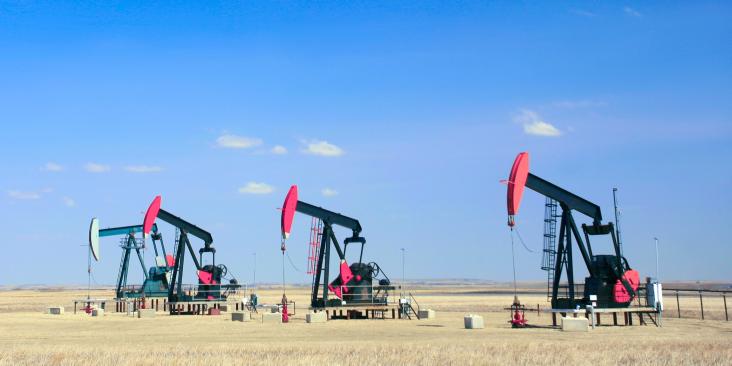
Leaky oil and gas wells are a problem worldwide. In the United States alone, of the 3.5 million abandoned oil and gas wells, roughly 2.3 million wells remain unplugged, including an estimated 1 million orphan wells with no responsible owner. Another 700,000 low-producing wells are responsible for about half of the country’s well-site methane emissions.
While EDF strongly supports a “polluter pays” approach and strong regulations requiring operators to mitigate methane emissions while producing and plugging their unproductive wells, we recognize that the scale and urgency of this problem is so vast in the U.S. and especially beyond that we must consider other tools, including market mechanisms. But for those tools to work, they must be rigorous and trustworthy, or else they will collapse.
Voluntary Carbon Markets could speed well decommissioning. Under a VCM, emissions reductions from plugging old wells would be independently verified and sold to companies, who could credit them towards voluntary greenhouse gas reduction goals. Revenue from the sale of carbon credits could facilitate accelerated plugging of leaky wells.
It’s a promising idea. But one that could easily go wrong. For these markets to achieve their purpose and maintain both integrity and financial stability, all stakeholders will need to properly design them. If they don’t, they risk misleading accounting over real emission reductions, and inducing a moral hazard where operators are not held to account for their legal responsibilities.
Clear market VCM standards are essential to ensure wells are properly plugged and credits represent real, lasting emissions reductions. Without credible credits, trust, prices, and financing could quickly collapse.
This isn’t just about orphan wells. VCM players have also shown interest in generating carbon credits from accelerated plugging of marginal wells. Could the VCM deliver emissions reductions from orphan and marginal wells that go beyond what regulations require? Quite possibly, but getting the details right is essential.
The marketplace for orphan and marginal well carbon credits is only a few years old. There are disagreements between stakeholders over the methods and protocols for estimating emissions reductions and awarding carbon credits to project developers.
In fact, last year a major VCM registry suspended the issuance of carbon credits tied to orphan wells to allow for more scrutiny of its underlying methodology. However, other VCM registries continue to issue orphan well credits – and some are preparing to expand into marginal well carbon credits, too.
Under current conditions, there is a risk that carbon crediting for orphan and marginal wells could expand too fast, embrace illegitimacy, and erode public trust in this fledgling market.
EDF has been working with VCM stakeholders and partners, led by the Center for Energy and Environmental Systems Analysis at the University of Texas at Austin, to build a real scientific foundation for market mechanism design.
We’re publishing two new issues primers on carbon markets for orphan and marginal wells. They will set the table for deeper conversations about the environmental integrity of these markets, and in the coming months, the development of targeted technical guidance on key unresolved questions.
Want to dive deeper into the science and strategy behind credible carbon markets? Join EDF and leading experts for a live webinar unpacking our latest findings and key safeguards for well-plugging credits.
Credibly designed carbon markets can make a rapid and material difference on emissions reductions. For more than three decades, EDF has helped design market-based programs to cut emissions. From the 1990 Clean Air Act Amendment’s sulfur-dioxide trading program to the Regional Greenhouse Gas Initiative, and beyond, thoughtfully designed solutions have proven successful.
Given the scale and scope of the world’s end-of-life well problem, we are obligated to investigate and improve carbon market mechanisms for orphan and marginal wells. Through that process, they can deliver real environmental outcomes beyond what regulation and public financing can achieve alone.
By Ari Pottens and Mina Berkow
A period of massive economic disruption is reshaping how countries understand the links between energy security, trade, and decarbonization.
In the Persian Gulf, the closure of the Strait of Hormuz has cut off 20% of the LNG supply the world relies on. In North America, U.S. tariffs have prompted allies such as Canada to pursue new trade relationships.
On September 10, EDF in partnership with Environment and Climate Change Canada (ECCC) and supported by the Institute of Energy Economics, Japan (IEEJ) organized a panel discussion hosted by the Embassy of Canada to Japan in Tokyo.
The event brought together Japanese and Canadian perspectives including the Japan Organization for Metals and Energy Security (JOGMEC), The Mitsubishi Corporation and GORads and, from Canada, Professor Matthew Johnson at Carleton University and PETRONAS Canada. Together, panelists explored a question at the heart of these economic disruptions: how can strong methane performance by energy-producing countries help meet the long-term energy security needs of major LNG importers?
Importers are seeking verifiable low-emission energy
After China, Japan is the world’s largest importer of LNG. It also coordinates the Coalition for LNG Emission Abatement Toward Net Zero (CLEAN), a public-private initiative launched by major LNG buyers in Japan and South Korea to improve emissions transparency and drive methane reductions across the LNG value chain. Several participants pointed to CLEAN as an indication that LNG buyers are paying increasing attention to methane performance and emissions transparency.
Canada is the world’s fifth-largest producer of natural gas. One major export facility is already operating with the capacity to send 14 million tonnes overseas each year, and planned projects could more than triple that capacity by the end of the decade. Canada also has some of the world’s leading methane regulations, which are estimated to reduce methane emissions by 72% by 2030 if every province implements them with the same stringency.
Panelists speaking from the importer perspective made clear that there is demand for low-emission natural gas that can provide a secure source of energy. The discussion highlighted that credible methane performance can support supplier credibility, improve transparency and strengthen the long-term competitiveness of LNG supply chains.
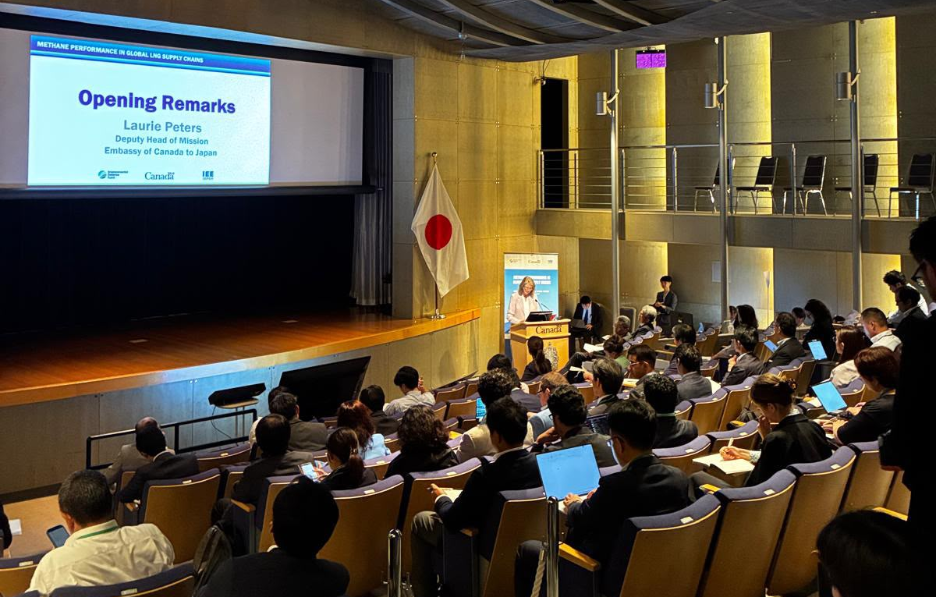
Canadian Minister and Deputy Head of Mission, Laurie Peters, delivers opening remarks at the Canadian Embassy’s Oscar Peterson Theatre
How to deliver emission reductions and transparency
Exporter representatives highlighted Canada’s progress in reducing methane emissions, the leadership of British Columbia, and the country’s potential to help meet Asian demand for lower-emission LNG. Realizing that potential depends on robust implementation of Canada’s national regulations across all major producing provinces.
For this to happen, Canada will need to determine that provincial regulatory proposals will have the same outcome as the federal regulation leading to the finalization of equivalency agreements. Any credible assessment of equivalency will need to be based on credible measured emission data found in Canada’s national inventory.
All too often stakeholder groups fall into competition or conflict. This is a rare example where stakeholders representing very different constituencies appear to have found common ground: mitigating methane is a win for the planet, for energy security and trade or, what hockey fans from the Canada panel might call a hat trick.
To the planners, scientists, cyclists, and countless other advocates working to bring congestion relief programs to their home city for safer streets, cleaner air, and better, more accessible transit: there is a way. And it’s worth fighting for.
Looking at the congestion relief program in New York today, it’s easy to assume the program was always destined to succeed. The benefits are broad, effective, and actively changing public perception.
But even looking back to a year-and-a-half ago, when the congestion relief program was in its nascent stages, it was a very different picture. At nearly every stage of the fight to bring the program to our city, we faced a combination of fierce opposition, good-faith skepticism, bureaucratic hurdles, lawsuits, and political delays that threatened to derail years of work. Even after the program was approved, there were moments it seemed like it might never take effect.
But that uphill battle also revealed what it takes to turn a bold idea into successful public policy. It showed us how to build a resilient movement and keep the public focused on what the program would actually deliver: less traffic, safer streets, cleaner air, and more investments in public transit.
The congestion relief program is a case study in persistence: had we accepted a speculative narrative that the policy would be too unpopular, too politically risky, or too difficult to implement, New Yorkers wouldn’t be enjoying the numerous benefits they are now.
So, to advocates in cities nationwide who are considering similar policies, we offer some friendly, unsolicited advice:
As soon as the cameras switched on in the congestion relief zone, the benefits started stacking up. Traffic entering the Congestion Relief Zone (CRZ) is down 11% and morning rush hour speeds are up 23% on average, as of January 2026. It’s easier to get in and out of the city, ambulances reach the hospital quicker, and car crashes are less frequent. In just a year and a half, congestion relief has delivered tangible benefits for New York City’s residents and commuters.
And the gains extend far beyond drivers who waste less time in traffic. Buses are moving faster, and transit ridership is up. According to a recent study published in Nature, levels of harmful fine particulate matter (PM2.5) were down 22% in the CRZ within the first six months. And the Department of Health just found that pollution in the Congestion Relief Zone and in surrounding communities has held steady or declined while revenue from the program is being invested to improve air quality in overburdened communities across our city. Even honking noise complaints have plummeted. The program is also funding desperately needed transit updates, including accessibility upgrades at more than 23 subway stations, making transit more equitable for people of all abilities Congestion relief is also funding $105 million in place-based mitigation, money that’s channeled directly into local communities from the Bronx to New Jersey to fight pollution.
All of these benefits are reasons why advocates should make measurement part of their campaigns from the beginning. Establish clear baselines before implementation. Track the outcomes people care about and publish the results regularly. The best defense against unfounded pessimism is evidence-based pragmatism.
Outside a relatively small circle of policy experts and transit advocates, the congestion relief program wasn’t always seen as a slam-dunk idea. In fact, only 32% of city residents were in favor of the program before it was implemented. A skeptical news media only reinforced the doom-and-gloom narrative.
But we also knew that plenty of people who opposed the program had experienced stagnant buses and polluted air; in other words, even the critics stood to benefit from the program.
It was faith in the program, and trust that New Yorkers would come to recognize the benefits for themselves, that kept us pushing for a congestion relief zone. Sure enough, people quickly came around: just three months after congestion relief went into effect, support was already up to 42%. Congestion relief has now become largely accepted as part of the fabric of the city, keeping buses on time (or early!), making our streets safer, calmer, and quieter, and funding needed transit improvement projects along the way.
Congestion pricing is transportation policy, but its effects extend into nearly every aspect of urban life.
Traffic determines whether a package arrives on schedule, whether the air is safe to breathe, and whether someone gets home in time for dinner. Because congestion touches so many parts of daily life, our coalition reached well beyond the traditional transit advocacy community. We brought together unlikely allies, including a railcar manufacturer, a construction association, and countless public transit advocates.
Each group contributed something others could not, whether technical expertise, political credibility, organizing capacity, or a direct connection to affected communities. That diversity made our movement stronger and helped improve the final policy by ensuring that accessibility, affordability, and accountability remained central to the conversation.
Building a broad coalition also meant listening to younger stakeholders and meeting people where they were. One of the most important lessons they reinforced was simple: have fun. Memes, influencer content, and rapid-response posts were not just ways to find humor in a serious policy debate. They helped bring congestion pricing into the cultural conversation, explain complicated issues in accessible terms, counter misinformation quickly, and give supporters content they could easily share. And when the wins began to happen, we celebrated them publicly with social media posts, influencer collaborations, and podcast episodes.
The lesson for advocates in other cities is clear: Build a bigger tent. Look beyond your usual networks, industries, and age groups, because congestion affects far more people than you might expect. And if your policy affects Gen Z, there is a good chance they’ll first encounter it on Instagram.
Congestion pricing remains in NYC because we recognize that no victory or loss is permanent, and that long-term policy is the result of persistent advocacy.
Legislative approval in 2019 was not the end of the campaign, nor was the installation of tolling infrastructure or the announcement of a start date. At every point, opponents looked for ways to delay, weaken, or eliminate the program. Advocates must remain incredibly vigilant and consistent in their messaging: it will take a sustained effort to make your argument break through and stick, both before and after any program is actually implemented.
Fortunately, we had a committed team that never lost faith in the possibility of congestion relief. We wouldn’t be here without organizers who helped communities understand what congestion relief would mean for them, and elevated their feedback to every level of government. Advocates fought tirelessly for months, and their sustained effort turned what critics called a pipe dream into policy.
But the work is not over. Even now that the cameras are on and the benefits are making their impact, opponents continue to file lawsuits against the program. Congestion relief will only endure if we remain just as organized and vocal after implementation as we were before it. Our coalition hasn’t backed down, and we don’t plan to.
To advocates working toward congestion relief elsewhere, New York’s program is proof that public opinion can change, political obstacles can be overcome, and a determined coalition can turn a controversial idea into a smashing success. With a strong coalition at your back, the sky’s the limit.
By Ari Pottens and Scott Seymour
Canada’s trade priorities are shifting quickly as its largest trading partner, the United States, proves less reliable with every passing month. Prime Minister Carney is travelling the world seeking new markets to diversify our customer base.
He asserts that “Canada has what the world wants” and touts our status as a clean energy superpower. Many of the Major Project Office’s priority projects are aimed at growing Canada’s energy and resources sectors, including a plan to export more oil and gas by way of British Columbia.
However, with global markets increasingly calling for lower emissions of methane from oil and gas supplies and the growing urgency of energy security, does Canada truly have what the world wants?
The short answer is not yet, and not in all major producing provinces. While BC is a leader in low-emission production, oil and gas from Alberta, Canada’s largest producing province, emits too much methane to meet the most common international methane standards. Luckily, Alberta can implement policies to help get there.
Importer standards equal external pressures
Some of Canada’s new trade partners are countries that are leading the way on methane standards, which means Canada must align with them to unlock new export opportunities. The European Union has already announced its methane regulation that imposes methane emission limits on imported oil and gas starting in 2030. Buyers in Asia are also expressing a preference for low-emission energy: Japan, the world’s second-largest importer of liquefied natural gas, has joined together with South Korea to launch the CLEAN initiative to improve LNG supply chain transparency and drive down methane emissions. Just two weeks ago Japanese and Canadian officials gathered at the Canadian Embassy in Tokyo for a productive discussion on the interconnection between methane mitigation and energy security.
The best way for major buyers to decide which fossil fuels are cleanest is to compare each production region’s methane emission “intensity”—the amount of methane emissions per unit of oil and gas. The most commonly used intensity standard for natural gas production is to have methane emissions less than 0.2% of the volume of the sold gas.
How close to ready are we?
Many leaders in Government describe Canada as having some of the lowest-emission gas on Earth, but aerial measurements have shown that not all oil and gas is produced equally across western Canada:
British Columbia: Based on recent analysis, BC’s oil and gas is calculated to carry less than 0.2% methane emissions intensity, meeting the most common international intensity standard.
Alberta: The oil and gas produced in Alberta carries a much higher emissions intensity at 1.3%, about 7x higher than that 0.2% target and leaving plenty of room for improvement.
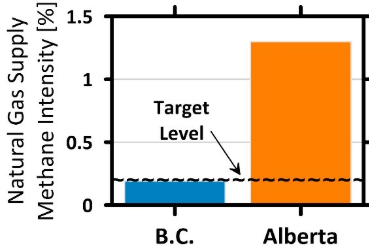
The reality is that if Canada wants to export truly low-emission energy at scale to new customers overseas, Alberta—which accounts for 84% of Canada’s oil production and 61% of Canada’s gas production—will have to reduce its methane emissions substantially.
The best way for Alberta to bring down its emissions is by bolstering its provincial regulations to a level equivalent to or stronger than the recently finalized federal standard. Any finalized equivalency agreement should be based on an assessment made by a truly independent third-party and based on credible federal emissions data.
Building on momentum to get across the finish line
Canada has announced new regulations to reduce oil and gas methane by 72% below 2012 levels by 2030. Provinces can adopt the federal regulations, or, under an “equivalency agreement,” develop their own regulations provided they meet or exceed the federal standard. The federal government has the power to approve these agreements and with that power, ensure Alberta’s new regulations result in meaningful reductions that can help enable the transpacific energy trade that the Carney government has sought.
There are clear market signals coming from overseas energy customers, and Alberta cannot afford to mute or ignore these signals as our nation pursues new trading partners. As Ottawa fast-tracks massive infrastructure investments to build complex, expensive pipelines to serve new customers, this is no time to skimp on regulatory strength to ensure we deliver truly low-emission oil and gas. If Canada wants to build stronger, stabler, trade relationships, then we need stronger regulations and more transparency when it comes to one of our marquee products.
A new analysis of MethaneSAT data provides the clearest evidence yet that the United States cannot solve its oil and gas methane challenge without directly addressing emissions from low-producing well sites, also known as marginal or stripper wells. Yet legislation now before Congress would move in the opposite direction by exempting most of these wells from federal safeguards designed to prevent methane waste and air pollution, and there is mounting evidence that the U.S. EPA plans to weaken standards for this class of wells.
Available in preprint, the new analysis represents the largest measurement-based assessment of methane emissions from marginal wells in the United States. EDF researchers analyzed MethaneSAT data from 11 U.S. oil and gas basins that collectively account for more than 80% of national onshore production. Utilizing the high precision, high spatial resolution satellite data, they incorporated measurements of methane emissions from 280,000 well sites, including 240,000 marginal well sites into the analysis.
The findings are striking. Low-producing well sites (defined as those producing 15 barrels of oil equivalent per day or less) account for 5% of U.S. oil and gas production but roughly 60% of production-related methane emissions. The intensity of their methane emissions is 16% of the marketed gas they produce, compared with just 0.6% for higher-producing wells.
In other words, these wells are responsible for a small fraction of the nation’s oil and gas production, but they are massive polluters.
The study also illustrates why policy must focus on low-producing well sites in addition to large emission events known as super emitters. Eighty-eight percent of observed well-site emissions came from areas emitting less than 100 kilograms of methane per hour per well-site, below the detection limit of current satellites. In other words, most of the methane pollution from U.S oil and gas production comes from hundreds of thousands of smaller sources whose cumulative emissions are enormous.
These findings dramatically expand the evidence behind a problem scientists have documented for years. Recent research in Appalachia, for example, found that low-producing conventional wells had methane loss rates roughly 200 times higher than higher-producing unconventional wells — 18.3% compared with 0.09% — and accounted for 63.5% of the region’s oil and gas methane emissions.
That evidence has significant implications for S. 4619 and H.R. 8990, the so-called Protect Domestic Oil and Gas Small Business Act.
The legislation would exempt 550,000 oil and gas well sites — about 84% of total well sites in the United States — from federal Clean Air Act methane protections. Those sites produce 5% of the nation’s oil and gas but are responsible for about 40% of the industry’s methane waste and pollution. The exemption would remove safeguards including leak detection and repair requirements, equipment standards, measures addressing venting and flaring, reporting and even audio/visual monitoring requirements.
Despite the legislation’s proclaimed focus on small businesses, ownership data show that most low-producing wells are controlled by large companies. Just 72 companies with more than 1,000 operating well sites control 47% of the nation’s low-producing well sites. More than three-quarters of those well sites are owned by companies that operate more than 100 sites. Companies with fewer than 10 sites control just 3%.
Meanwhile, major energy-producing states continue to strengthen methane oversight. New Mexico, the nation’s second-largest oil producing state, recently proposed stronger methane rules, which include equipment upgrades and an enhanced super-emitter response program. Pennsylvania, the nation’s second-largest gas producing state, has begun developing its first comprehensive statewide methane standards for existing sources. Both states understand that methane emissions are a threat to local communities and the long-term health of the energy industry. Congress and the EPA should follow their lead, not undercut it.
The new national data make the stakes especially clear. Low-producing wells are a central player in America’s methane problem. They are precisely the category of production sites we should be improving, not exempting.
Medium- and heavy-duty electric vehicles are hitting the road in 2026, and we’ve collected last month’s most exciting news. In 2025, EDF delivered monthly deployment updates on the biggest zero-emission transportation stories. By the end of 2025, it was clear that momentum was sustained throughout a challenging year. This year will undoubtably see more big announcements, and we’ll be here to showcase the biggest orders and deployments of zero-emission trucks happening around the country.
August announcements included more news for electric yard truck deployments after a record summer, and a first of its kind announcement for heavy-duty freight.
Einride partners with Tesla for mass Tesla Semi deployment
Einride announced plans to deploy 500 Tesla Semi trucks across North America, with notable fleets like Amazon, across freight corridors in California, Texas, New Jersey, Illinois and Georgia. The deployment will roll out in phases over 24 months starting September 2026 and will triple Einride’s deployed electric-truck fleet. The Tesla Semi entered mass production earlier this year, and Einride cites the deployment as an example of bringing electric freight to scale.
Republic Services unveils fully electric residential recycling and waste collection fleet in Florida
Republic Services and the city of Coconut Creek, Florida, have launched the state’s first fully electric residential waste and recycling collection fleet, featuring six McNeilus Volterra electric trucks. The initiative delivers quieter collection operations in Coconut Creek and supports the city’s sustainability goals. Republic Services says the launch demonstrates how collaboration between municipalities and industry can accelerate the adoption of cleaner, safer and more sustainable waste-management solutions, building on its position as the operator of North America’s largest electric collection fleet.
APM Terminals Elizabeth orders 96 electric terminal trucks from Orange EV
APM Terminals Elizabeth has ordered 96 electric terminal trucks from Orange EV, marking one of the largest port electrification commitments to date. The order follows APM Terminals Los Angeles’ expansion from a 20-truck pilot to 60 Orange EV trucks and comes as port operators increasingly evaluate electrification based on lifetime value, uptime, operating performance and service support. In June, electric terminal trucks observed record order volume, underscoring growing momentum for electric yard trucks at major U.S. ports.
Now is a critical time for fleets to invest in medium- and heavy-duty electric trucks. These vehicles improve public health and help combat the climate crisis by reducing greenhouse gas emissions and air pollution. Unlike traditional diesel-powered trucks, electric trucks produce no tailpipe emissions, which significantly cuts down on health-harming pollution. Adoption represents a key step toward a more sustainable and resilient transportation industry.
Check back here next month to see a collection of the most exciting zero-emission vehicle announcements from September. In the meantime, check out EDF’s Electric Fleet Deployment & Commitment List to track announcements as they happen in real time, and view all August announcements.
Check out last month’s announcements here.