






Quadrupling sustainable fuels by 2035? Only if they’re truly sustainable.
Posted: in Hydrogen
Written By

Share
Summary
- At COP30, 23 countries launched the Belem 4x Initiative to quadruple sustainable fuel production and use by 2035, reflecting a growing view of alternative fuels as essential to decarbonizing hard-to-abate sectors while strengthening energy security, competitiveness and supply-chain resilience.
- Alternative fuels are only “sustainable” if their full value chains meet high, science-based standards; without rigorous lifecycle accounting, leakage controls and safeguards for land, communities and ecosystems, scaling alternative fuels risks locking in climate and environmental harms instead of delivering real benefits.
As COP30 came to a close, 23 countries — led by Brazil, India, Italy and Japan — signed onto a bold commitment: to quadruple sustainable fuel production and use by 2035. The ‘Belem 4x Initiative’, under the Future Fuels Action Plan, is one major signal that governments increasingly view alternative fuels not just as climate policy, but as a pillar of energy security, industrial competitiveness and supply-chain resilience.
https://blogs.edf.org/energyexchange/wp-admin/post-new.php Share on XThis shift is long-due, putting a real focus on the so-called hard-to-abate sectors, i.e. industries that require a lot of energy to reach very high temperatures or to move heavy loads. Heavy trucking, shipping, aviation, steel, cement and chemicals are together responsible for roughly one-third of global carbon emissions and as long as those sectors remain reliant on fossil fuels, global decarbonization efforts will fall short. Recent investments in alternative fuels by, for example, the EU, China, India, and others are critical steps toward filling this gap.
Still, the rising demand for alternative fuels brings critical questions: Which fuels? And how clean are they, really? The answers: it depends. And right now, we have an incredible opportunity to bring stakeholders together around sound science, innovative policies and best practices, to get the sustainable fuels ecosystem right as it develops.
Energy security meets climate reality
The strategic appeal of a diverse clean fuel mix is obvious. Countries that secure a portfolio of domestically produced hydrogen, e-fuels, sustainable biofuels and other low-emissions fuels can reduce reliance on unstable fossil import markets while growing their economies. They can protect themselves from geopolitical shocks, stabilize industrial inputs, and foster robust export industries — all while advancing a clean energy transition.
But this ambition should not come at the expense of environmental integrity. A new peer-reviewed perspective article from our own EDF scientists, recently published in Environmental Science & Technology, makes it clear: sustainability is not inherent to the molecule – it is a feature of the full value chain. Feedstock and energy sourcing, production efficiency, methane or hydrogen leakage, land-use impacts, carbon capture performance and combustion emissions all determine whether a fuel is genuinely sustainable, or no better (or even worse) than fossil fuels. The most successful strategies will build in environmental integrity from the start, to maximize all potential benefits.
The numbers confirm the challenge of scaling up sustainably. Today, sustainable fuels represent only 1.3% of total energy use worldwide. In its October 2025 report, the International Energy Agency calls on global use of sustainable fuels to nearly double by 2030 and expand fourfold by 2035, pointing to existing and announced policies as an achievable pathway.
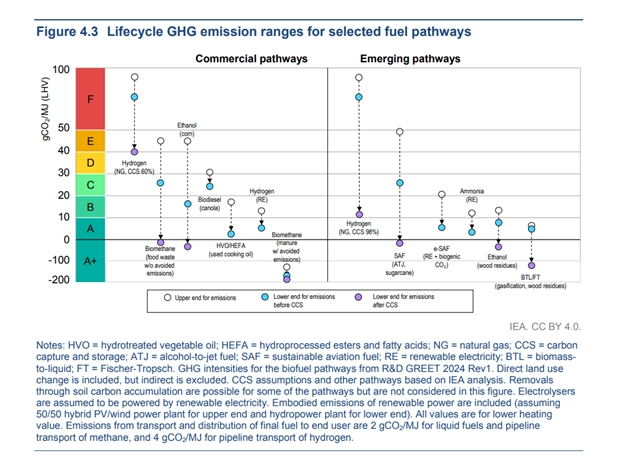
IEA defines a ‘sustainable’ fuel as having a low (though unspecified) greenhouse gas intensity over its lifecycle, while complying with other sustainability criteria around biodiversity, water management and social safeguards. However, the range of actual GHG emissions and other impacts can vary greatly. For example, the chart below from the IEA demonstrates the wide range of emissions intensities that can exist within each pathway. Some pathways, like biomethane from food waste or alcohol-to-jet fuel from sugarcane, can offer a near-zero-emission fuel option — or they can be no better than natural gas (~50 gCO2/MJ). Moreover, even these ranges of IEA estimates are not comprehensive — they downplay or ignore warming impacts from indirect land use change and methane, ammonia and hydrogen releases (as outlined in EDF’s recent perspective paper).
Beyond labels: Why the details matter
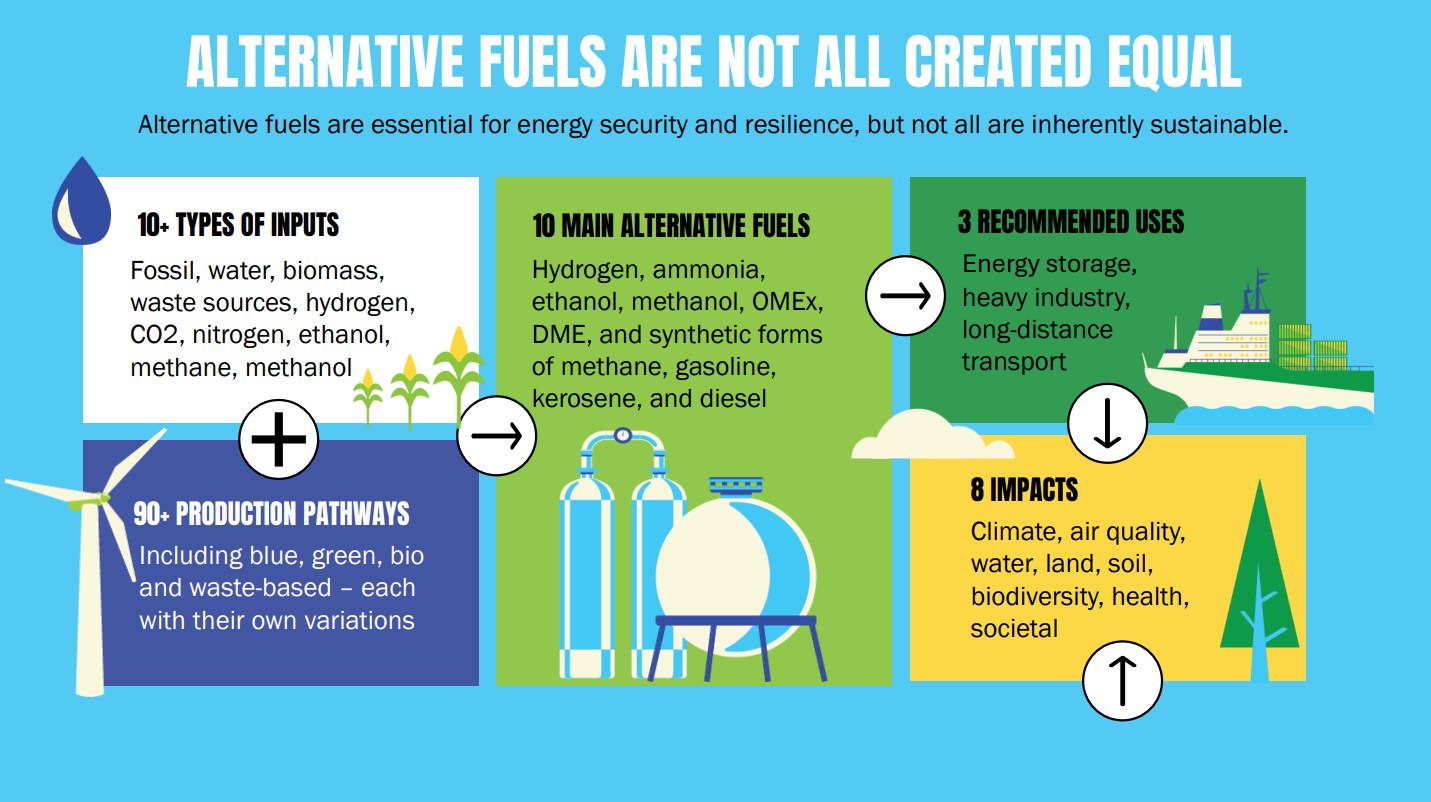
Calling something a sustainable fuel based on its potential does not guarantee sustainability. Because the term encompasses dozens of fuel types and feedstocks, and a wide variety of production pathways and value chains, the environmental and social outcomes can vary drastically.
A few high-stakes examples:
- Biofuels derived from crops grown on recently converted forest land could emit more CO2 than the fossil fuels they displace — not to mention negative impacts on biodiversity, water and local communities.
- Hydrogen produced from natural gas without high carbon capture rates and permanent storage, or with high upstream methane leakage, might offer little or no climate benefit, and could lock in new fossil infrastructure for decades.
- E-fuels or bio-derived fuels made with fossil-intensive electricity or inefficient processes might carry hidden carbon and air-quality burdens.
Put simply: fuels that are irresponsibly sourced or poorly regulated risk locking in climate, environmental, and social harms right when the world can least afford them. That’s why fuel diversification must come with not only big aspirations, but high standards grounded in science. This is not only smart — it’s doable.
What policy and practice needs to look like
What’s needed now is to channel momentum (and finance) into pathways that deliver real climate, environmental and societal value. For policymakers, the steps should be clear:
- Prioritize electrification (paired with additionality) wherever feasible as the most efficient use of energy; use alternative fuels where no better options exist, maximizing positive impacts.
- Encourage investment, incentives and technological innovation in truly low-impact fuel pathways.
- Require transparent accounting of lifecycle emissions and societal and environmental impacts for every fuel pathway — from feedstock sourcing and energy inputs to emissions and impacts during production, transport, storage and use.
- Mandate best-in-class controls to prevent methane, hydrogen and ammonia leakage, ensure permanent carbon capture and storage when needed, and protect ecosystems and local communities from land-use or pollution impacts.
- Adopt internationally harmonized sustainability standards to avoid a patchwork of weak regulations that undermine credibility and market stability.
This disciplined approach will not only safeguard the climate — it will also deliver greater energy security, economic resilience and long-term value for industry, governments and communities alike.
Why this matters — not tomorrow, but now
The world stands at a crossroads. As energy costs surge, supply chains fray and fossil fuel volatility deepens, the case for clean fuel diversification grows stronger every day. The COP30 pledge is a political landmark. But decisions made in the coming months — about which feedstocks to allow, how to measure emissions, how to regulate production, distribution and use — will determine whether the pledge becomes a historic success or a cautionary tale.
If we act decisively and in line with science, aligning policy, investment and environmental integrity, alternative fuels can become an integral pillar for decarbonization. They can be a cornerstone of global climate security, economic strength and energy sovereignty. But if we cut corners, chase quick wins or ignore the details, we risk trading today’s emissions for tomorrow’s liabilities. The path forward is clear. What matters now is not just ambition, but integrity.
Environmental Defense Fund is partnering with stakeholders to work on getting the necessary frameworks in place through, for example, our observer status at the International Civil Aviation Organization , the International Maritime Organization and other international fora. We’re using our science-led approach to proactively find the solutions that work for the entire ecosystem, and we’re ready to engage with all stakeholders to get this right.