









Is My Lunch Causing Global Warming?
Posted: in News
Written By

Share
 This post is by Sheryl Canter, an online writer and editorial manager at Environmental Defense Fund.
Want to know how your lifestyle impacts the environment? Yahoo Green’s Lifestyle Calculator (data provided by EDF) estimates your carbon footprint based on factors like the size of your home, and how much you drive and fly. The H2O Conserve Water Use Calculator asks questions about your habits to assess your water usage (see why saving water saves energy)
But what about the food you eat? Bon Appétit Management Company has a new Low Carbon Diet Calculator that can tell you. It has a very entertaining interface, but how good is it? We asked Lisa Moore, Ph.D., a scientist at Environmental Defense Fund, to check it out.
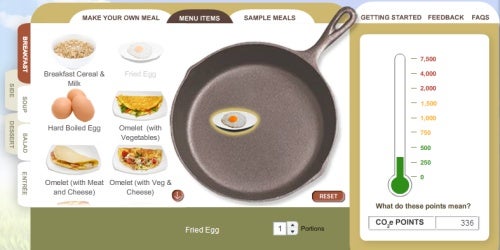
Lisa found no glaring errors, but she noted two caveats:
- The calculator is specific to Bon Appétit’s recipes, cooking
processes, and supply chain. - Most of the numbers are underestimates (for example, it doesn’t include emissions from all recipe ingredients, and it omits nitrous oxide emissions from fertilizer use).
Still, the calculator can give you a sense of which foods have higher emissions than others. For example, it says that beef has higher emissions than pork, pork more than chicken, and chicken more than vegetables. This is the same order as our own analysis, but the magnitudes are different.
Bottom line: The calculator is good for comparisons, but not exact numbers.



2 Comments
Don’t forget the water consumption in your food! Meat requires a lot of water (2,500 gallons/pound). More: http://aguanomics.com/2008/05/gods-water.html
Good point!
By the way, I somehow forgot to mention our own very excellent carbon calculator:
http://fightglobalwarming.org/carboncalculator.cfm