








Antarctic Ice Shelf Hanging by a Thread
Posted: in Arctic & Antarctic
Written By

Share
 This post is by Sheryl Canter, an Online Writer and Editorial Manager at Environmental Defense Fund.
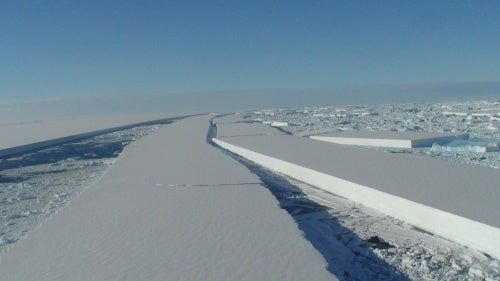
A huge Antarctic ice berg – seven times the size of Manhattan – is close to breaking off, supported only by a thin strip of ice hanging between two islands.
Part of the Wilkins Ice Shelf, the berg was captured in satellite and video images by British Antarctic Survey (BAS), which said, “It is another identifiable impact of climate change on the Antarctic environment.”

2 Comments
While not ‘THE’ cause of this ice shelf falling apart, this news release by the British Antarctic Survay on January 22, 2008 says that there is active volcanism under the western Antartic Ice sheets. This warms the water under the ice and may be a contributing factor to this melting. At least partially anyway. Is this a valid concern?
Here’s the link to that story:
http://www.sciencedaily.com/releases/2008/01/080120160720.htm
Good question about the volcano. The authors found evidence that there was still some heat being generated, which could account for some of the recent movement seen in one particular glacier (called Pine Island Glacier).
However, they also note that Pine Island Glacier is geologically and hydrologically isolated from other glaciers in the region. As a result, the volcano “cannot explain the widespread thinning that has been observed across these glacier basins in recent decades”. If you have access to Nature Geoscience, they discuss this in more detail in the last paragraph of the paper (PDF).
So for this particular glacier, yes, the volcano could be a factor. But for the WAIS as a whole, it isn’t implicated.