







Storms May Be Fewer, But Still More Fierce
Posted: in Extreme Weather
Written By

Share
 This post is by Lisa Moore, Ph.D., a scientist in the Climate and Air program at Environmental Defense.
Last week, scientists published a study about global warming and hurricanes in the U.S. The authors found a weak downward trend in the number of landfalling U.S. hurricanes, but concluded that future trends will depend on the spatial distribution of ocean warming.
In its coverage of the study, the Miami Herald said that "global warming actually is diminishing the number of hurricanes that strike Florida and the rest of the United States – and the phenomenon is likely to continue." This is not exactly what the study said. Here’s the full scoop.
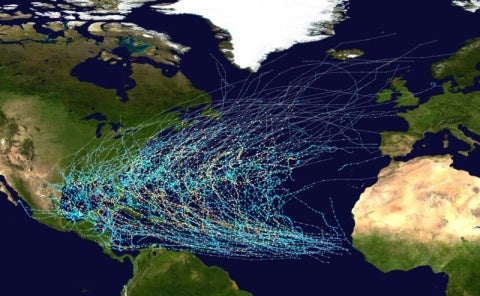
Atlantic hurricane tracks, 1980-2005.
When it comes to hurricanes, there are two important concerns: storm intensity and storm frequency. There is much solid research establishing a relationship between global warming and increased storm intensity, and this recent study does not contradict it. This new study is about storm frequency, not storm intensity.
The authors looked at the number of hurricanes making landfall in the U.S. since 1854 and found a slight decrease over time. They suggest that this weak trend is from increased "wind shear" in the Atlantic Ocean caused by warming in the tropical Pacific and Indian Oceans. Wind shear occurs when wind speed or direction changes with altitude. This can inhibit storm development by "shearing" off the top of a nascent storm.
There has been other research suggesting that global warming will increase Atlantic wind shear, thus decreasing storm frequency. But with warmer oceans, when storms do come, they will tend to be fierce. In discussing another paper about wind shear, climatologists at the RealClimate blog said:
While increases in wind shear could offset the impact of tropical temperatures in some – maybe even the majority – of storm seasons, one might worry about what happens during those seasons where there is anomalously low shear (e.g., a very strong La Niña event). The warm ocean will still be sitting there, waiting to produce tropical cyclones and Hurricanes – and the prospects for destructive Hurricane activity during those seasons could be especially grim.
Wind shear will not reliably protect us from landfalling hurricanes.
The authors of the study found a significant relationship between rising global sea surface temperature (SST) and wind shear, and a significant relationship between wind shear and U.S. landfalling hurricanes. But the downward trend in the number of U.S. landfalling hurricanes since 1854 was not statistically significant. Essentially the line was flat.
Moreover, the authors don’t say that the number of U.S. landfalls will go down in the future. They say that future trends will depend on the spatial distribution of warming and other factors: "…if the effects of warmings in the tropical Pacific and Indian Oceans cannot overcome that of Atlantic warming, global warming may favor landfall incidence for the United States."
If you’d like to learn more about hurricanes and global warming, visit our Extreme Weather site. It includes summaries of the latest research and maps of storm surge risks for various states. Check it out!