Climate change solutions
We deliver game-changing environmental solutions that have a real impact for people around the globe.
When it was first conceived, California’s Multibenefit Land Repurposing Program (MLRP) was envisioned to be one of many initiatives needed to help landowners and communities adapt to less groundwater pumping and prevent the San Joaquin Valley from turning into a dust bowl of fallowed fields. Instead, the idea was to fund projects that strategically transition farmland to other uses that deliver a range of new benefits, from wildlife habitat to community open spaces to low-impact solar farms.
Four years and two rounds of funding later, MLRP is delivering some additional benefits that proponents of the program (including EDF) never imagined. The Tule Basin Land & Water Conservation Trust’s Capinero Creek Restoration Project is one of the most inspiring examples of these unexpected positive results, from the early return of an endangered lizard to high school students winning a scholarship for college.
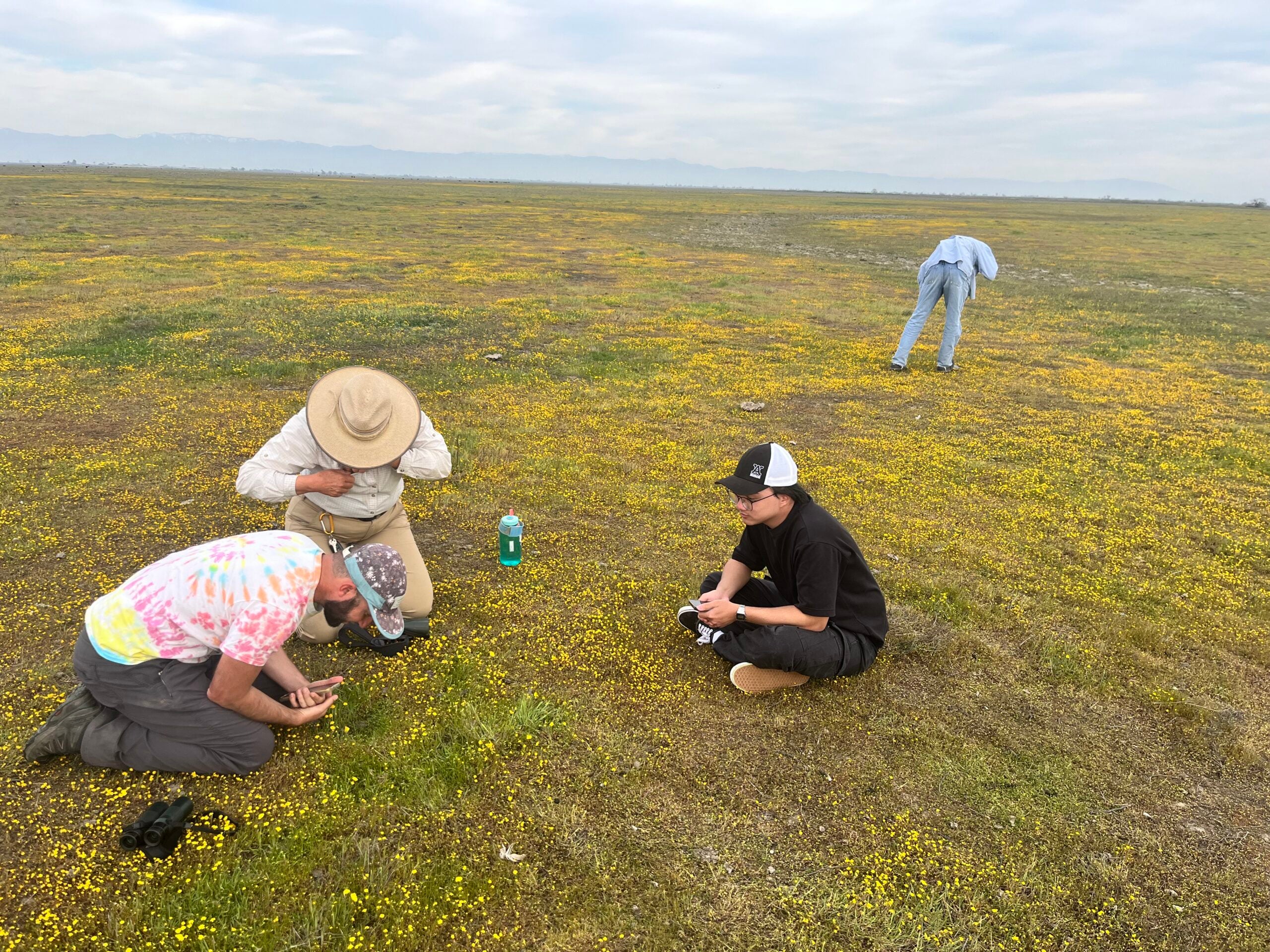
In April, MLRP grantees, partners, and conservationists gathered in Pixley for a tour to see firsthand how the Capinero Creek Project has evolved into a living laboratory featuring several experiments that will provide valuable lessons for future land repurposing and water conservations projects, and I’m excited some highlights from that tour here.
So far, the MLRP has approved 23 projects covering 4,800 acres of land, equal to the size of more than four Golden Gate Parks or about seven square miles. The Capinero Creek Restoration project sits on 467 of those acres on the site of a former dairy farm.
A partnership between The Nature Conservancy and the Tule Basin Land & Water Conservation Trust, the multiphase project started in 2021 with funding from the U.S. Bureau of Reclamation, Union Pacific and Wildlife Conservation Board. The MLRP served as a perfect opportunity to fund some of the most unique aspects of the project, including cost-effective native habitat restoration to improve groundwater flows and soil quality, wildlife monitoring, and community science efforts. The goal of the project is to restore native habitat and attract and protect threatened and endangered species in the South San Joaquin Valley.
Abby Hart and Daniel Toews from the Nature Conservancy and Nick Reed-Krase from the Tule Basin Land and Water Conservation Trust led visitors through the multiple phases of the project. Phase 1 of the restoration project focuses on planting alkali scrub habitat like native shrubs, grasses and wildflowers, which require significantly less water than non-natives. River Partners has also been involved in Phase 1.
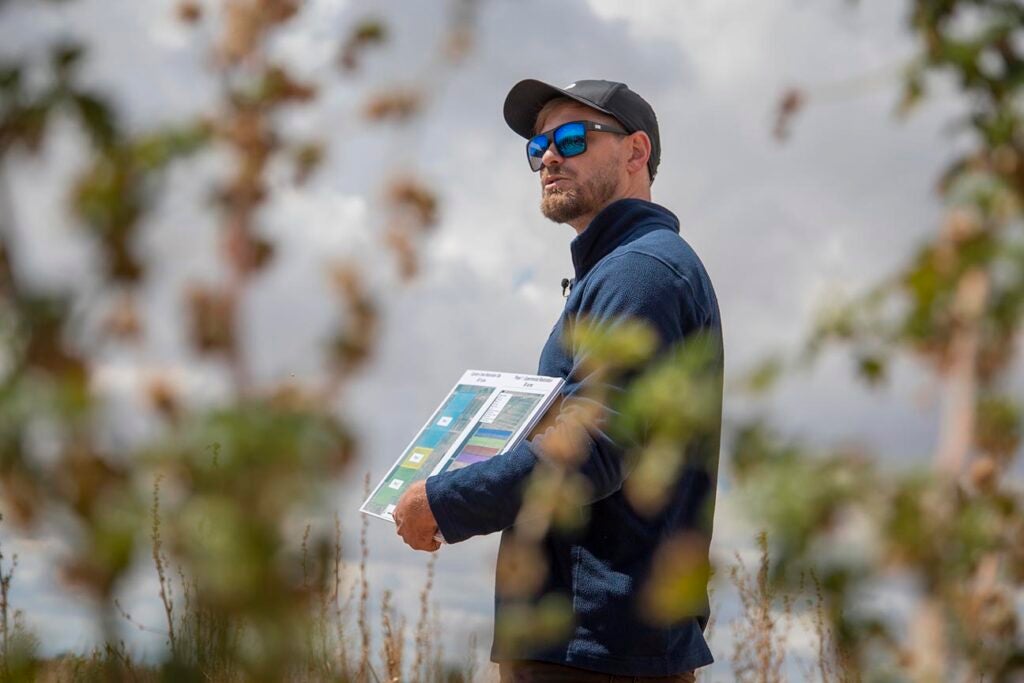
Toews, a strategic restoration project manager with The Nature Conservancy, explained how the project team is using an experimental approach that aims to determine the best mix of native seeds, best density of planting and most effective irrigation frequencies to establish new vegetation on the former grazing land.
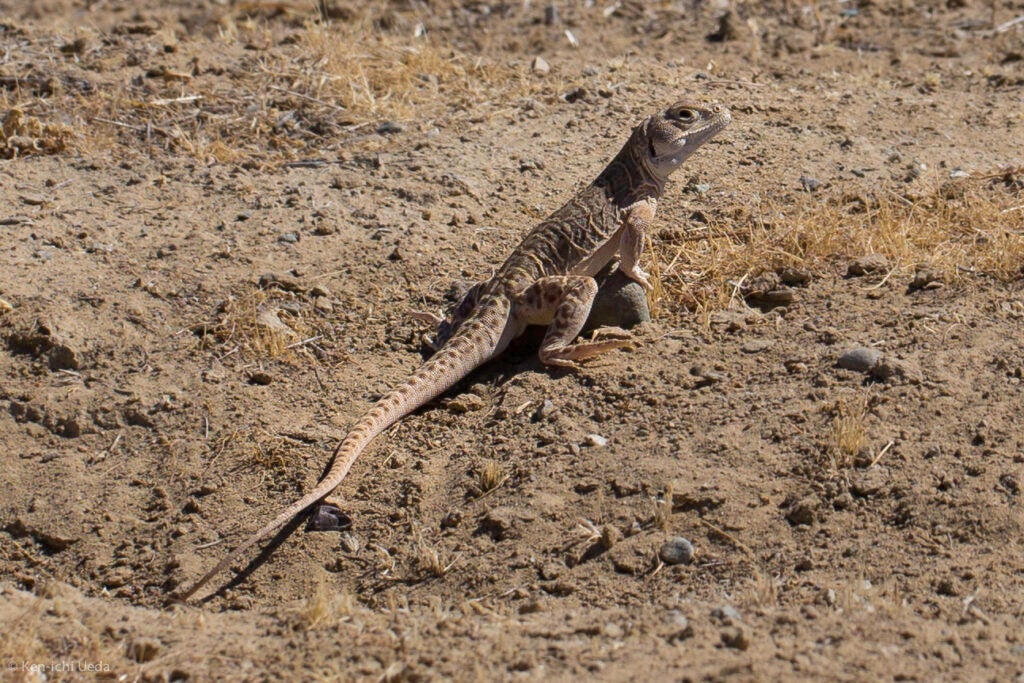
While those experiments are still underway, there has already been one surprise: the arrival of a blunt-nosed leopard lizard, an endangered species, six months after planting and months earlier than expected. The site also has seen the return of the crotch’s bumble bee, burrowing owls and kangaroo rats. Toews describes kangaroo rats as the “farmers” of natural habitat in the San Joaquin Desert — ecosystem engineers that disproportionately shape the landscape by turning soil, managing vegetation, and creating burrows used by other fossorial animals like lizards and toads. They are also a key prey species for raptors, owls, and other carnivores, including the endangered San Joaquin kit fox.
This effort includes acoustic monitoring to compare wildlife diversity in restoration zones compared to fallowed areas, which can help us further understand the benefits of restoring fallowed lands. Wildlife cameras help monitor species distribution across the site, specifically of the blunt-nosed leopard lizard and kangaroo rats. The team has partnered with UC Davis to conduct DNA tests to determine whether kangaroo rats discovered on site are an endangered species variety, which have not been observed in the area for more than 30 years.
The Tule Basin Land and Water Conservation Trust has an agreement with the irrigation district to use water only as necessary, in keeping with one major goal of MLRP: to reduce groundwater pumping, as required by California’s Sustainable Groundwater Management Act (SGMA), Reed-Krase from the Tule Trust explained. As part of SGMA reporting, the trust confirmed that across 80 acres, groundwater pumping is well under 20 acre-feet per year — an accomplishment that drew applause from our tour participants. (An acre-foot of water is approximately 326,000 gallons, which is the amount of water used by two to three average households per year.)
Similar to all MLRP projects, the Capinero Creek Project involves a collaborative partnership with local landowners. On a field that will be replanted as part of Phase 2, Trevor Freitas, a local rancher, has brought 45 cows to graze on the land and help prepare it for future restoration.
Freitas explained how he collaborated with the Tule Trust to experiment with virtual fencing for grazing cows, which wear special solar-powered collars around their necks, similar to the electric fences homeowners sometimes get for their dogs.
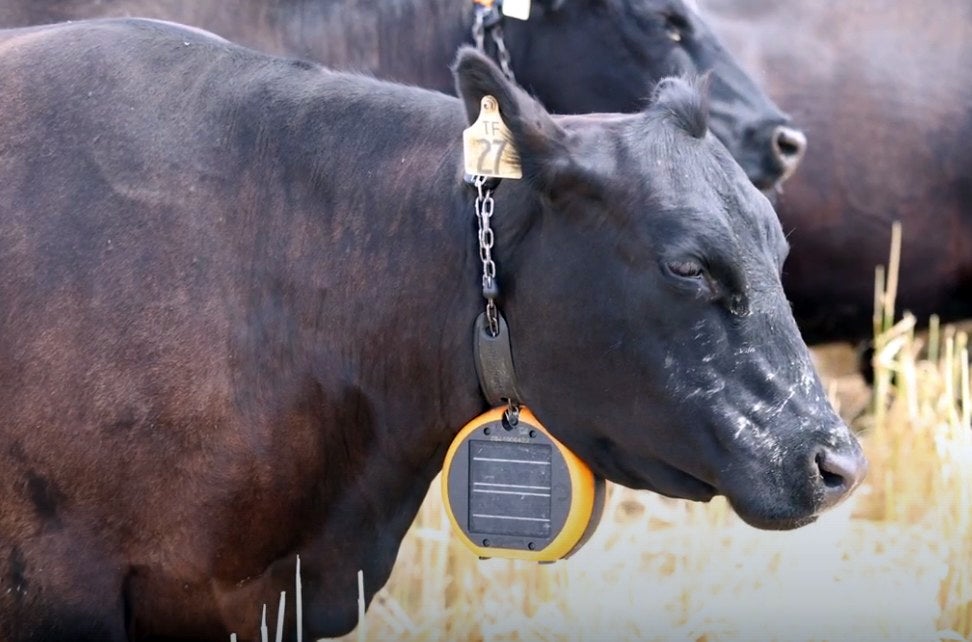
“Within 24 hours the cows were trained to stay out of the boundary,” said Freitas, who estimated the collars cost one-fourth of the cost of a physical fence surrounding the Phase 1 restoration site.
The collars also monitor movement patterns and health and have been used in a trial near Yellowstone National Park, too.
Community science is another pillar of the Capinero Creek Restoration Project. Students from Alpaugh High School have helped monitor air, water and soil quality as well as biodiversity sampling.
Some students turned their research into a project that won top honors at the Tulare County Office of Education Science and Engineering Fair. Two of those students went on to present their project at the California Science and Engineering Fair, winning second place and scholarships to college!
This community science success story was a great learning experience for me. Like others, I tend to think of MLRP projects delivering benefits only for neighboring communities. Education on project sites provides another layer of opportunity and community benefits that early supporters of MLRP had not imagined.
“One of the biggest blessings of MLRP has been building local capacity and creating positions in the local community that offer an alternative to agricultural jobs and are needed to support land repurposing. Capacity building can be a little invisible, but it is so important.” — Abby Hart, The Nature Conservancy
While the Capinero Creek project cannot singlehandedly reduce groundwater use in the state, it is an example of what can be done through partnerships, innovative funding mechanisms and creative thinking. It is also a large enough project that it could help inform, simplify and even accelerate habitat restoration at scale in the San Joaquin Valley.
Bringing other grantees to the site allowed TNC and the Tule Trust to share lessons learned and ultimately aid current and future MLRP projects. And most importantly, it shows that MLRP and other land transitioning efforts work, hopefully inspiring more funding for MLRP in the future.
New Mexico is on the front lines of climate change. Temperatures are rising, aridification is accelerating and water supplies are drying up in some regions. As river flows decline, communities are turning to groundwater to fill the gap. But in some areas, that underground water supply is also falling to record low levels.
Our aquifers provide 50% of New Mexico’s total water supply and drinking water to 78% of the state’s public water systems. Where we have groundwater data, we know these vital supplies are declining.
The New Mexico Groundwater 360 Report, published in January by the New Mexico Groundwater Alliance, documents these challenges in depth and highlights a few communities that are already implementing solutions. At a recent EDF-hosted webinar, three of the report’s co-authors shared their solution stories. Their approaches are different, but each one is building local groundwater resilience.
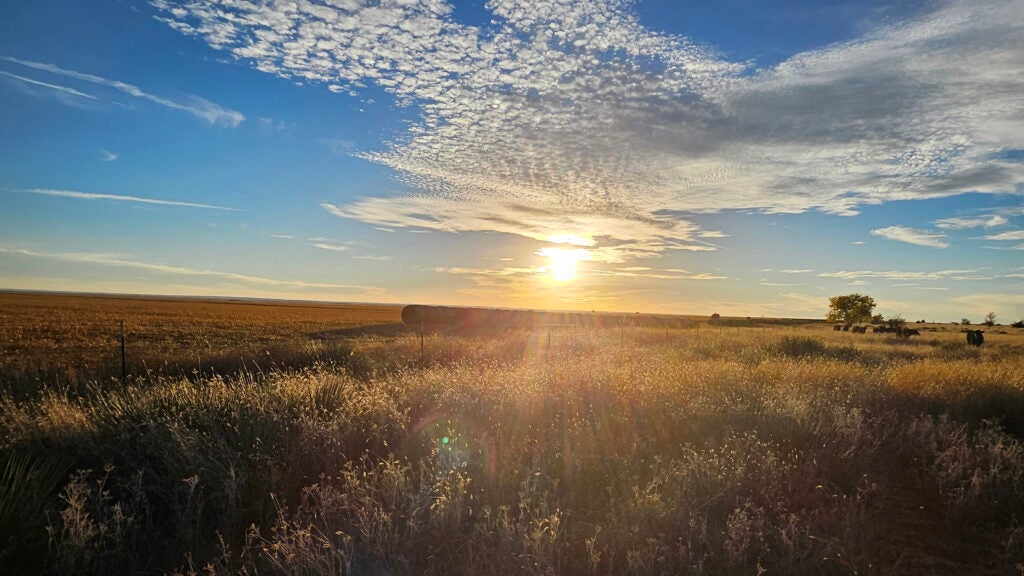
Ten miles from the Texas border, the communities of Clovis, Portales and Texico face a situation that Ladona Clayton describes as “a matter of survival.” There are no rivers, no streams, no backup water supply. The Ogallala Aquifer is their only source of water, and it is in fast decline.
Since 2018, more than 20% of the groundwater in the area has been used up, with irrigation for farming accounting for roughly 95% of all groundwater use. To make matters worse, groundwater recharge, as Clayton puts it, is “negligible.” Projections in the Groundwater 360 Report caution that without intervention, Clovis could run out of water in the next five to10 years.
As founding executive director of the Ogallala Land and Water Conservancy (OLWC), Clayton has built a community-driven, two-phase model to address the crisis before it turns into a complete groundwater bankruptcy. In the first phase, the conservancy enters voluntary water-right lease agreements with local farmers, who are compensated annually to stop irrigation.
“This is a matter of survival for us. Our producers have stepped up voluntarily — there’s no eminent domain, there’s no forcing anyone. This is strictly voluntary.”
— Ladona Clayton, Ogallala Land and Water Conservancy
The second phase focuses on long-term protection through permanent groundwater conservation easements. These easements leave 80% of the conserved groundwater untouched as a strategic reserve, and the other 20% can be used by landowners for livestock, domestic use or potential sale to support municipal needs during drought. Clayton’s team also supports farmers through the transition, investing in dryland cropping, regenerative agriculture, and restored wetlands so that retiring irrigation wells doesn’t eliminate farming.
“Once it’s gone, it’s gone,” Clayton said of the groundwater. But her community is proving it doesn’t have to come to that. Over four years, the program has conserved nearly 37,000 acre-feet of groundwater and retired 56 irrigation wells. New Mexico Tech monitoring has found that water levels have been rising for two consecutive years, including in city of Clovis municipal wells that previously had been declining for years.
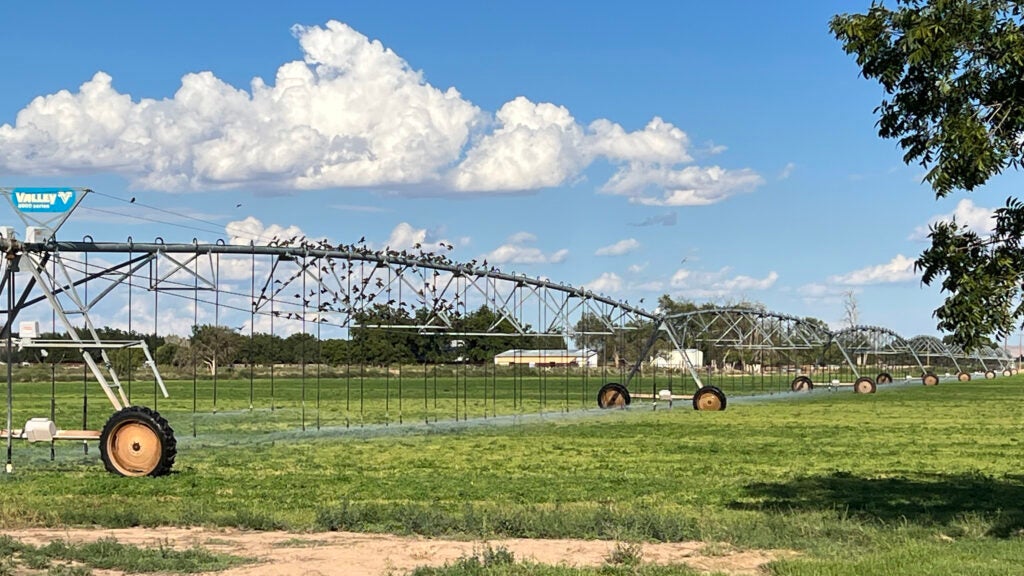
Not every groundwater story in New Mexico is a response to a crisis. The Pecos Valley Artesian Conservancy District (PVACD) has been engaging in groundwater management for nearly a century. Aron Balok, the district’s superintendent, says the reason management works in his district comes down to a few fundamentals, and a mantra he’s had printed on t-shirts: “You can’t manage what you don’t measure.”
Every production well in the district with an associated water right carries a PVACD-owned meter. The district funds the state engineer’s water master to track and report total diversions, so they know exactly how much is coming out of the aquifer at any given time. The district also commissioned a hydrological survey of the basin in the late 1920s, before this active management even began.
Balok is a strong believer in the prior appropriation doctrine. “It’s an exhaustive, expensive process, but it’s an extremely fair process,” he says. When the PVACD wants to reduce pumping, it avoids fighting landowners over restrictions by instead purchasing valid water rights and removing them from production.
Because groundwater and surface water are connected, the district manages them together. “If you’re managing one, you absolutely should be managing the other,” Balok said.
The PVACD is governed by a board elected by the community it serves and funded through a local property tax. That shared investment, Balok argues, is part of what makes the district work. “I think it’s a biological impossibility for you to not be a water user,” he says.
“Everybody needs water and we’re all invested in that,” Balok says. Nearly a century in, the results speak for themselves.
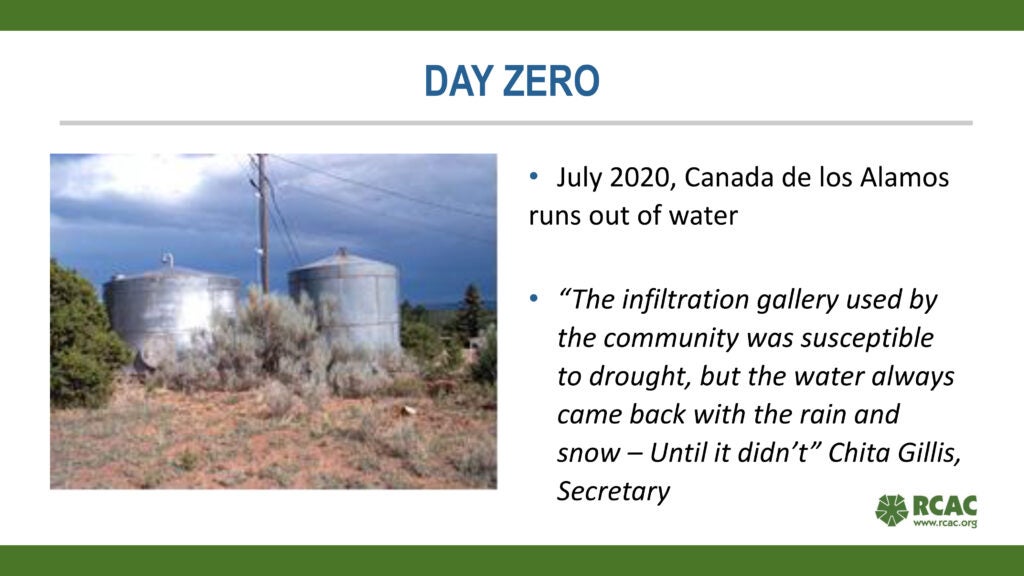
In July 2020, the 68 residents of Cañada de los Alamos experienced what water experts call “Day Zero.” Their only water source, a 30-foot infiltration well drilled in 1958, went dry.
Ramón Lucero, a regional field manager with the nonprofit Rural Community Assistance Corporation (RCAC), worked closely with the community through the crisis. The community spent its entire $44,000 in savings hauling water from Santa Fe County over a ten-month period. Monthly bills shot up to $720 per household, which is roughly ten times the statewide average for comparable systems.
“About 86% of community water systems across the state only have one well, so a lot of them are really vulnerable to the drought conditions that we’re currently in.”
— Ramón Lucero, Rural Community Assistance Corporation
Thanks to a combination of emergency and long-term funding, including $335,000 from the State Board of Finance and $566,000 from USDA Rural Development, Lucero’s team helped the community drill a second shallow well, rehabilitate the original infiltration gallery and upgrade its storage infrastructure. Today, the system produces about two gallons of water per minute, which is enough for a community that has come to prioritize conservation. Unfortunately, connecting to Santa Fe County’s water system, which could serve as a permanent solution, would require another $12 million that hasn’t yet been secured.
Cañada de los Alamos is far from alone. As outlined in the Groundwater 360 Report, New Mexico has approximately 625 community water systems, and 95% of them serve fewer than 3,300 connections. These smaller communities carry the same regulatory requirements as larger ones, like the city of Albuquerque, but only have a fraction of the staff and financial resources.
Lucero’s lessons from this case are urgent and direct: Every community needs a secondary water source, regularly monitored groundwater levels, and organizational capacity before a crisis hits, not after.
All of these examples in New Mexico are very specific to localized water conditions. But each provides an example of how the community has come together, voiced their values, and created systems they support in one way or another to locally manage their resources. The New Mexico Groundwater 360 Report is a call to action, and these three communities are showing what answering that call looks like.
Climate change projections estimate a 25% to 30% reduction in surface water availability in New Mexico by 2050, and aquifer declines are already reaching crisis levels in some areas. The urgency for proactive and comprehensive groundwater management could not be clearer.
Seven U.S. states have been deadlocked for years in negotiations around a plan to manage the shrinking Colorado River. Water supplies for 40 million people who depend on the river are on the brink after a dismal winter snowpack and reservoirs at record lows. With river management rules set to expire in just months, Arizona, California and Nevada stepped up with a short-term bridge proposal to collaborate on water use reductions.
The bridge is an important step, but will it catalyze long-term solutions across the basin? Tough decisions must be made on how we manage this shrinking river, and time is nearly up. This bridge proposal buys us one final overtime period to figure out how to take control of our own future, and we have a lot left to do.
The Lower Basin states agreed to collectively work to reduce water use from the Colorado River by at least 3.2 million acre-feet (AF) through 2028. In addition to mandatory reductions each year — 760,000 AF for Arizona, 440,000 AF for California, and 50,000 AF for Nevada — the states are targeting 700,000 AF of conservation. For comparison, in 2022 and 2023, the first years of shortage under the 2019 Lower Basin Drought Contingency Plan, mandatory shortages in the Lower Basin totalled 533,000 AF and 617,000 AF, respectively. This bridge proposal’s water use reductions will make a meaningful difference in the short term.
The proposal includes a new Tribal pool in Lake Mead to help ensure the federal government meets its trust obligations to Tribes in Arizona, the first of its kind on the Colorado River. It also extends “intentionally created surplus”, an adaptive water management tool that allows banking water in Lake Mead for future use, with future withdrawal limits tied to reservoir levels.
Other features include protecting critical water levels at Glen Canyon Dam with deadlines for the federal government to develop a plan for how to pass water through the dam when water levels are low. The details of implementing these elements matter for a flowing Colorado River in the Grand Canyon and beyond. Under the status quo, a collapse of the Colorado River as we know it through the Grand Canyon is possible in the near future. This once unthinkable scenario would be a failure that the next generation will hold us accountable for, and rightly so.
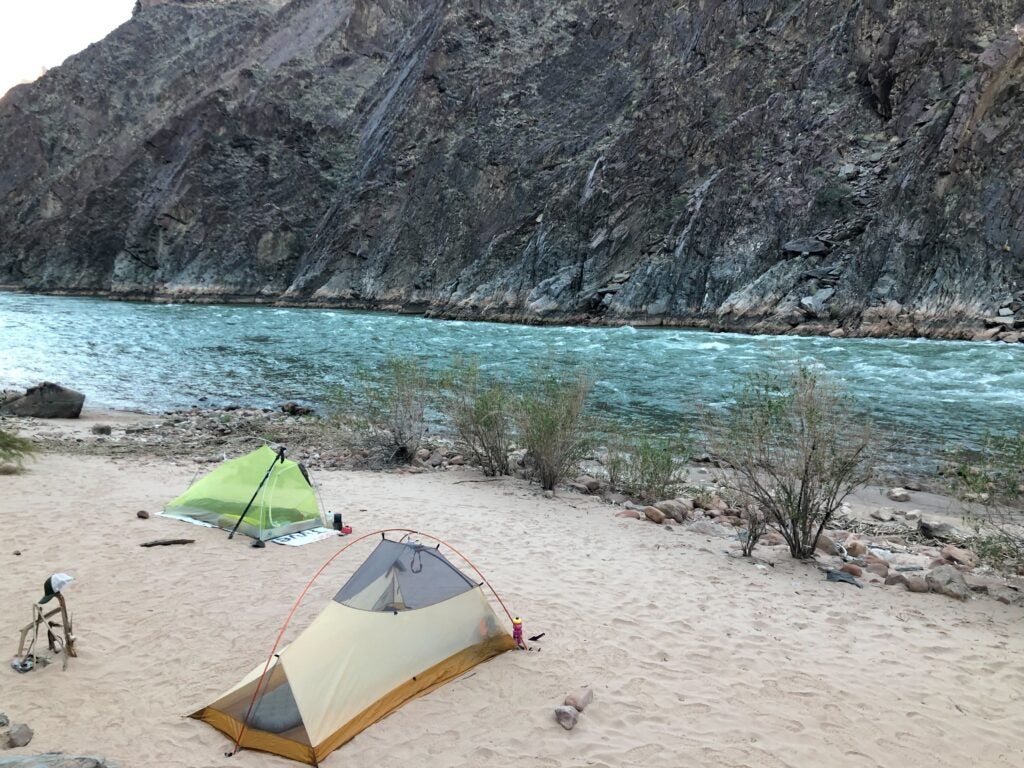
We need to use this overtime period wisely.
The federal government is considering whether to approve the bridge proposal. Considerations that keep the door open with the Upper Basin to a seven-state agreement will be important in the next steps. Both the Lower and Upper Basin states have expressed openness to continuing negotiations with a mediator — and it’s critically important for these negotiations to continue even as any Lower Basin bridge agreement is being implemented. Mexico and the 30 sovereign Tribes in the basin must also have a meaningful role shaping any outcome. What we decide to do in this overtime period may be one of the more consequential decisions of our generation in the western United States.
We need sustainable funding.
Federal funding is a critical need for a sustainable future in the Colorado River Basin, including for the stop gaps in the bridge proposal. Given the emergency at hand, a good part of this funding is likely to be used to generate short-term water savings and mitigation. While necessary, we cannot lose sight of the need to invest in permanent water use reductions and transition local economies toward a resilient future with less water, while creating new jobs and opportunities. Taxpayers must see real and lasting public benefits in order for public funding to be sustained for the long term. At some point soon, we must shift our approach from crisis management to building the future we want.
Sustainable, state-based funding mechanisms play an essential role, too. For example, Colorado dedicates revenue from sports betting to water. Within Arizona, discussions in the state Legislature about creating a Colorado River Protection Fund tied to new fees from data centers offer an innovative path forward — if it passes. State funding mechanisms, including those within the Water Infrastructure Finance Authority of Arizona, also serve as important funding multipliers, whether through federal matching, public private partnerships, or other innovative financing arrangements. All options are becoming increasingly necessary to support adaptation.
We need to adapt to less water, at a massive scale, across the West.
California and Arizona water agencies and the Arizona Legislature must also approve the bridge proposal. The still-to-be-worked-out details of intrastate plans matter for communities as much as any multistate Colorado River agreement. Arizona is agreeing to a 27% mandatory reduction of its Colorado River supply — a significant commitment equal to over 10% of the state’s total annual water use.
Like virtually everywhere across the Colorado River Basin and the West, we must adapt here in Arizona, the state that I call home. To keep thriving in Arizona as conditions only get drier and warmer, a broad menu of adaptation actions will be needed, including building out systems to access the water we’ve long stored underground for times of shortage.
We also need to continue to build new regional wastewater recycling facilities, upgrade infrastructure such as Bartlett Lake Dam and explore other augmentation opportunities, and expand forest health and restoration programs. Innovative water sharing partnerships are already taking root, and the future may hold opportunities for new regional economic development partnerships that facilitate transitions to low water use economies while also bringing new jobs and opportunities.
We need to protect the water we have.
A significant portion of the Colorado River that we’ve relied on in the past in Arizona is no longer there. Groundwater has been and will continue to be an essential resource in the basin. However, over the last 20 years, more water was lost in the Colorado River Basin from groundwater pumping than the entire capacity of Lake Mead, the largest reservoir in the U.S. About three-quarters of that loss occurred in Arizona.
Bipartisan community leaders and citizens on the front lines are making history to protect their local groundwater supplies for the first time ever in Cochise, La Paz and Mohave counties. With Colorado River supplies declining, even more focus is needed to defend against ongoing efforts to weaken the groundwater protections we have – efforts demonstrated by numerous bills advanced in the Arizona Legislature in recent years.
Fortunately, these bills have thus far been stopped, but the threats continue. Just weeks ago, a Maricopa County superior court judge issued an initial decision in favor of a homebuilder industry lobby group that could jeopardize a key groundwater management program that has protected millions of urban homeowners for decades. With nearly 50% of the land mass of the Colorado River Basin in Arizona, protecting our groundwater supplies here is an essential part of a future where every person across the basin enjoys basic water security.
We need to get Tribal water rights settlements across the finish line.
Two Tribal water rights settlements in Arizona are currently awaiting final ratification and funding in Congress. When passed, these settlements will finally resolve longstanding water claims; end decades-long litigation; greatly increase water certainty for everyone; and benefit the settling Nations, neighboring communities and the entire state.
With the Colorado River dwindling, it is essential to secure other critical water supplies like the Verde River. The Yavapai-Apache Nation Water Rights Settlement Act is a historic opportunity to do exactly that. In addition, the Northeastern Arizona Water Rights Settlement Act would provide long overdue improvement in water security for the Navajo Nation, Hopi and San Juan Southern Paiute and get water to homes for the first time ever, unlocking new water management and economic development opportunities.
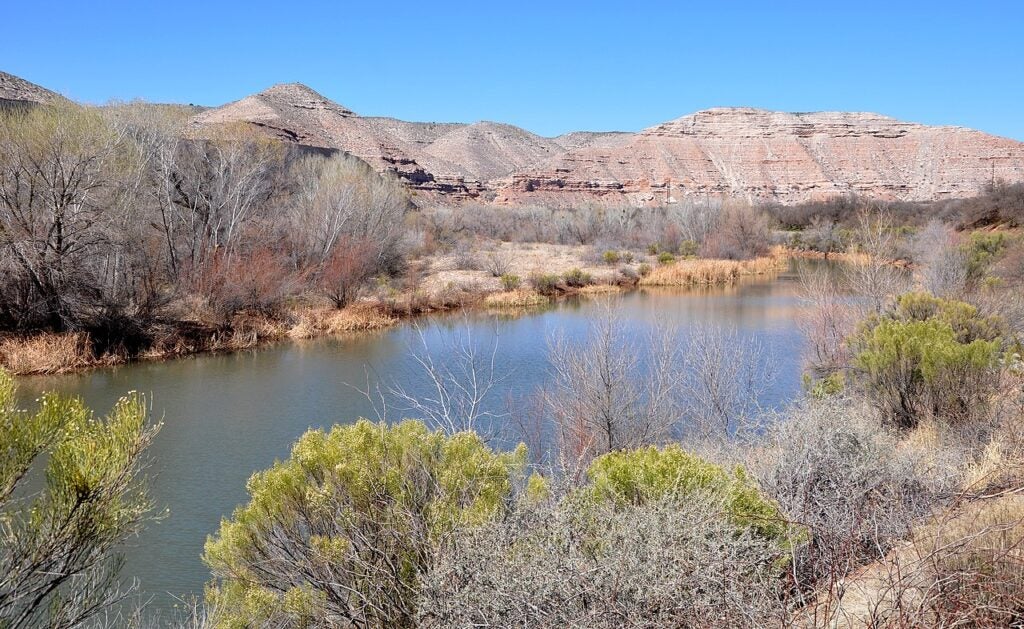
Last fall, shortly after the Colorado River Indian Tribes passed a resolution acknowledging the personhood of the Colorado River under the Tribal Nation’s laws, Chairwoman Amelia Flores offered us direction, saying, “If we are to protect this resource for the future, we must think beyond terms of what it can provide to us; we must think of what we can provide to it. Our collective future depends on it.”
The tired and fractured way we manage the Colorado River, which brings us to the brink every few years, is breaking down. It can’t sustain us for the long term. It’s time to ask, what does sustainable river governance look like to enable our kids to continue living and thriving in this place we call home, in our urban, rural, and Tribal communities across the Southwest? Whether this Lower Basin proposal can be a bridge to that future might depend on the collective choices we make in this one last overtime period.
The state of Arizona’s annual budget provides an important opportunity to invest in strengthening public water security and community resilience. While community leaders have made historic progress to protect their local water supplies through new groundwater protections for the first time ever in Cochise, La Paz and Mohave counties, much of Arizona still remains vulnerable to unlimited groundwater pumping.
Intensifying challenges with significantly reduced Colorado River supplies (pictured above) are also compounding uncertainty for the state and its residents. If that is not enough, just last week, a superior court judge in Maricopa County issued a decision in favor of an industry lobby group that could jeopardize the state’s Assured Water Supply Program, a longstanding program that has protected millions of homeowners for decades in the initial active management areas mostly in the Phoenix and Tucson areas.
We face unprecedented challenges in the months and years ahead. With rising costs squeezing more and more Arizona families, Arizona cannot afford to skimp on public water security investments, despite another challenging fiscal year.
Unfortunately, the state Legislature unilaterally advanced a partisan state budget earlier this week that does just that: skimps. For example, last month the Legislature unanimously passed a widely supported spending bill to provide the Arizona Department of Water Resources (ADWR) with dedicated funding to protect the state’s Colorado River supplies in court, if necessary. However this new partisan budget proposes to actually cut funding to ADWR. This contradictory, seemingly aimless approach to state budgeting cannot advance water security for all Arizonans.
EDF in Arizona, on behalf of our combined 96,000 Arizona members across both EDF and our advocacy partner EDF Action, is asking lawmakers to vote no on this partisan budget and if necessary, Gov. Katie Hobbs to veto it. Instead, we offer lawmakers from both parties a roadmap below to reengage in good faith, bipartisan negotiations and craft a state budget that meets this moment, with Arizona in need of strategic investments in water security and resilience now more than ever.
Maintain and strengthen state capacity to effectively manage our water supplies.
We recommend $25.8 million from the General Fund (for a total of $27.8 million across all funding sources) to ADWR to ensure they can effectively safeguard the state’s water supplies. This funding will support essential functions, including groundwater assessments, administration of active management areas and technical expertise related to water rights. Expanding ADWR’s capacity is vital to meeting increasing demand and work through intensifying water scarcity.
We also recommend $18.3 million from the General Fund for the Arizona Department of Environmental Quality (ADEQ) to ensure adequate staffing to carry out the agency’s duties related to air quality, water quality and other programs. Of this amount, $9.5 million would be allocated to the Water Quality Fee Fund to support surface water, groundwater and drinking water programs that protect water quality.
Support Colorado River efforts.
We recommend a minimum of $1 million from the General Fund for the Colorado River Litigation Fund, along with a $30 million one-time deposit into a newly established Colorado River Protection Fund. These investments will support conservation strategies such as crop shifting and other proven water-saving practices, while enabling Arizona to maintain a sustainable and growing economy in both rural and urban areas.
Additionally, the Protection Fund should support the development of new recovery wells within initial active management areas to strengthen water banking, recharge and recovery systems as areas that are home to millions of people adapt to an imminent future of less Colorado River supplies.
Modernize revenue and incentives around water sustainability.
We recommend both closing the sales tax loophole associated with the Data Center Tax Exemption and establishing a water-use assessment for data centers. It is unnecessary for the state to subsidize an industry that is clamoring to come to Arizona, with or without tax breaks, particularly one that is so taxing on our natural resources.
If Arizona families can pay sales tax on their purchases, so can the world’s richest companies. Part of the revenue from these measures would generate a dedicated funding stream for a new Colorado River Protection Fund while encouraging responsible water use. Establishing this fund tied to part of these revenues will help ensure long-term investment in Arizona’s water future.
Support tribal water Infrastructure and uranium contamination monitoring.
We recommend $340,000 for the Ganado Irrigation Project on Navajo Nation and $1 million for statewide monitoring of uranium contamination, with a particular focus on protecting tribal communities affected by abandoned mines. Ensuring safe and reliable water infrastructure in these regions is essential.
Invest in rural economic development.
We recommend $250,000 from the General Fund to support the maintenance, planning, and preservation of the Arizona Trail. This 800-mile corridor supports recreation and tourism, and it is an important and sustainable economic driver for many rural communities across the state.
Water security is foundational for creating opportunities for residents, whether that is housing, health and wellbeing, or good jobs and a strong economy. Sustainable water systems underpin vibrant economies, requiring care and investment. With so many headwinds threatening the state’s water supplies, now is the time for the state Legislature to invest more in water — not less.
Because March 22 was designated World Water Day by the United Nations, I thought it made sense to revisit the U.N.’s recent report, “Global Water Bankruptcy: Living Beyond Our Hydrological Means in the Post-Crisis Era,” which I read during a trip to Dakar for planning meetings for the U.N. Water Conference in December.
With much of the EDF Water Team’s work concentrated in the western United States, I inevitably read the report through a western water lens. What struck me most is that some parts of the West have already begun adopting the report’s recommendations, such as California with the Sustainable Groundwater Management Act (SGMA), while others seem to be avoiding them, such as the Colorado River Basin.
Despite its dire diagnosis, the report was still inspiring with its calls for transformative institutional frameworks and a new global water agenda, using the 2026 and 2028 U.N. Water Conferences as milestones to reset how water is governed worldwide.
I agree that many water systems have crossed critical tipping points that require fundamentally different governance to prevent further collapse. But I couldn’t help thinking that waiting until 2028 to take meaningful action on a global water agenda is too late. Communities are already seeing groundwater wells go dry. Water levels in Lake Powell are falling to perilously low levels that could threaten energy generation and water deliveries. Corpus Christi, Texas, could run out of water next year. In India, where EDF also works, farmers have committed suicide under the crushing pressure of debt associated with drilling deeper bore wells. It’s clear that we need a new actionable global water agenda now.
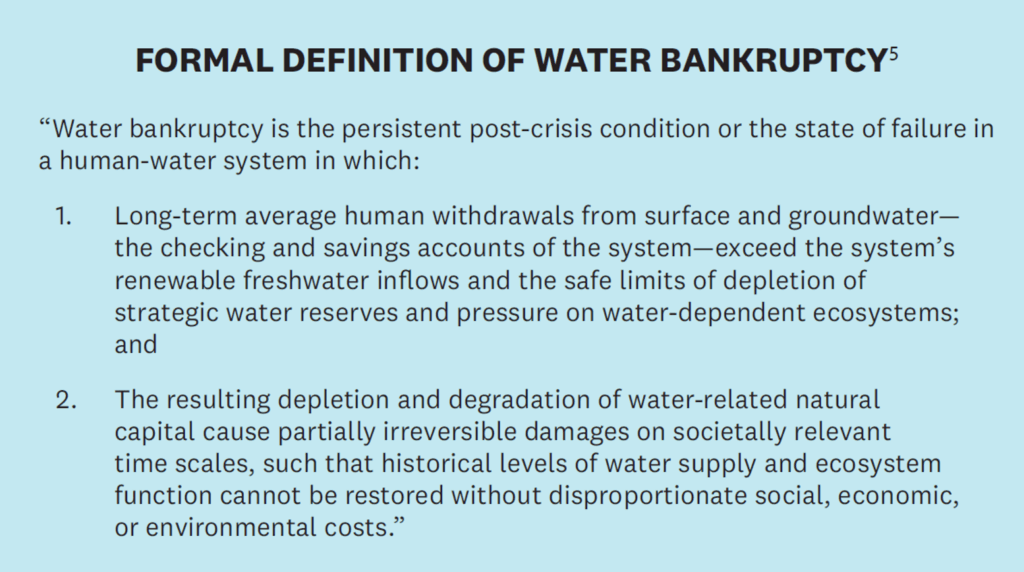
The U.N. report introduces the term “water bankruptcy” because the often-repeated phrase “water crisis” no longer adequately describes the situation we’re in.
In many basins, aquifers and ecosystems, the combination of chronic overdraft, ecological degradation and crossed tipping points signals a transition to water bankruptcy: a persistent post-crisis condition in which water use has exceeded renewable inflows and safe depletion limits, and the old normal cannot be restored.
Crisis management is designed to absorb a shock and return a system to something close to its previous state — if only we can survive this drought, repair this dam or wait out the next dry year. Bankruptcy is different.
In finance, bankruptcy is declared when spending beyond one’s means has accumulated into unsustainable debt. While it’s an admission of failure, it is also the first step toward a fresh start: claims are written down, expectations are reset and a more realistic balance sheet is negotiated to prevent further collapse.
Declaring a water bankruptcy serves a similar function. It creates the political and institutional space to move beyond the illusion that past conditions can be restored, and instead design governance frameworks to prevent further collapse.
Similarly, declaring a water bankruptcy is the first step toward a fresh start with improved governance frameworks aimed not at returning to the baseline but preventing further collapse.
While the details vary by geography, the report highlights two key drivers of water bankruptcy that are all too familiar in the western U.S.
The first is “anthropogenic drought” — chronic water deficits driven largely by human activity rather than natural variability alone. Overallocation, groundwater depletion, land and soil degradation, deforestation, pollution, and climate change all contribute. Western North America is explicitly named among the regions experiencing this kind of drought.
More than 1.8 billion people were living under drought conditions in 2022–2023. Drought-related damages total roughly $307 billion per year, and that figure is likely low as it predates the deadly Los Angeles fires.
The second pathway is institutional inertia and denial. Even as evidence mounts, decision-makers continue operating under the assumption that the old normal will return. Water rights, subsidies and infrastructure investments reinforce overuse, while politically difficult decisions about demand reduction, reallocation and adaptation are postponed.
But declaring water bankruptcy opens the door to resetting expectations, renegotiating claims and designing arrangements that are realistic and just, the report argues.
This pattern closely mirrors California’s experience before the severe 2012–2016 drought, which ultimately forced lawmakers to confront groundwater overdraft and its very real impacts and pass historic groundwater legislation. Today, groundwater sustainability agencies are doing the difficult work of setting allocations and developing water budgets to balance groundwater demand and supply.
Other states such as Arizona and Texas that were once ahead of California in managing groundwater are now facing the limits of their patchwork approaches amid the arrival of large, new water users.
In the Colorado River Basin, where Lakes Mead and Powell remain at historically low levels and many areas are suffering a snow drought, it’s impossible to assume the old normal will return. Yet the inability to reach an agreement on new river guidelines suggests that some leaders continue to avoid politically difficult decisions.
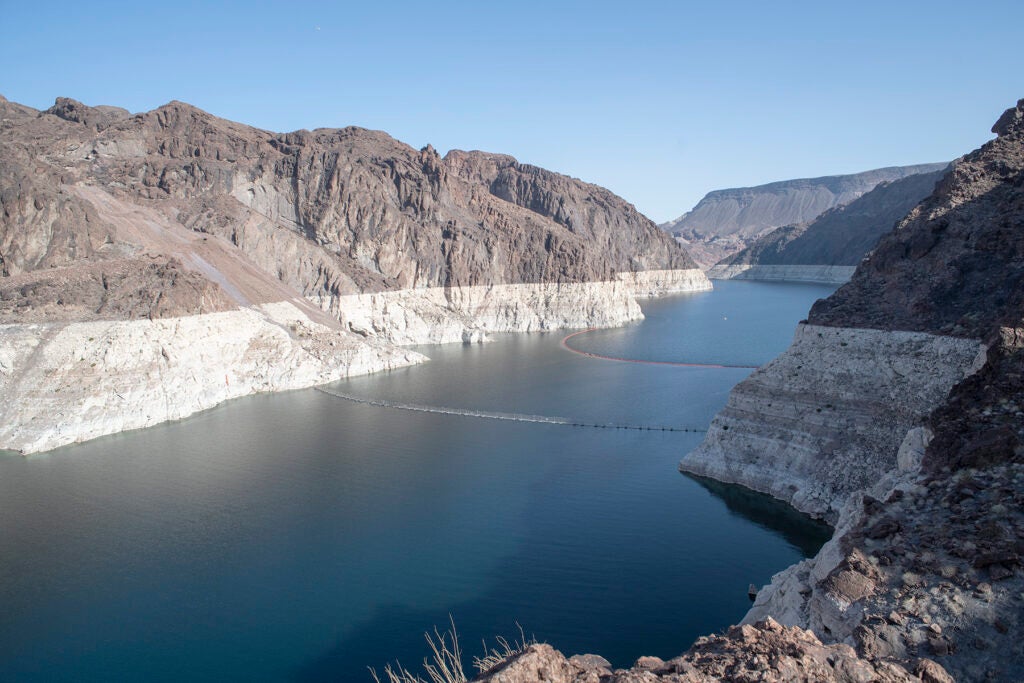
The report diplomatically concludes that “existing governance and agendas are no longer fit for purpose.” In many basins, the sum of legal water rights, informal expectations and development promises far exceeds today’s hydrologic reality.
The report highlights that carefully transforming agriculture — the largest global water user — as central to any solution. Roughly 70% of global freshwater withdrawals go to agriculture, much of it from groundwater, an often-overlooked resource I was encouraged to see emphasized.
Some key groundwater stats:
In water-bankrupt systems, incremental efficiency gains are not enough if irrigated acreage, crop choices and production models remain misaligned with hydrologic realities.
The report also cautions that abrupt allocation cuts or poorly designed subsidy reforms can devastate livelihoods and erode support for change. Instead, it rightfully calls for a just transition that reduces pressure on water while protecting farmers and rural communities.
This resonates in California, where roughly one million acres in the San Joaquin Valley are predicted to come out of production over the next two decades to balance groundwater supply and demand. The transition will be difficult. But programs like California’s Multibenefit Land Repurposing Program are helping to support a just transition, with nearly 5,000 acres of projects converting agricultural land to new uses that reduce groundwater pumping and deliver new benefits, such as lower water use crops, habitat, open space and flood mitigation. And the program is expected to ramp up significantly to meet growing demand for land repurposing.
Water bankruptcy is experienced locally, but its drivers and consequences are increasingly global, the report notes. Food grown in overdrawn basins is shipped worldwide, and climate change is reshaping hydrology everywhere.
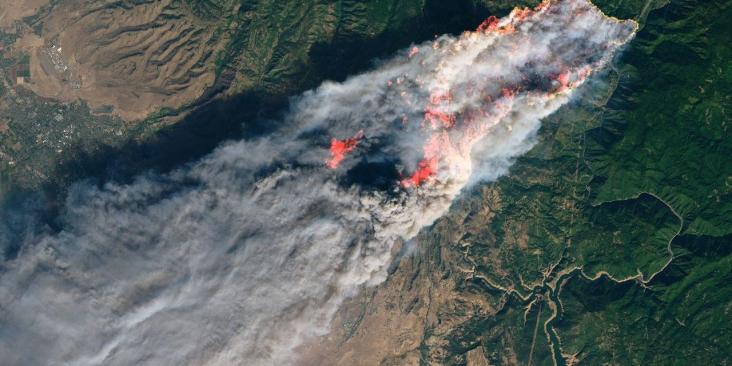
The report concludes change is needed at every scale — local, basin, national and global — with stronger international cooperation and a higher profile for water in U.N. efforts on climate change, biodiversity, and desertification. As we experience a record heat wave in the West — triple digits before April! — we are painfully familiar with these connections between water, climate change, desertification, biodiversity loss and wildfires. I look forward to the 2026 U.N. Water Conference and helping to sound the alarm about the urgent need for a new, transformative and action-focused global water agenda now.
Transitioning 1,090 acres of active agricultural land to wildlife habitat while supporting farmer leadership in cover cropping. Repurposing 150 acres of almond orchards to cattle rangeland and native grasslands, reducing groundwater use and improving wildlife habitat. Converting 12 acres of pistachio orchard into a groundwater recharge basin with integrated renewable solar infrastructure, capturing floodwater and increasing groundwater recharge.
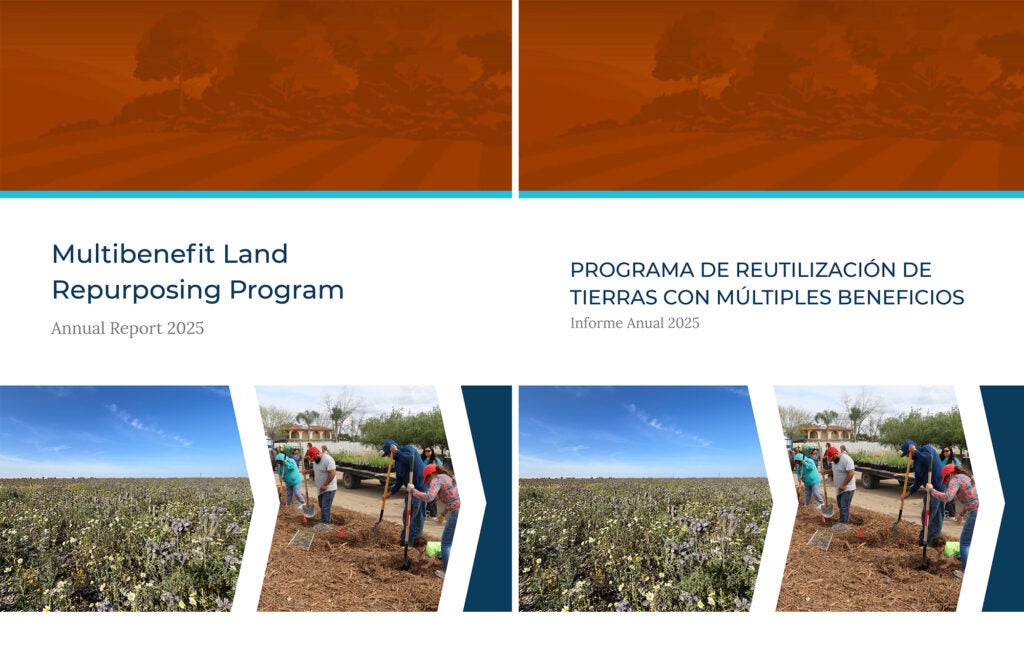
These three projects are among 13 projects that the California Department of Conservation approved in 2025 to receive funding from the state’s Multibenefit Land Repurposing Program (MLRP). Details about these projects and updates on 10 others approved in previous years are featured in the new Multibenefit Land Repurposing Program 2025 Annual Report (available in English and Spanish).
Since launching in 2022, MLRP has allocated nearly $80 million to support regional land repurposing planning and projects across nine regions. The program is picking up momentum with more than 4,800 acres of projects approved or breaking ground and the establishment of a strong peer network of local and regional staff who are helping to implement MLRP in their areas.
Interest in the program among growers and community members remains strong, with such regions as Madera County and the Kaweah Subbasin receiving more than two dozen applications — far more than they could fund in this initial round.
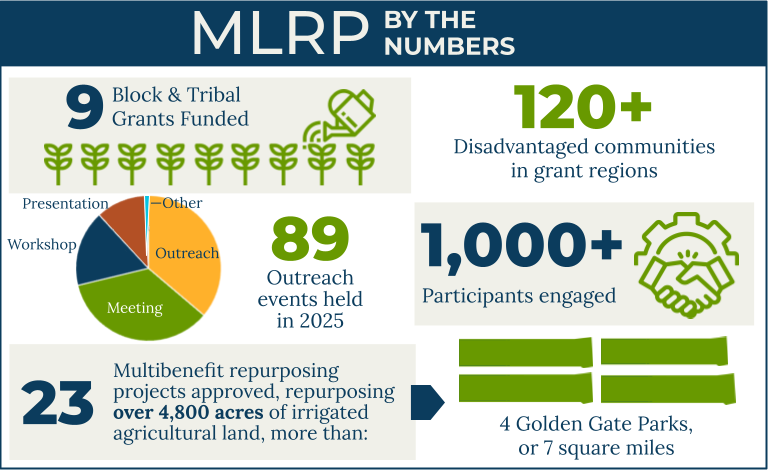
MLRP seeks to strengthen California’s long-term groundwater resilience by repurposing the least-viable irrigated agricultural lands to other uses that benefit communities and ecosystems. The program is an important tool in helping communities transition to pumping less groundwater to comply with the Sustainable Groundwater Management Act.
For example, five approved projects feature recharge or flood control basins, eleven projects offer habitat or environmental benefits, and five projects continue working lands practices more sustainably, such as switching to grazing land or planting less water-intensive cover crops.
Community involvement is a cornerstone of MLRP, which features a unique requirement for comprehensive outreach to determine community priorities. When outreach efforts brought growers, communities and implementing partners together, block grantees noted improved alignment between regional priorities and proposed projects.
Four of the 13 projects approved in 2025 are designed to not only conserve groundwater but also deliver meaningful benefits to disadvantaged communities:
Another unique feature of MLRP is its emphasis on creating a peer learning network across the state. The Department of Conservation administers MLRP grants to regions and Tribes and funds a Statewide Support Entity to provide technical assistance and facilitate learning through an MLRP Community of Practice.
In 2025, the Statewide Support Entity, led by Self-Help Enterprises and EDF, hosted 11 learning exchange opportunities focused on topics ranging from “Protecting Groundwater Quality in Recharge” to “Corporate Investment and Funding for Long-term Operations and Maintenance.” In addition to bringing in external experts, the MLRP Community of Practice provides space for grantees and their partners to learn from each another, share resources and solve implementation challenges.
In 2026, the first two rounds of grantees will be continuing planning efforts and focusing increasingly on project solicitation and implementation. For fiscal year 2025-26, MLRP will receive $32 million in funding from California’s Proposition 4 Climate Bond, which aims to protect communities from climate change impacts and increase long-term resilience.
This spring, DOC will release draft guidelines for this initial round of Climate Bond-funded MLRP grants and will award new grants by the fall. The Climate Bond approved by voters in November 2024 commits a total of $200 million to MLRP.