Climate change solutions
We deliver game-changing environmental solutions that have a real impact for people around the globe.
By Ari Pottens and Scott Seymour
The Canadian federal government has an important decision to make that will determine if it will follow through on the promise of the December 2025 methane regulations. Millions of metric tons of methane, thousands of jobs and more than a billion dollars’ worth of energy are at stake.
The decision is whether the federal government will enforce consistent standards across the country or give Alberta special treatment: will Alberta get a five-year delay, and will Alberta get to use its own problematic data to set the emissions reduction target?
EDF crunched the numbers, and it’s clear that capitulating on either of these issues will seriously undermine the regulations’ effectiveness:
For some background, in 2021, the federal government promised to reduce oil and gas methane emissions by at least 75% from 2012 levels, with a 2030 deadline. Last December, the federal government finalized regulations that are estimated to reduce methane emissions by 72% from 2012 levels, with that same 2030 deadline.
Provinces can create and enforce their own regulations, as long as they achieve a result that is equal or better than the federal rule—known as an equivalency agreement. The recently signed federal-Alberta Memorandum of Understanding calls for a finalized equivalency agreement by April 1 that achieves a 75% reduction by 2035—with no mention of the 2030 deadline to reduce emissions by 72%.
Despite a clarification from Canada’s Environment Minister that all provinces are subject to the new regulations and their 2030 target, Alberta appears to have adopted an interpretation that it will only need to adhere to the 2035 deadline, effectively a special five-year delay that other provinces won’t get.
Worse still, the Canadian Association of Petroleum Producers is demanding that Alberta’s equivalency agreement be based only on provincial data, and not the federal data collected by Environment and Climate Change Canada . This is concerning because Alberta’s methane emissions data is primarily based on estimates from industry, which as many peer-reviewed studies have shown, severely understate emissions. The Canadian federal government was the first government in the world to use aerial measurements of methane emissions, an approach that is far more accurate.
In the chart below, EDF modelled the amount of methane that could be mitigated from 2028 to 2040 for scenarios where Alberta is granted special treatment.
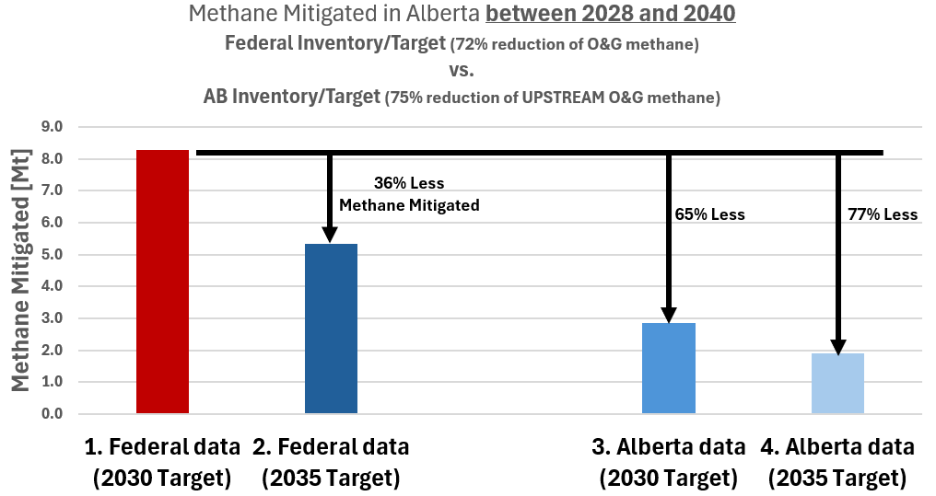
The data makes it clear that a later deadline seriously reduces the regulation’s effectiveness, and using Alberta’s data would undermine it even further:
Our analysis underlines the importance of accurate and speedy implementation of the federal methane requirements. Equivalency agreements need to result in equivalent outcomes and only one scenario achieves them: the scenario where Alberta does not receive special treatment. If a five-year delay is granted and/or the province is allowed to use its own data, then Alberta will come nowhere close to the government’s target.
Prime Minister Carney’s government can hold to its initial promise of strong federal regulations, follow the legal guidelines for equivalency agreements under the Canadian Environmental Protection Act, and cut more than an estimated 8 million metric tons of methane emissions. The cost of a five-year delay would be nearly a thousand jobs in Alberta, a critical blow to Canada’s climate goals, and millions of extra metric tons of methane emissions. Using Alberta’s inaccurate data drives those costs even higher.
The decision in front of the federal government is essentially a binary question of which matters more: Canada’s promised climate goals, or special treatment for Alberta.
Medium- and heavy-duty electric vehicles are hitting the road in 2026, and we’ve collected last month’s most exciting news. In 2025, EDF delivered monthly deployment updates on the biggest zero-emission transportation stories. By the end of 2025, it was clear that momentum was sustained throughout a challenging year. This year will undoubtably see more big announcements, and we’ll be here to showcase the biggest orders and deployments of zero-emission trucks happening around the country.
February announcements included expansion in the refuse industry, Rivian’s customer base and continued progress for transit buses.
Royal Waste Services adds three more Mack LR Electric trucks to growing fleet
Royal Waste Services announced the deployment of three additional Mack LR Electric refuse trucks in New York, after the successful deployment of the company’s first electric unit in December 2025. The vehicles received funding from the New York Truck Voucher Incentive Program. Royal Waste Services took delivery of its first LR Electric in early 2025 through the The Bronx Is Breathing initiative, which was supported by additional funding from the New York Clean Transportation Prizes program. The trucks have been well received by drivers, with operators citing less fatigue thanks to the elimination of engine vibration that comes with traditional diesel engines, as well as sharper handling and smoother responsiveness than conventional trucks on frequent stop-and-start routes.
Rivian expands commercial van customer base with Illinois service firm
Wm. Masters, a maintenance and repair company, is reportedly the first commercial fleet customer to purchase and deploy a Rivian electric van outside of the manufacturer’s deal with Amazon. Wm. Masters is located in Bloomington, IL, a short drive from the Rivian manufacturing plant in Normal, IL. Outside of the purchase order of 100,000 vans for Amazon, Rivian has partnered with HelloFresh, Slice and Cintas to expand their customer base.
New Flyer receives order for 100 additional transit buses for the Washington Metro Region
New Flyer of America announced that the Washington Metropolitan Area Transit Authority has placed an order for 25 Xcelsior battery-electric transit buses (and 75 hybrid buses). The purchase will be supported by federal, state and local funding as well as funds awarded through the Federal Transit Administration Low or No Emission grant program. The new buses will contribute to the Metro’s Strategic Transformation Plan. The Metro is America’s fifth-largest bus network in the United States.
Now is a critical time for fleets to invest in medium- and heavy-duty electric trucks. These vehicles improve public health and help combat the climate crisis by reducing greenhouse gas emissions and air pollution. Unlike traditional diesel-powered trucks, electric trucks produce no tailpipe emissions, which significantly cuts down on health-harming pollution. Adoption represents a key step toward a more sustainable and resilient transportation industry.
Check back here next month to see a collection of the most exciting zero-emission vehicle announcements from March. In the meantime, check out EDF’s Electric Fleet Deployment & Commitment List to track announcements as they happen in real time, and view all February announcements.
Check out last month’s announcements here.
By Kae Tuitt and Danna Widmar
When Cary, North Carolina, committed to electrifying their fleet, the goal wasn’t to make headlines — it was to make a practical, people-first investment in cleaner air, operational resilience and long-term cost efficiency. That vision came to life with the deployment of Cary’s — and the East Coast’s first electric fire truck.
Cary’s deployment of the Pierce Volterra electric fire truck marks a milestone that signals an opportunity for fleets to expand into more demanding applications with a strategic approach. After starting with light-duty EVs a decade ago, Cary’s first heavy-duty EV deployment demonstrates how steady progress can position municipalities of all sizes to scale their zero-emission fleet. This shift from planning to implementation shows that even light-duty deployments can lead to larger projects that benefit the staff and communities they serve. EDF worked with the Cary fleet to share how the project came together and what they learned along the way to offer practical insights for other fleets considering similar steps.
What Cary’s experience shows other municipalities
Cary’s journey underscores several lessons echoed throughout EDF’s electric fleet case studies:
There are still obstacles on the road to fleet electrification, but it’s important for fleets to find an avenue to get started. Deploying one electric vehicle may not seem significant, but a targeted deployment builds knowledge, confidence and momentum. It also provides a framework for other municipal fleets to learn and work from.
Focused deployment, big difference
Transportation remains the largest global contributor of air pollution, and trucks make up a disproportionate amount of those emissions, contributing to deadly health conditions like asthma and heart disease. For Cary, putting an electric fire truck into service aligns with the town’s goals of protecting public health and air quality while also supporting their frontline staff with reliable equipment.
EDF interviewed Cary firefighters for the case study, who shared first-hand experience on how the electric fire apparatus improves their health and working conditions. From no added tailpipe emissions in an already threatening work environment to added comfort and coordination in a quieter, more temperate vehicle, Cary is able to take care of the people who take care of the community. Deploying electric public safety vehicles is a great entryway into zero-emission transportation for municipalities, and the benefits speak for themselves.
Partnerships fuel progress
Electric truck deployments are complex efforts, and communication across multiple organizations and departments is essential to success. Cary’s progress was made possible through collaboration between the town’s leadership, fire department, utility, OEMs and stakeholders.
Their investment in forming and maintaining relationships unearthed hidden benefits for Cary and ensured a smooth integration of the new technology. EDF’s case study shows how other fleets can start these conversations early to replicate Cary’s thoughtful planning and incorporate coordination into their initial research and transition plans.
Leading by example: A model for what’s next
EDF’s electric fleet case study highlights how Cary created a learning opportunity that will inform broader fleet decisions in the years ahead, not just for their town but for other municipal fleets as well. Municipalities are uniquely positioned to directly impact the communities they serve through electric truck deployment and the many environmental, operational and financial benefits they provide.
Cary took the lead to help future fleets navigate the deployment of an electric public safety vehicle by starting with one truck and having lots of discussions with stakeholders. Your municipality can also take steps to get started and expand electrification in your fleet by building on lessons from Cary’s successful deployment.
To hear about the experience directly from Cary, watch EDF’s video case study , which includes interviews from the town leaders and fire personnel as well as footage of the electric fire truck out in the field.
When EDF published Four actions fleets must take to be sustainability leaders today in 2021, zero-emission trucks were just beginning to move from promise to practice. Only a small number of fleets had zero-emission vehicles on the road, early models were still proving their performance and major federal programs like the Bipartisan Infrastructure Law and Inflation Reduction Act had yet to reshape the market.
Five years later, the landscape looks very different. Zero-emission truck deployments have been announced for every vehicle class, manufacturers have expanded offerings and utilities and logistics hubs are planning infrastructure at scale. At the same time, companies face new political and economic uncertainties that shape how and when they lead.
Much has changed, but fleets remain central to whether the freight sector reaches a net-zero future by 2040. The Four Actions for Fleet Leadership continue to guide emissions reductions and responsible industry influence. In today’s environment, leadership requires renewed clarity about how those actions show up in practice.
Below, we revisit the Four Actions with today’s realities in mind.
In 2021, we called on fleets to set public, ambitious zero-emission goals. That leadership remains and begins with clear, public commitments to fully transition fleets away from fossil fuels.
What we have learned since 2021:
Commitments alone are not leadership, but they are a foundational north star. Without time-bound commitments that define an end state and timeline, it becomes difficult to coordinate planning and execution across complex fleet operations.
Credible commitments define the ultimate goal, a target year, and interim milestones that demonstrate progress. Defining the destination is only the first step. Leadership also requires a defined roadmap to drive success which is further structured by the second step: creating and sharing a transition plan.
In 2021, we called on companies to create and share high-level transition plans that detail how commitments will be implemented over time. A commitment defines where the fleet is going and how it will get there.
A credible transition plan outlines the operational pathway, including:
Leadership also requires recognizing the public health impacts of fleet operations as criteria for investment and prioritization. Diesel pollution disproportionately affects communities near freight corridors, ports and logistics hubs. Zero-emission trucks eliminate tailpipe pollution, delivering immediate and meaningful health benefits.
What we have learned since 2021:
Transition planning turns ambition into coordinated action. Plans align internal teams, prepare fleets for grant opportunities and surface operational constraints before they become barriers.
Transition plans should be treated as enabling tools, used to guide and facilitate ambition, rather than being rigid. Fleets should not wait for perfection or certainty before beginning. Companies developing transition plans for the first time can benefit from external support, including EDF Climate Corps fellows and resources available through EDF’s Fleet Electrification Solution Center.
In 2021, we called on fleets to begin deploying zero-emission vehicles to gain real-world experience. Hands-on deployment is the most effective way to understand operational performance, infrastructure needs and cost dynamics. Early deployments inform transition plans, surface best practices and help unlock additional use cases over time.
What we have learned since 2021:
Deployments are most impactful when they are part of a broader strategy, not isolated projects. A single vehicle deployment can generate valuable insight, but lasting change occurs when deployments feed into a transition plan, inform future capital decisions and scale over time.
As fleets integrate zero-emission vehicles into regular replacement cycles, operational confidence grows and long-term cost dynamics become clearer.
Zero-emission deployments prove what is possible within a company’s operations. The next step is helping shape the broader conditions that make scaling possible across the industry.
In 2021, we called on fleets to engage with policymakers in support of the standards, investments and programs needed to accelerate the transition. That principle remains true. No fleet can scale a zero-emission transition alone. Companies play a critical role in shaping the policies, programs and investments that make clean transportation possible.
What we have learned since 2021:
Since 2021, the ways companies exercise influence have evolved. Leadership extends beyond direct public advocacy — trade associations, industry forums and supply chain relationships increasingly shape policy outcomes and market signals.
Companies with sustainability goals have both the opportunity and responsibility to help create a level playing field that rewards climate leadership. Companies can use their influence constructively to reduce risk, unlock investment and normalize zero-emission solutions. This can include:
What matters is alignment between a company’s stated commitments, operational progress and the influence it exercises across the industry.
Leadership under this action is not about visibility for its own sake. It is about helping create the durable market and policy conditions that make zero-emission fleets achievable at scale.
Fleets, it’s time for your leadership
The transition to zero-emission freight is underway, but it is not guaranteed. In a moment of heightened uncertainty, fleet leadership is essential to sustain clean transportation progress, even as EDF works to protect federal standards and incentives that are under threat of rollback.
By setting clear commitments, sharing credible plans, deploying solutions thoughtfully and using industry influence responsibly, fleets can keep zero-emission progress on track and ensure the benefits of clean transportation reach communities where they matter most.
In the coming months, EDF will build on this framework with deeper analysis of fleet commitments and real-world practices to further clarify how leadership is taking shape across the sector.
By: Cole Jermyn and Dakoury Godo-Solo
California’s energy debates rarely generate consensus. But recent analyses reveal a clear and important point of alignment across the state’s large electric utilities and the California Public Advocates Office, the state’s ratepayer advocate, with major implications for utility customers and California’s clean energy future.
Utilities and consumer advocates agree that smart growth in electricity use can lower costs for customers, even as the grid modernizes. Electric vehicles, especially when charging is managed well, are one of the most effective ways to turn grid investment into long-term savings for Californians.
When managed well, electric load growth can lower costs for ratepayers, and transportation electrification — particularly managed electric vehicle (EV) charging — is one of the most effective ways to deliver those benefits. This alignment should give regulators and policymakers confidence to stay the course on electric vehicles and strengthen the policies that make electrification work for Californians.
California is electrifying transportation and buildings to cut air pollution, reduce climate risk and improve public health. Doing so requires investment in the electric grid. That fact is often framed as a cost problem and sometimes as a reason to slow progress.
Load growth can reduce costs, not raise them
But the latest studies from PG&E, Southern California Edison, San Diego Gas & Electric and the Public Advocates Office tell a more complete story.
Yes, grid upgrades will require significant investment over the coming decades. At the same time, electrification increases electricity sales. When utilities connect new customers — such as electrified vehicle fleets — to the grid, they can spread grid investment costs across a larger base of customers, lowering the average cost of service for everyone.
Put simply, electrification done right can reduce electricity rates rather than raise them. This conclusion holds across multiple analyses, even though they rely on different assumptions and modeling approaches. While precise cost estimates vary, the direction is consistent: Managed load growth creates value for customers.
The details differ, but the takeaway is clear
Utilities and the Public Advocates Office do not model the grid in the same way, nor should they. Forecasting future grid needs involves uncertainty, particularly over long time horizons, and differences in assumptions naturally lead to different investment estimates.
What matters most is where the studies agree. They find that electrification can deliver significant benefits for customers and that adding flexible load is the most effective way to do so, with transportation electrification playing an outsized role. This convergence should give policymakers confidence that the case for electrification does not rest on any single model or set of assumptions but holds across perspectives.
Why electric vehicles matter so much
Electric vehicles stand out because of how and when they use electricity. Unlike some emerging large loads, such as data centers that often require round-the-clock power, most EV charging is flexible. Vehicles spend far more time parked than on the road. With the right rates, programs and infrastructure, charging can shift away from the most expensive and constrained hours on the grid.
That flexibility makes EVs uniquely valuable from a grid perspective. Every major study identifies EV charging behavior as a key driver of cost savings. Managed charging reduces peak demand, avoids unnecessary grid upgrades and makes better use of existing infrastructure.
In many cases, the savings are large enough to more than offset the costs of preparing the grid for electrification. The Public Advocates Office estimates that by 2040, managed EV charging could avoid between $5 billion and $18 billion in grid upgrade costs.
This is not a future promise. California already has time-of-use rates, managed charging programs and growing experience integrating EVs into grid planning. The studies confirm that these tools work and that scaling them will increase benefits for all customers.
What this means for California’s energy policy
This alignment across utilities and consumer advocates sends a clear message: California does not need to choose between affordability and electrification. It needs to execute electrification well.
As Environmental Defense Fund outlined in recent comments to the California Public Utilities Commission’s High DER proceeding, getting electrification right means accelerating electric vehicles and charging infrastructure while removing barriers that slow deployment and delay energization. It also means expanding managed charging and demand flexibility programs that make it easier for customers to charge at grid-supportive times, and planning proactively for electrification so investments are timely, targeted and cost-effective.
It also means recognizing that moving to electric vehicles is not just a climate strategy — it is a people strategy. When designed and managed thoughtfully, EV adoption can help stabilize rates, improve grid utilization and deliver broad public benefits, including cleaner air and lower household energy costs.
A moment to move forward with confidence
At a time when energy affordability remains a front-and-center issue in California, it is rare to see the state’s utilities and the Public Advocates Office in agreement. That convergence should build confidence, not caution.
Electrification is coming. The opportunity now is to capture its full value. By supporting smart load growth and continuing to accelerate electric vehicles, California can lower costs for ratepayers, strengthen the grid and stay on track to meet its clean energy goals. This is one of those moments when the analysis is clear — and the policy response should be, too.
The Colorado Public Utilities Commission (“PUC”) issued a disappointing decision last month, failing to adopt commonsense technology standards to find and fix dangerous leaks from pipelines and ensure strong requirements to protect our environment.
Better oversight is long overdue and critically needed. In the last ten years, operators in Colorado have reported 56 pipeline incidents, costing over $16 million in property damages and emergency resources. EDF is continuing to fight for improved rules to protect communities from the harms associated with leaking pipelines, seeking reconsideration of the Commission’s order.
Gas pipeline leaks are bad for Colorado communities
Colorado is home to over 80,000 miles of natural gas pipelines, with neighborhoods and towns hosting distribution, transmission, and gathering pipelines. Natural gas pipeline losses are harmful to the environment and human health, pose a safety risk to the nearby public, and result in economic waste that is costly to customers. Natural gas is primarily composed of methane, a potent greenhouse gas that contributes to climate change, which is driving rising temperatures, continuing reductions in snowpack, more frequent and intense droughts, and more and larger wildfires for Coloradans.
The best way to prevent pipeline incidents and address the public health and environmental risks associated with natural gas infrastructure is to find and fix leaks quickly. Methane detection technologies have become more commercially available and cost-effective, with the ability to locate more pipeline leaks and quantify leak flow rates. Strong leak management standards can help Colorado meet its climate goals, while improving public safety.
Last year, the Colorado Legislature directed the Public Utilities Commission to adopt statewide advanced leak detection technology standards for gas pipelines, to improve public safety and environmental protection.
The Commission failed to uphold its legal mandate
After months of stakeholder input—during which EDF presented evidence-based recommendations to improve leak management on gas pipelines—the PUC on January 29 issued a final decision containing significant deficiencies that betray its statutory obligation to issue rules that “meet the need for pipeline safety and protection of the environment.”
EDF is formally requesting that the Commission reconsider and modify its decision. The Commission should (1) strengthen the definition of “advanced leak detection technology” to ensure that qualifying equipment is capable of detecting most leaks on each pipeline type, including distribution lines, and (2) require operators to mitigate environmental harm—not just safety risks—when prioritizing leaks for repair, by incorporating consideration of environmental impacts into the leak grading standards.
The final rules are inadequate for the following reasons:
With strong, comprehensive advanced leak detection and repair standards for gas pipelines, the PUC can protect communities from dangerous health risks, reduce the threat of pipeline incidents, and drive climate progress by cutting methane emissions. The Commission should reconsider its decision and issue improved standards to ensure meaningful improvements to gas pipeline operations and oversight.