Climate change solutions
We deliver game-changing environmental solutions that have a real impact for people around the globe.
Across the country, regulators are making decisions that will shape the energy system for decades as they navigate rising energy costs, growing electricity demand, grid modernization and the accelerating energy transition. Meaningful public participation helps build stronger evidentiary records, improve accountability and lead to better outcomes for communities.
I recently joined Carolyn Parrs on her Just Power podcast to discuss why community voices matter in energy decision making and what regulators, utilities and advocates can do to help ensure those voices are heard. One message stood out: an open door is not the same as a seat at the table.
Most utility regulatory proceedings are open to the public. Anyone can attend a hearing, submit comments or follow a case. But meaningful participation requires more than access.
As a former utility commissioner, I saw firsthand how difficult it can be for community members to engage in complex regulatory proceedings. For residents already balancing work, family responsibilities and rising energy costs, participation can feel out of reach.
Strong records require diverse perspectives
Consider a grandmother who cannot afford to run her air conditioner during a heat wave and must sit in dangerous heat to keep her utility bill manageable. That story may never appear in a technical filing, but it provides critical information about how energy decisions affect real people.
Community members bring perspectives that data alone cannot capture. Technical data in energy proceedings gains meaning when combined with the experiences of people living with the consequences of regulators’ decisions, helping regulators understand the practical impacts of utility investments and energy policies.
Strong decisions require strong evidentiary records, and strong records are based on diverse perspectives.
Participation must start before decisions are made
To participate meaningfully, communities must be brought into the conversation before key choices are made, while their input can still shape outcomes. That requires providing clear information in multiple languages, sharing it through trusted communication channels and creating opportunities for participation that fit people’s daily lives.
Meetings should be held at times and locations that work for working families, caregivers and community leaders. People should not have to travel long distances or navigate complicated processes simply to understand decisions that will affect their lives. Meaningful engagement requires meeting people where they are and creating practical opportunities for participation.
Being heard matters
Being heard does not mean every recommendation is adopted. It means communities can see how their perspectives were evaluated and understand why decisions were made.
People deserve to know how their concerns are considered and addressed. Regulators may not agree with every recommendation raised during a proceeding, but participants should be able to see how their comments informed the final decision. Without evidence that their concerns were considered, communities’ trust erodes. Opposition to utility plans may increase. That is why meaningful participation requires transparency, responsiveness and accountability.
Progress is possible
Progress is possible when regulators intentionally reduce barriers to community participation in energy proceedings. In Massachusetts, recommendations from the stakeholder report Overly Impacted and Rarely Heard helped spur several important reforms, including an intervenor compensation program to support community participation in regulatory proceedings, expanded public outreach efforts and new resources to help residents better understand regulatory processes.
Massachusetts also strengthened language access at public hearings, established resources to help residents navigate regulatory proceedings and added environmental justice expertise to the Energy Facilities Siting Board. These reforms demonstrate that participation barriers can be overcome through thoughtful policy changes and sustained commitment.
Other states can learn from and adapt the Massachusetts progress. At a time when commissions across the country are confronting similar challenges, sharing lessons learned and building on proven approaches can help improve energy decision-making nationwide.
Building community voices in energy
Environmental Defense Fund is helping support strong energy decisions through Community Voices in Energy, a growing platform that provides resources, case studies and examples from across the country. Our goal is to help advocates, community leaders and residents better understand energy issues and participate more effectively in regulatory processes.
As the energy transition accelerates, states will be the focus of consequential decisions about affordability, reliability, who will be affected by infrastructure investments and who will have access to the benefits of a modernized electric grid. The people most affected by those decisions deserve meaningful opportunities to participate, be heard and help shape outcomes.
An open door is important. A seat at the table is better. But the strongest decisions are made when community voices help shape the conversation from the start.
Learn more about EDF’s Community Voices in Energy initiative at communityvoicesinenergy.org. Join our LinkedIn group to engage with others on this topic and to hear or share the Just Power podcast conversation.
Medium- and heavy-duty electric vehicles are hitting the road in 2026, and we’ve collected last month’s most exciting news. In 2025, EDF delivered monthly deployment updates on the biggest zero-emission transportation stories. By the end of 2025, it was clear that momentum was sustained throughout a challenging year. This year will undoubtedly see more big announcements, and we’ll be here to showcase the biggest orders and deployments of zero-emission trucks happening around the country.
May announcements included continued adoption of zero-emission refuse vehicles on the west coast, along with Tesla receiving bulk orders for their new semi from several California carriers.
City of Issaquah and Recology announce new all-electric waste collection vehicles
The City of Issaquah has announced the deployment of two electric waste collection vehicles through its contracted waste hauler, Recology. The trucks are the first fully integrated side-loading waste vehicles in Washington state. The vehicles were requested during contract negotiations with Recology after feedback from city residents.
Tesla Semi gets largest order yet with WattEV’s 370-truck deal
WattEV announced an order of 370 Tesla Semi trucks, making it the largest single order of heavy-duty electric trucks in California to date. The first 50 vehicles are scheduled for delivery in 2026, with the full fleet expected to be operational by the end of 2027. WattEV cited the truck’s cost, performance and availability as factors in the purchase decision.
City of Long Beach deploys first-ever zero-emissions collections trucks
The City of Long Beach has launched a pilot program featuring its first two electric refuse collection trucks to evaluate the feasibility of transitioning to a fully zero-emission waste collection fleet. The program includes one large truck operating on standard routes and one smaller truck serving alley routes. The pilot will assess key performance factors such as payload capacity, operating time per charge and route completion reliability. City officials aim to determine whether electric trucks can match the performance of the current fleet before moving to broader adoption.
Tesla Semi lands 60-truck order from port drayage fleets in California
Two California port trucking companies, Big F Transport and NICA Container Freight Line, have ordered a combined 60 Tesla Semi trucks through charging infrastructure provider Forum Mobility, making it one of the largest Tesla Semi commitments in the port drayage industry to date. Big F Transport ordered 40 trucks, while NICA Container ordered 20. The trucks will operate from Forum Mobility’s new charging depot in Rancho Dominguez, California, scheduled to open in early 2027. The facility will include 14 megawatt-class chargers and support more than 200 zero-emission trucks.
Now is a critical time for fleets to invest in medium- and heavy-duty electric trucks. These vehicles improve public health and help combat the climate crisis by reducing greenhouse gas emissions and air pollution. Unlike traditional diesel-powered trucks, electric trucks produce no tailpipe emissions, which significantly cuts down on health-harming pollution. At the same time, these vehicles can help fleets manage exposure to volatile fuel prices and improve long-term operating cost stability. Adoption represents a key step toward a more sustainable and resilient transportation industry.
Check back here next month to see a collection of the most exciting zero-emission vehicle announcements from June. In the meantime, check out EDF’s Electric Fleet Deployment & Commitment List to track announcements as they happen in real time, and view all May announcements.
Check out last month’s announcements here.
By David Lyon, PhD
The second annual Appalachian Methane Initiative report offers two different tales for one basin: several operators of higher-producing, unconventional wells have successfully mitigated their methane emissions, while operators of lower-producing conventional wells have disproportionately high loss rates.
According to the study: unconventional wells have an average loss rate of just 0.09%, while conventional wells have an 18.3% loss rate — that’s 200 times higher. This lopsided phenomenon is particularly stark given that conventional wells account for 97% of active wells but just 2% of the region’s gas production and more than 60% of its emissions.
Conventional wells are oil and gas wells that are drilled vertically to tap a reservoir of oil and/or gas. Hydraulic fracturing is sometimes used for production.
Unconventional wells are oil and gas wells that are drilled vertically and horizontally to release oil and/or gas contained within shale rock formations. Hydraulic fracturing is always used for production.
Importantly, operators participating in AMI demonstrate that very low methane intensity is achievable, reinforcing that the region’s emissions challenge is concentrated among higher-emitting, often marginal and conventional wells.
As domestic and international buyers seek cleaner sources of energy, developing accurate, measurement-based inventories for natural gas by region and operator is critical for the integrity of differentiated natural gas markets.
About the study
AMI is a collaborative, multi-year research study designed to understand methane emissions in the Appalachian Basin. It is led by the Energy Emissions Modeling and Data Lab at the University of Texas at Austin, managed by SLR, and consists of four full-member operators, including CNX Resources, EQT Corporation, MPLX and Seneca Resources, as well as two data-contributing operators, Ascent Resources and Expand Energy Corporation. All of the operators have upstream and/or midstream assets in the Appalachian Basin. Together, the operators produce over 50% of the total gas production in the Basin.
Emission profiles in Appalachia can be complicated and complex to measure due to the numerous methane sources, including oil and gas wells, coal mines and landfills, located in mountainous, forested terrain.
The 2026 study integrated multi-scale measurements to quantify methane emissions, including aerial measurements by three companies (Bridger Photonics, Insight M and ChampionX). AMI estimates that the region’s methane loss rate is 0.52% of natural gas production (95% CI: 0.30-0.62%), similar to an analysis of MethaneSAT data collected between 2024 and 2025 which found a loss rate of 0.6%.
The findings reaffirm earlier studies and underscore that the outsized emissions contribution of low-producing, conventional wells in Appalachia may be far greater than previously understood. EDF’s groundbreaking 2022 study found that marginal wells nationally were responsible for about half of all emissions.
Methane waste in Appalachia matters
Considering methane’s potency and warming power, allowing low-producing wells a pass to pollute supercharges climate change in the near term. It also stands to hurt the region’s bottom line.
As global and domestic markets begin to demand cleaner and transparent sources of energy, failing to address the loss rate of methane gas (also known as methane intensity) harms the economic competitiveness of Appalachian energy companies. In a world currently dealing with energy instability, cutting waste and bringing that gas to market can ease supply chain concerns.
Low-producing, conventional wells are a big problem, but also a big opportunity.
The AMI study demonstrates that making significant cuts in methane emissions is possible, but to get at oil and gas industry’s methane problem, we simply cannot afford to ignore such a large source of emissions. Operators of Appalachia’s unconventional wells have proven they can tackle leaks. It’s time for conventional operators to do the same instead of dragging the entire region’s emissions portfolio down with them.
Over the last decade, the number of warehouses across the nation has exploded. In Illinois alone, there are almost 7,000 warehouses larger than 30,000 square feet with a combined area of more than 1 billion square feet. More than one in four people in Illinois now live within half a mile of a warehouse.
The new Illinois Warehouse Boom report examines the impact these truck-attracting warehouses have on communities across the state. The report includes information on the demographics of the communities near these warehouses, while estimating the negative health impacts of living in close proximity to these facilities.
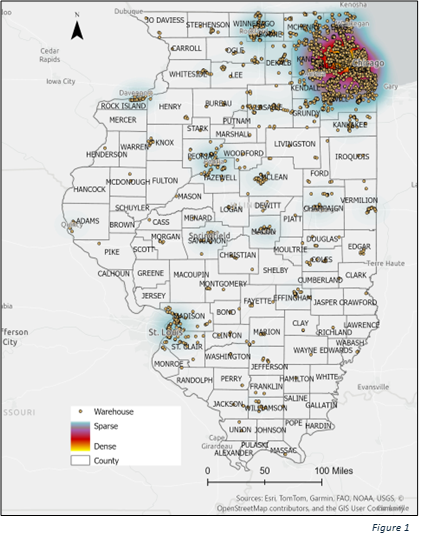
Warehouses tend to be disproportionately located in communities of color, bringing vehicle traffic, mainly made up of polluting diesel trucks. These state-defined environmental justice communities cover 1.3% of the state but contain 41% of warehouses. Our report finds that the mega-warehouses (100,000 square feet or larger), prevalent in these communities, generate an estimated 683,000 truck trips a day.
Medium- and heavy-duty vehicles are disproportionate polluters: Despite only being 7% of on-road vehicles they emit 67% of the transportation sector’s nitrogen oxide emissions and 59% of particulate matter — these pollutants increase instances of asthma, and PM 2.5 alone will result in an estimated $4.8 billion in public health costs in 2026.
Despite the harm warehouses cause to the communities they are sited in, there is currently no method or database to track warehouses. While the U.S. Energy Information Agency contains information on polluting facilities such as oil refineries or power plants; there is no federal or state data base for facilities that attract pollution instead of producing it directly. Due to the lack of regulation, it is extremely difficult to learn the location of warehouses or who operates them. EDF used a private database in the analysis, but private databases tend to be expensive, limited in scope and have burdensome terms of service for sharing data. Therefore, as things currently stand, communities lack the means to monitor the facilities in their own backyard.
To address the pollution and lack of transparency from warehouses, the Clear the Air Coalition, which EDF is part of, is supporting the Warehouse Pollution Reduction Act. The act would address the impacts of warehouses by establishing an Indirect Source Rule — a measure that seeks to regulate facilities indirectly responsible for pollution. In addition to Illinois, other states such as New York, New Jersey and Colorado are considering their own ISR rules.
California has already implemented the policy in the South Coast Air Quality Management District. According to South Coast’s most recent analysis, its ISR program resulted in reductions of 1.5 tons of NOx pollution and 0.33 tons of particulate matter. The program is on track to result in 300 fewer deaths, 5,800 fewer asthma attacks and $2.7 billion in reduced health costs by 2031. The success of California’s program makes a strong case for Illinois to adopt their own ISR.
The key provisions of the Warehouse Pollution Reduction Act are:
Illinoisans are already paying the cost of diesel pollution impacts. It’s time for achievable, life-saving pollution reduction through the Warehouse Pollution Reduction Act.
Co-Authored by Harish Makarim, EDF Legal and Regulatory Extern
Electrification is accelerating across the United States. Homes are switching from gas to electric appliances, electric vehicles are scaling rapidly and new clean energy projects, data centers and manufacturing are facilities coming online. But in many places, long grid connection times have become a major bottleneck that threatens to slow this transition.
This final step in electrification, known as energization, is where delays can block project completion. Even the most ambitious clean energy goals stall when new connections or upgrades take months or years to complete, with upstream upgrades driving a large share of the delay. Energization delays can hold up housing development, prevent EV charging deployment, slow clean energy projects and increase costs for customers and utilities alike.
Rapid energization is not just a technical issue. It is central to making electrification affordable and reliable. If timelines remain slow and unpredictable, electrification will become more expensive, more frustrating and less equitable, especially for customers with fewer resources to navigate delays.
Timeline tracking makes delays visible
Energization delays persist in part because they are often invisible. Customers may experience long waits, but utilities, regulators and policymakers often lack consistent data showing where delays occur, how long they last and who controls each step. In many jurisdictions, energization timelines are not tracked consistently, leaving regulators without a clear view of where delays occur.
Energization involves multiple phases: application review, engineering design, permitting, construction, inspection and final connection. Some of these steps depend on customers or local governments, while others fall under utility control. Without clear tracking, delays are often attributed to complexity even when utility processes are the primary cause. Even steps assigned to customers or local governments are often shaped by utility processes, from application clarity to coordination and review timelines.
Timeline tracking addresses this problem by introducing transparency and accountability. By measuring and publicly reporting how long each step takes, utilities and regulators can identify bottlenecks, compare performance across service territories and focus improvement efforts where they matter most.
California’s Public Utilities Commission recently became the first regulator in the country to adopt energization timeline tracking requirements, recognizing that electrification goals require measurable expectations for grid connection. Other states are beginning to follow. Colorado and Illinois have enacted legislation directing regulators to collect and use energization data, while Washington, D.C. requires tracking of EV charging timelines as part of its infrastructure planning. In New York, Con Edison has incorporated energization timelines into performance incentives for transportation electrification, with broader tracking under consideration. Together, these efforts reflect growing recognition that timely grid connection is critical to electrification.
EDF’s design recommendations for timeline tracking
Timeline tracking is necessary but not sufficient to accelerate energization. EDF’s analysis shows that impact depends on how regulators design these systems. Key decisions about what to measure and how to define timelines will determine whether tracking documents delays or drives improvement.
Grid connections must be faster
Electrification will only succeed if customers can connect to the grid quickly, affordably and reliably. Delays do not just slow projects, they increase financing risk, raise project costs and ultimately show up in customer bills. Energization delays are solvable, but fixing them requires visibility, accountability and intentional reform.
Timeline tracking is a foundational step. By making delays measurable and transparent, it gives utilities and regulators the tools they need to identify bottlenecks, improve performance and accelerate the clean energy transition.
Across major economies, from the U. S. to Germany and India, governments and industry are working to scale low-emissions hydrogen as a substitute for fossil fuels in hard-to-abate sectors such as fertilizers, refining, shipping and aviation.
Low-emissions hydrogen remains a critical option for energy security and deep decarbonization. Yet despite widespread interest and clear use cases, many projects are stalling before final investment decisions because offtake commitments and bankable market structures have not kept pace with market ambitions. Delayed action risks slowing decarbonization and prolonging dependence on volatile fossil fuel markets.
Building on EDF analysis of hydrogen use in US fertilizer and refining markets, this blog outlines four market and policy levers that can help create hydrogen demand even under today’s uncertain conditions.
Book and claim – unlocking demand by separating physical use from climate value
Book and claim systems offer a practical way to address cost premiums in today’s low-emissions hydrogen market. Under this market-based approach, companies with a higher willingness to pay — for example, consumer-facing food brands – cover the added cost of low-emissions hydrogen and claim the associated emissions reductions, helping to meet their climate targets, even if they may not use the hydrogen directly themselves. The hydrogen can then be steered to sectors, such as fertilizer production, that urgently need to reduce emissions but may struggle to absorb the green premium between clean and fossil-based fuels.
This type of book-and-claim system is being piloted in Minnesota, where Pepsi and others can purchase certificates for low-emissions fertilizer made from green hydrogen-based ammonia. Similar accounting systems exist elsewhere. CertifHy – a European voluntary hydrogen book-and-claim system – has been operational since 2018. Renewable electricity markets have used similar systems for decades, through Renewable Energy Credits in the U.S. and Guarantees of Origin in the European Union. These programs offer useful lessons for future book and claim design, including the importance of robust, verifiable and transparent emissions accounting.
Buyers’ alliances: aggregating demand to create bankable signals
Buyers’ alliances are another market-based tool that can help create the early demand signals that producers need to get projects off the ground. By pooling their purchasing power and committing to buy low-emissions hydrogen, companies can give producers and financial backers more confidence to move projects forward.
This approach is already being used across a range of sectors needing to decarbonize. The World Economic Forum’s First Movers Coalition is a leading example, targeting hard-to-abate sectors such as shipping, aviation and steel. In its first five years, the coalition helped generate more than 130 offtake agreements and investments, demonstrating the power of buyers’ alliances to create credible demand signals.
Hydrogen industry members and policymakers can build on this momentum by expanding existing alliances, such as ZEMBA and SABA, while also developing sector-specific initiatives like the alliance for Low-Emission Ammonia-based Fertilizers, launched at COP30. These groups are helping to create the demand certainty that hydrogen producers and investors need to accelerate deployment.
Product standards: mandating demand through regulated markets
Product standards use regulation to create predictable demand for low-emissions hydrogen. The standards can require a certain amount of low-emissions hydrogen to be used during production. For example, the EU has set targets requiring a growing share of industrial hydrogen use to come from renewable electricity by 2030.
Alternatively, a limit might be set for the carbon intensity of fuels or end products, as seen in Colorado’s Buy Clean standard for publicly funded construction materials. This creates predictable demand for low-emissions hydrogen or its derivatives, reducing risk for early projects and encouraging investment.
Public financial support: closing the cost gap to enable demand
Public financial support strengthens demand by bringing down hydrogen costs to be competitive with fossil fuels. Government support can take the form of production or end-use tax incentives where producers or end-users must meet a minimum emissions intensity threshold, or Contracts for Difference where the government sets a guaranteed price floor or ceiling for clean fuel options.
The U.S. and Australia have introduced federal clean hydrogen production tax credits, while Colorado and Illinois have implemented clean hydrogen tax credits aimed at hard-to-abate end uses. Meanwhile CfDs have been the preferred policy in the EU (European Hydrogen Bank auctions), Japan (Green Transformation (GX) scheme), and the United Kingdom (Low Carbon Hydrogen Agreement).
Both tax incentives and CfDs improve project affordability and strengthen demand. Some forms of CfDs, like those in the EU and India, can further address demand by matching offtakers and producers directly, resulting in signed offtake agreements.
Looking ahead
Hydrogen markets are facing barriers to uptake, but these challenges are not insurmountable. The tools are out there, yet the absence of coordinated action to deploy at scale remains a constraint.
The four levers outlined in this blog — book and claim systems, buyer alliances, product standards and public financial support — already exist in different forms across jurisdictions and sectors. The challenge now is scaling and aligning these approaches to build credible demand.
These levers are most effective when deployed together: market coordination, regulatory certainty and financial support each address different barriers to demand formation.
Achieving net zero by 2050 will require this kind of early market leadership. Policymakers and industry members do not need to wait for perfect market conditions to emerge; they can begin shaping the market through the decisions they make today.