Climate change solutions
We deliver game-changing environmental solutions that have a real impact for people around the globe.
Insurance that Builds Resilience for the Ocean & Coastal Communities
By: EDF’s Sepp Haukebo, Director of Ocean Resilience Initiatives
INSURANCE. What emotions stir when you hear that one word? For some, it might evoke memories of rebuilding a home or a life thanks to the coverage provided. Others might feel abandonment. After years of paying monthly premiums, you learn that your insurer and many others pulled out of your community, like after wildfires or hurricanes/cyclones. And for too many around the world, insurance feels like a far-off dream, impossible to obtain or afford…but perhaps, available one day through an innovative approach or public-private intervention.
EDF recently embarked on a global landscape analysis to identify how such interventions and insurance products are driving adaptation and resilience (A&R). The full results will be shared through a report and webinar this summer – you can sign up here to receive updates. In our first blog about this work, we outlined how insurers can engage across the entire climate risk lifecycle. Now, let’s look at how governments, insurers, and non-governmental organizations (NGOs) are partnering to drive A&R specifically within ocean and coastal communities.
Why explore the intersection of insurance and the ocean?
The ocean covers three-fourths of the planet and plays a critical role in regulating the climate, absorbing a lot of the world’s heat and carbon dioxide from the atmosphere. Hundreds of millions of people directly depend on the oceans for their livelihoods, and 3 billion people rely on seafood as a primary source of protein and vital micronutrients that are not easily replaced. In short, a vibrant ocean is essential to life on earth.
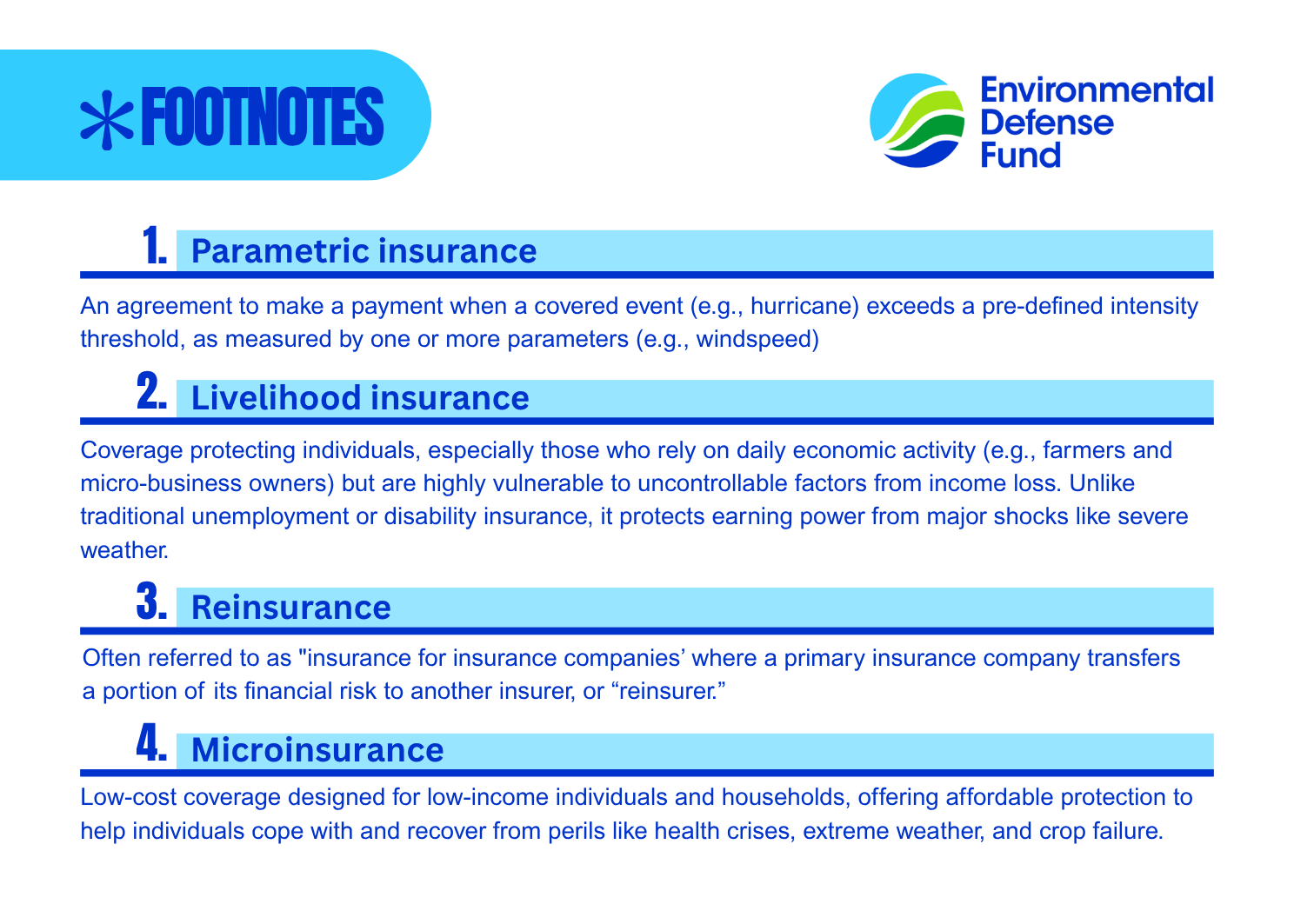
As a part of our analysis, we found innovative ways insurers are already supporting the ocean and the people that depend on it. We also found key gaps that still need to be filled. We’ve come across insurance that covers mangrove forests, coral reefs, and surf ecosystems. We learned about ocean-focused parametric insurance1, livelihood insurance2, reinsurance3, and microinsurance4. We also explored insurance for ‘debt-for-nature’ swaps, helping build ecological and economic resilience for entire nations.
While some of these concepts might seem far-fetched on paper, it’s important to remember that nature provides extensive economic services and value to communities, companies and nations. Insurance that incentivizes risk reduction for our oceans and coastal communities isn’t just smart conservation; it’s also smart business.
Key findings for advancing insurance-based solutions:
Each insurance instrument we researched was unique, but we found five common themes that may help insurers, non-profits, and governments exploring partnerships in this space.
1. Insurance covering climate-related disasters is critical, but persistent extremes need coverage too. Climate change is driving extreme conditions across many regions, from dangerous temperatures to more dangerous seas. For the latter, Rare and Willis developed a parametric livelihood insurance that pays fishers for lost fishing days when wind speed and wave height reach specific extremes. This incentivizes fisherfolk not to fish when the weather is unsafe, and it reduces the likelihood of overfishing because fishers don’t have to fish twice as hard to make up for lost wages when the weather turns fair again.
2. Gender-focused insurance programs can drive equitable resilience. In India, HERA (with support from the Howden Foundation) and the Self-Employed Women’s Association crafted a parametric insurance measure that reduces female entrepreneurs’ exposure to dangerous heat by paying out wages when heat thresholds are exceeded. (Note: Extreme heat is the leading cause of weather-related deaths globally and is predicted to get worse with continued climate change.) The insurance, in conjunction with early warning systems and community education, is protecting the women from heat illness and high medical costs, while minimizing shocks to the supply chains that depend upon the self-employed women. We didn’t come across any gender-focused insurance instruments in coastal communities, but there is a significant need, given that 45 million women participate in small-scale fisheries (SSF) worldwide, contributing to 50% of post-harvest SSF activities.
3. Public-private partnerships unlock new possibilities to expand coverage. Some initiatives require a philanthropic kickstart, like the examples listed above. Another interesting example is the Miami Foundation’s funding of parametric insurance for local communities. In some regions, countries have pooled their resources and risks together to improve access to insurance tools that help mitigate financial risk and can provide post-disaster payouts. These include SEADRIF, (Southeast Asia), CCRIF (Caribbean and Central America), ARC Ltd. (Africa), and PCRIC (Pacific) which provide disaster risk financing and parametric insurance to member countries, helping countries prepare for and respond to extreme weather events.
4. Insurance can unlock capital and new projects, but the reverse is also true: without insurance, many large projects can’t move forward. World Wildlife Fund, The UNEP FI Principles for Sustainable Insurance (PSI), and UNESCO recognized this critical link and developed a pledge for insurers to protect World Heritage Sites. The results were astounding, with over 24 major insurance companies around the world signing a commitment to “protect World Heritage Sites through risk management services, insurance products and/or investments”. Notably, a rejection from insurance ultimately stopped the development of a controversial dam project right near a World Heritage Site in Australia.
5. Every insurer in the world* uses data to assess risk, and the oceans have vast data gaps compared to the land (*note we did not interview every single insurer in the world). Data is key to calculating risk, and some insurers have created their own commercial platforms dedicated to advising and educating customers about risk, especially climate risk (e.g., AXA Altitude andAllianz’s GLORIA). EDF is helping fill data gaps through innovative partnerships like the Fishing Vessel Ocean Observation Network. Much more work is needed to fill these gaps to improve risk modeling, tropical storm forecasting, and multi-hazard early warning systems.
Perhaps most importantly, we learned that leadership and partnerships matter. Across our research, we heard how leaders from a company, government, or community came to the table to find solutions and form a collaboration that helped people become more resilient to specific risks. Partnerships are critical to customize solutions based on local needs and to scale via operational efficiencies. We heard, and took to heart, that insurance and collaboration can mean the difference between a short-term crisis and a catastrophe with long-term harm. For our oceans and the communities that depend on them, let’s make sure we get this right.
To receive updates and our final report, sign up here: https://mailchi.mp/edf/8nfccjwe8s
International trade shapes access to blue nutrients in Pacific Island Countries
By: Keiko Nomura, University of Colorado Boulder, and EDF’s Jacob Eurich
Blue foods like fish, shellfish, and algae are central for diets around the world. Beyond calories, they deliver “blue nutrients” important to people’s health, like protein, omega-3 fatty acids, and essential vitamins and minerals that are hard to replace with land-based foods. Yet the future of blue food faces growing pressure from climate change, shifting consumer demand, and the ongoing challenge of sustainable fisheries management. Among these pressures, international trade stands out as a powerful force shaping who gets access to these resources and where they end up. While seafood is among the world’s most traded commodities, a large proportion is sourced from developing countries.
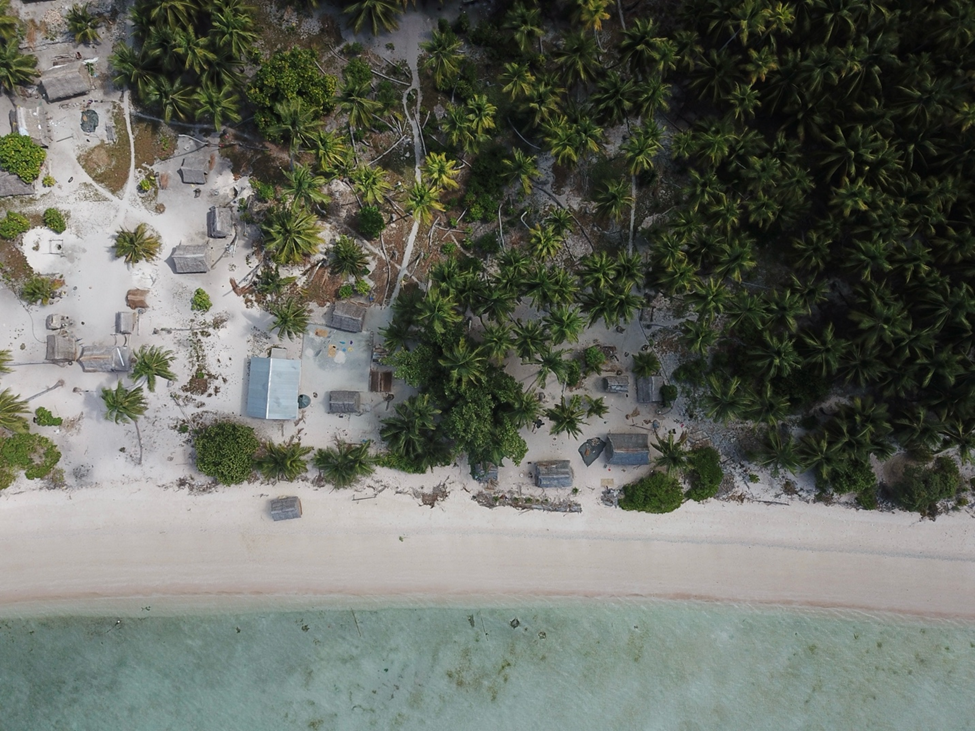
In Pacific Island Countries, blue foods play a central role in diets, culture, and livelihoods. Fishing remains a cornerstone of local economies, with most of the world’s tuna harvested from the Western Pacific. However, global trade patterns often redistribute seafood – and thus blue nutrients – away from where they are caught and toward high-income countries. When so much of the Pacific’s catch flows abroad via trade, what does that mean for blue nutrient retention within Pacific Island communities?
New Science on Blue Nutrient Flows
In a recent paper in Fish and Fisheries, researchers examined how Pacific Island Countries fit into the global seafood system, and how trade redistributes blue nutrients across borders. Using nutrient information and new high-resolution global datasets that track seafood production and trade by species, the researchers were able to trace how nutrients move through international supply chains in ways that weren’t feasible before.
The study found that Pacific Island Countries are major sources of blue nutrients, driven largely by tuna fisheries, but much of that value leaves the region. On average, Pacific Island Countries export about 54% of the total blue nutrient production from fisheries. These exports lead to substantial nutrient losses that may otherwise contribute to local diets. The study also showed that the trade network itself is fragmented and dominated by a handful of central countries. Within this system, Papua New Guinea and Fiji act as key hubs in the trade network, connecting Pacific nations to distant markets and influencing how blue nutrients circulate.
Balancing Trade & Local Nutrition Needs
This research offers a novel, data-driven look at how blue nutrients move through international trade, showing that seafood exchanges are not just about economics but also about nutrition and equity. By leveraging large global datasets, the study reveals both the dependencies and vulnerabilities that define the global seafood system.
For fisheries policy and management, the findings highlight the need to better integrate nutrition goals into fisheries governance and trade planning. For instance, strengthening local supply chains, designing equitable trade agreements to better serve producing countries, and prioritizing nutrition in blue food policies could help Pacific Island Countries capture more of the benefits from their own marine resources. Investing more in local coastal fisheries capacity could also enhance the nutrition these systems already provide. These efforts are increasingly recognized across the region and internationally, and this new science adds evidence to ongoing conversations about where change is most needed.
As the world becomes more interconnected, the challenge is clear: how to balance the economic opportunities of trade with the nutritional needs of communities. Getting that balance right will be key to building food systems that are not only sustainable and resilient but also fair and nourishing as blue foods play a growing role in feeding the world.
Connecting Research to Action
EDF is a joint secretariat of the Aquatic Blue Food Coalition, which brings together partners to champion aquatic foods for healthy diets, resilient livelihoods, and a changing climate. The coalition started with the UN Food Systems Summit to help unlock the potential of blue foods for food security, climate resilience, and biodiversity. Visit aquaticbluefood.org to explore the coalition’s work and see how blue foods can play a bigger role in shaping sustainable food systems.
By: Kristin Kleisner and Sarah Swain
The mesopelagic zone, one of the most important parts of the ocean’s most important climate-regulating system, is under threat just as we’re beginning to understand its true value. With IUCN members preparing to vote on Motion 035 this October, we have a narrow window to protect this climate-critical ecosystem before industrial exploitation of the mesopelagic zone begins. (more…)
By Tommy Clay and Gemma Carroll
Some of the ocean’s most charismatic species are among its most vulnerable. From sharks and whales to sea turtles and albatrosses, many species of ‘marine megafauna’ traverse vast distances, crossing ocean basins between feeding and breeding grounds. As they undertake these epic migrations, they play vital roles in ocean ecosystems—regulating food webs, recycling nutrients, and connecting distant habitats. (more…)
By: Kristin Kleisner, Marie Hubatova, and Karly Kelso
Recent geopolitical shifts and trade tensions have rocked the international community, and our vast oceans, far from being immune, are often on the front lines. (more…)
The 10th annual Our Ocean Conference (OOC) in Busan, South Korea is happening this week, and we are glad to join the conversation on several topics relevant to our work. This year, the conference is set to discuss “digital oceans,” taking a look at the use of technology in ocean spaces as a tool for supporting sustainability.
Here is a look at some highlights from EDF’s engagement at this year’s conference. (more…)