Climate change solutions
We deliver game-changing environmental solutions that have a real impact for people around the globe.
With Governor Abigail Spanberger’s signature on a budget agreement that directs the Commonwealth to immediately rejoin the Regional Greenhouse Gas Initiative (RGGI), Virginia is back on track with the climate policy the state needs. This budget agreement — which legislators call the “caboose” budget — doesn’t just cut pollution, it supports communities as they adapt to increased flood risk and creates a dedicated pathway to increase energy affordability for those who need it most.
A huge dose of gratitude goes out to the General Assembly and the Governor for recognizing that a cleaner grid and affordable bills go hand-in-hand. By re-entering this proven, multi-state program, Virginia is securing a healthier, more resilient and more affordable future.
Virginia’s journey with RGGI has been eventful. The General Assembly originally passed a law in 2020 requiring participation, and the Commonwealth successfully participated from 2021 to 2023. Unfortunately, the Youngkin administration unlawfully withdrew the state from the program in 2024. While a court ruled his unilateral repeal “unlawful and without effect” in November 2024, an ongoing appeal kept Virginia on the sidelines.
With Governor Spanberger’s signature, that uncertainty is over. Virginia is back in the game.
RGGI is a practical, market-based solution to climate pollution. Power plant owners are required to purchase an allowance for every ton of carbon dioxide their plant emits. Over time, the supply of these allowances decreases, which steadily drives down emissions across participating states. Beyond delivering cleaner air, RGGI actively reduces utility reliance on dirtier, more expensive fossil fuels. This transition leads to steadier, more predictable energy bills, greater energy independence and enhanced grid security.
When power plants purchase carbon allowances, the revenue generated flows directly back into participating states.
Here is how RGGI revenue is put to work in Virginia:
The Virginia Department of Environmental Quality has now been instructed to begin the necessary steps to rejoin RGGI immediately, a process that should conclude by the end of May. Rejoining RGGI is a victory for every Virginian who wants cleaner air, lower utility bills and neighborhoods that are protected from the impacts of climate change. Thank you, Governor Spanberger, Delegates and Senators, for prioritizing Virginians and climate over polluters.
(This post was co-authored by EDF technical analyst Grace Hauser)
The Trump administration has rolled back the 2024 Mercury and Air Toxics Standards.
Those standards guard against mercury, arsenic, lead and other dangerous pollution from coal-fired power plants – pollution that causes brain damage in babies, cancer, and serious heart and lung diseases.
But at Environmental Defense Fund, we just did an analysis of 2025 coal plant mercury data that shows a clear need for stronger protections — not their abandonment.
That new data is included in our map of the top 30 mercury-polluting power plants, which you can see below:
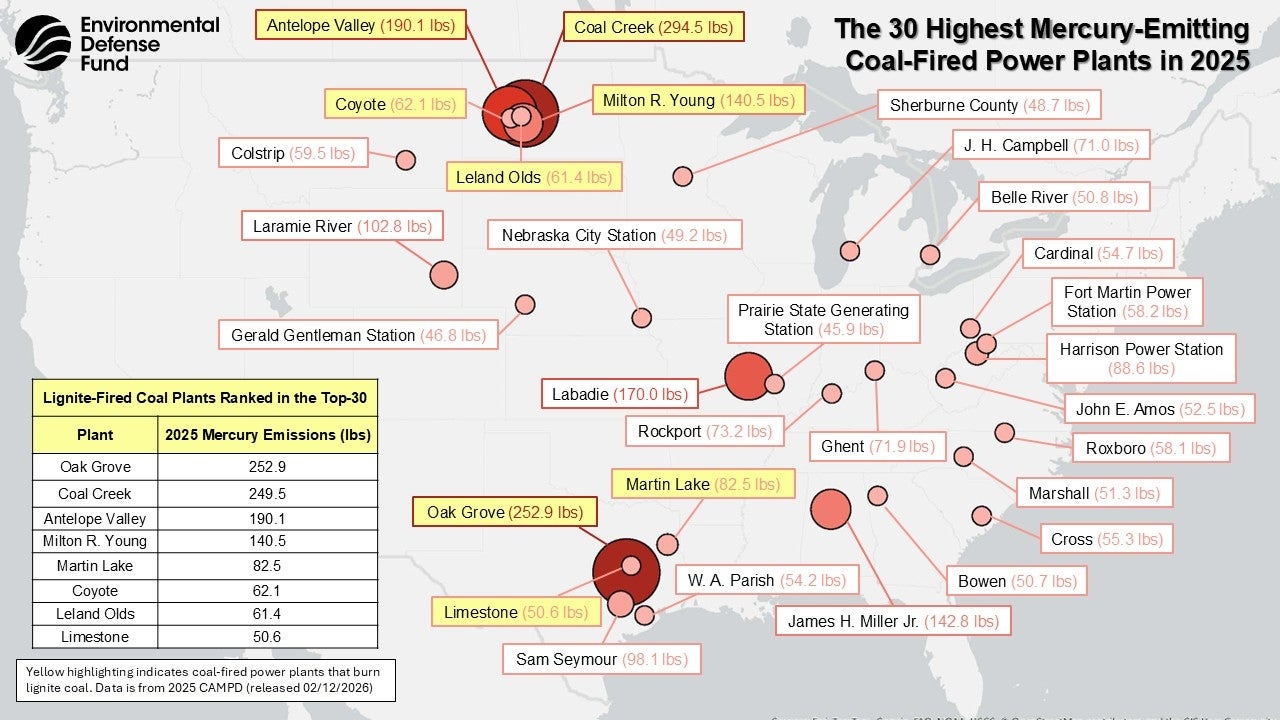
Our updated map shows significant mercury emissions concentrated near a small set of high-emitting facilities in North Dakota and Texas, many of which burn lignite coal.
Lignite coal is an especially dirty power source. It contains higher levels of mercury and other toxics than other types of coal, and more lignite coal must be burned to generate power compared to other types of coal, which then produces even more emissions.
Before the 2024 Mercury and Air Toxics Standards, lignite coal plants were allowed to release more than three times as much mercury as other coal plants. The 2024 Mercury and Air Toxics Standards closed this loophole, and required lignite plants to meet the same mercury pollution standard that all other coal plants have been subject to since 2012. Now, with the Trump EPA’s repeal, the lignite loophole is reopened.
Here’s more highlights from our updated analysis:
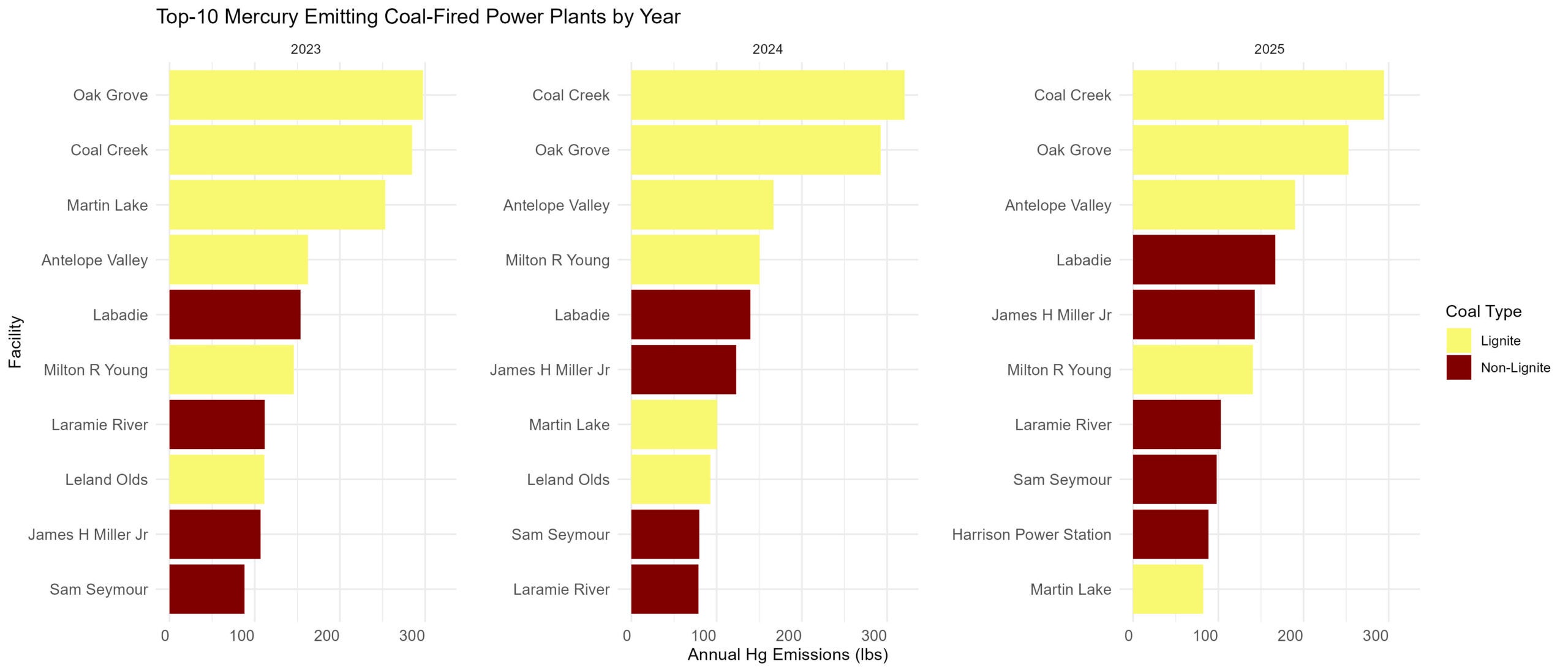
Our analysis finds that, while only eight of the 30 most-polluting plants burned lignite coal in 2025, those plants are heavily concentrated at the very top of the list – all three of the nation’s highest mercury emitters are lignite-fired (see the graphic below).
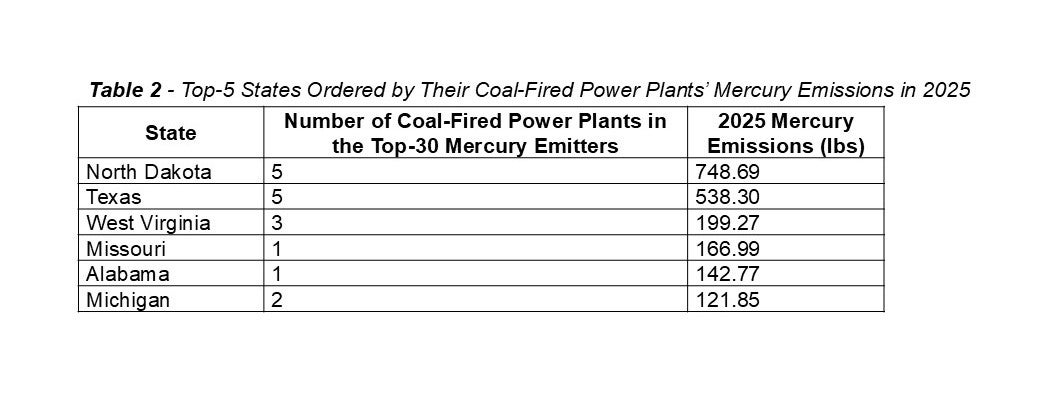
Texas and North Dakota contain the most extensive lignite deposits in the U.S. – and our analysis finds that those two states have the highest coal plant mercury emissions (see the chart below)
Some of the most striking increases in mercury pollution in 2025 were seen in coal-fired power plants that previously did not make the top 30 list.
The Roxboro plant in North Carolina shows how increased operation of fossil generation can drive pollution. From January 2023 through November 2025, Roxboro increased its generation by roughly 50% and its mercury emissions rose by 192.8% (from 2023 Form EIA-923 and 2025 Form EIA-923 November 2025, Page 4 Generator Data).
That caused it to jump from the 75th-highest mercury emitting coal plant to the 19th.
Several coal-fired power plants reduced their mercury emissions from 2023 to 2025, but much of this decline reflects reduced coal use and lower electricity generation during that period rather than cleaner operations.
For example, the Martin Lake plant reduced its mercury emissions by roughly 67% (see the chart above) but its electricity generation fell by 30% due to one of its units being offline for the entirety of 2025 (from 2025 Form EIA-923 November 2025, Page 4 Generator Data).
In addition to closing the lignite loophole, EDF has long advocated for strengthening the Mercury and Air Toxics Standards for non-lignite coal plants.
One example of why is the non-lignite Harrison plant (see the chart above). It increased its mercury emissions by approximately 30% since 2023, which contributed to West Virginia’s status as the state with the third-highest coal plant mercury emissions in 2025
Cost reasonable and technologically feasible control solutions are also readily available for these plants.
You can explore the full data set on 2025 mercury emissions here. And read more about the Trump EPA’s rollback of the 2024 Mercury and Air Toxics Standards here.
(This post was co-authored by EDF technical analyst Grace Hauser)
The Trump administration just finalized its repeal of the 2024 Mercury and Air Toxics Standards – a suite of lifesaving protections against highly dangerous air pollution from coal-fired power plants.
That action cancels stronger safeguards against pollution from lignite-fired coal plants, which are among the highest emitters of mercury pollution in the U.S.
It also rolls back protections against other toxic pollutants like arsenic and lead from all coal plants, and reverses a requirement that coal plants use modern monitoring technologies to continuously monitor their toxic pollution.
EDF will go to court to defend the 2024 Mercury and Air Toxics Standards. We will continue fighting to advance cleaner, healthier air for all Americans.
Here are eight things you should know:
At Environmental Defense Fund, we recently updated our map of the top 30 mercury-polluting power plants to include 2025 emissions data. (You can see the updated map above.) It shows significant mercury emissions concentrated near a small set of high-emitting facilities in North Dakota and Texas, many of which burn lignite coal.
You can see the top 10 emitters from 2023 to 2025 in the chart below:
This is especially concerning because EPA’s own final rule analysis predicts that lignite coal use will increase by 10.5% per year by 2035 as a direct result of its repeal of the 2024 Mercury and Air Toxics Standards.
EPA’s projection for all mercury emissions is even more alarming – a 23% increase by 2030, which means up to 1,500 additional pounds of pollution per year. That’s pollution that EPA admits will increase deposits of mercury in our ecosystems and lead to the accumulation of methylmercury in fish.
(Read more findings from our updated map and analysis here)
The Mercury and Air Toxics Standards guard against mercury, arsenic, nickel and other pollutants that can cause brain damage in babies, cancer, and serious heart and lung diseases.
In its rollback, the Trump EPA claims it cannot put a dollar value any of the rule’s health harms.
That’s a stark departure from EPA’s decades-long practice of estimating the health impacts of its rules. And it’s a sudden reversal from the Trump EPA’s own proposal for the rollback — which monetized the lost benefits of reducing just some of the pollutants affected by the rule at $340 million.
The Trump EPA announced in its final rule that it will no longer calculate the monetary value of the lives saved and illnesses avoided from reducing fine particulate matter and ozone. The agency conducted the air quality modeling and health impact analysis, but then chose not to present it or rely on its resulting dollar values, citing newly-claimed “uncertainties” that did not prevent them from monetizing these same impacts just months earlier. The Trump EPA also failed to consider the cost of health harms from mercury pollution itself.
By continuing to quantify compliance costs for industry while refusing to quantify health costs the Trump EPA has skewed the cost-benefit analysis in favor of eliminating safeguards for our health.
Unlike the Trump EPA, independent researchers have estimated the cost of health harms from mercury pollution.
A 2025 analysis by Harvard University estimated the health costs of repealing the 2024 mercury standard would be $200 million per year – more than two-and-a-half times the Trump EPA’s own estimated savings from the entirerepeal.
The costs are due to reductions in children’s IQ levels and to premature deaths from heart and lung disease, both of which are caused by an increase in mercury pollution. These harms fall most heavily on subsistence fishers and their children, whom EPA previously found are more likely to be racial minorities and low-income families who would most benefit from reducing mercury in fish.
Lignite coal is one of the dirtiest types of coal to burn. It contains higher levels of mercury and other toxics than other types of coal, and more lignite coal must be burned to generate power compared to other types of coal, which then produces even more emissions.
Before the 2024 Mercury and Air Toxics Standards, lignite coal plants were allowed to release more than three times as much mercury as other coal plants. Some coal plants took advantage of this loophole, burning a small amount of lignite coal and claiming to be subject entirely to the lax standards.
The 2024 Mercury and Air Toxics Standards closed this loophole, and required lignite plants to meet the same mercury pollution standard that all other coal plants have been subject to since 2012.
The 2024 Mercury and Air Toxics Standards required continuous emissions monitoring systems for coal plants — modern technology that provides real-time data about emissions — to ensure compliance with limits for toxic pollutants.
Under the Trump EPA’s repeal, coal plants will be allowed to conduct short monitoring tests much more infrequently – four times a year, for some, or as infrequently as once every three years.
In other words, the Trump EPA is charting the way for these large emitters of arsenic, lead and similar toxic metals to obscure their pollution levels almost every day of the year instead of requiring transparent continuous monitoring of their toxic pollution based on accessible, widely available technologies.
In 2024, EPA found that power plants that burn lignite coal could lower their mercury emissions to the levels allowed for all other coal plants just by using more of the same chemical additives they already use to control mercury pollution.
The agency also found that coal plants can readily meet stronger limits for nickel, arsenic, lead and other toxic pollution by using widely-available controls that many coal plant owners have already installed. In fact, they found that 93% of the U.S. coal fleet is already meeting the more protective 2024 Mercury and Air Toxics Standards, and most of the other 7% can meet the standards through relatively simple upgrades.
EPA also found that the continuous monitoring systems needed to meet the 2024 Mercury and Air Toxics Standards are in widespread use and are only marginally more costly than the previous antiquated requirements. One-third of the U.S. coal fleet is already using continuous emissions monitoring systems.
Recent analysis of 2025 energy sector trends shows that, for the first time in years, U.S. coal generation is increasing. This trend isoccurring simultaneously with increased data center power demand (and concern that consumers will end up paying the tab for it).
Pollution standards based on modern control technologies are more important than ever considering this reality.
Notably, the Trump EPA’s own modeling for its final repeal of the 2024 Mercury and Air Toxics Standards shows that the repeal has zero impact on coal plant retirements, total capacity, electricity generation mix, and retail electricity prices — undermining the administration’s claim that the repeal is needed for grid reliability and energy security. In fact, EPA projects 36 gigawatts of coal plant retirements by 2035 regardless of whether the 2024 Mercury and Air Toxics Standards are in place.
Repealing the standards is another in a long line of Trump administration giveaways for the coal industry.
They include newly-announced subsidies to the coal industry, a wasteful deal with the Department of Defense to procure electricity from burning coal, and grants of “pollution passes” – two-year exemptions from having to comply with national pollution standards – to 71 coal plants around the country after EPA invited the plant owners to request an exemption via email. Newly-released EDF analysis of the requests shows that exemptions were far broader than what coal plants requested. (EDF is one of a dozen groups suing over those unlawful exemptions.)
President Trump has also issued a series of emergency orders forcing aging, costly and unreliable coal plants to stay open long after they had planned to retire – and passing the costs along to families and businesses. The ratepayer cost for just one of those plants, the J.H. Campbell power plant in Michigan, is over $600,000 each day – a cost that will be passed on to American families as higher power bills.
The Trump EPA’s attack on the Mercury and Air Toxics Standards won’t do anything to bring those bills down – but it will expose Americans to more toxic air pollution and increased health costs. EDF is determined to defend these vital public health safeguards.
It’s becoming all too common for families and businesses to experience the symptoms of a strained electricity grid—whether it’s rising bills or more frequent power outages. Between growing demand, aging infrastructure and extreme weather, the U.S. grid is under immense pressure. For Western states, the challenge is especially pronounced: during peak hours of electricity demand, up to 70% of states’ power is imported from neighboring states’ utilities. Decision makers across the region are looking for guidance as they plan for the next generation of the grid.
Transmission lines deliver electricity from where it’s generated to homes, businesses and schools. Building and improving the transmission system is the key to ensuring the lights stay on and utility bills remain affordable. Since new transmission lines can take several years to come online, utilizing existing grid infrastructure more effectively can lead to solutions in the near term. Utilities in Western states typically use , which means there is significant capacity for serving new load and integrating new generation quickly and affordably. To ease costs and keep the grid reliable, we need to build new transmission lines and make the most of existing infrastructure.
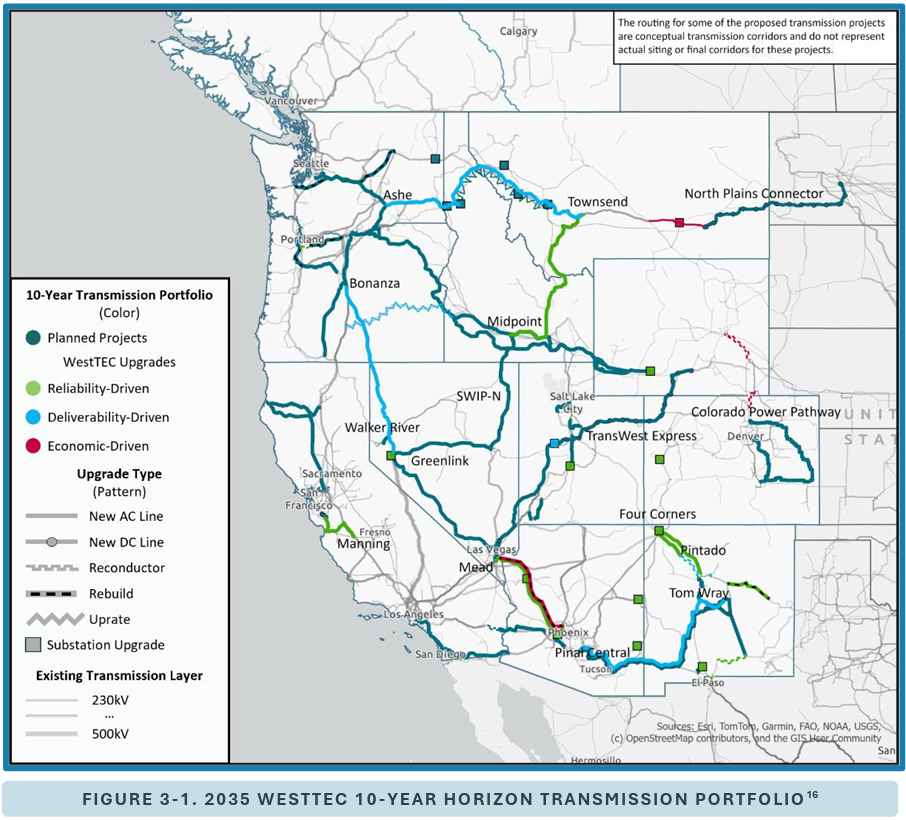
A coalition of utilities, developers, states and Tribes recently published a roadmap for planning a more reliable and affordable grid throughout the West. The Western Transmission Expansion Coalition (WestTEC)’s 10-Year Horizon report offers important insights for decision makers, providing clear guidance for states and transmission developers navigating landscape marked by rapidly growing demand and shifting priorities. This coalition’s findings should spur action to ensure continued access to affordable and readily available electricity. Otherwise, families and businesses will foot the bill for an ever-growing demand for electricity.
There are four primary reasons why proactive planning is so necessary to maintaining a reliable, affordable electrical grid:
Importantly, as demand shifts and generation capacity grows, the infrastructure for getting power where it needs to go—transmission—isn’t keeping pace.
Taken together, these pose major challenges for state decision makers and make clear the need for coordination across states for transmission planning.
WestTEC was launched in 2023 to address this need for long-range transmission planning. Facilitated by the Western Power Pool—a group of electric utilities in the Western United States and Canada that share resources—the coalition is charged with supporting the Western Interconnection, the power grid that spans much of the Western U.S. and parts of Canada and Mexico.
WestTEC’s new report is a key component of the effort to increase transparency and coordination in transmission planning. It details the reasons for proactive planning and dives deeper into the transformative forces reshaping the grid. It also identifies projects that will help the West meet demand growth, seamlessly integrate new generation, and increase reliability. The report identifies 12,650 total line miles of upgrades needed to meet the region’s forecasted needs. Around 9,400 miles worth of projects are already planned, with close to one fifth of these under or nearing construction. That leaves around 3,300 line miles of identified upgrades that still need to be developed to address reliability, deliverability, and efficiency goals across the region.
Building this technology comes with a price tag—roughly $5.3 billion per year. Though that number seems steep, it’s actually just a fraction of the total spending on Western electricity, which was nearly $120 billion in 2024. In fact, it’s only about 2.5% of today’s average retail electricity price. Importantly, transmission has front-loaded costs that are repaid over time. A recent report from Americans for a Clean Energy Grid estimates that, for every $1 invested in transmission, customers see up to $4.70 in benefits. In other words, these transmission upgrades have the potential to translate into massive future savings for families and businesses without breaking the bank today.
Stronger transmission networks can ensure states reap the full benefits of forthcoming Western electricity markets. A more interconnected grid helps utilities manage stressors like extreme heat. When local conditions tighten and electricity is constrained, states can share resources to ensure reliable electric service. A more coordinated and connected transmission grid also produces significant economic benefits. The Western Energy Imbalance Market allows participants to buy and sell power in real-time. Since 2014, the market has resulted in over $7.4 billion in total market benefits. Coordinated transmission planning and development create the conditions for a mature, fully regional electricity market that benefits every participating state.
The forces pressuring the grid will only grow more complex, but the collaborative solutions offered by WestTEC give decision makers the knowledge and tools to tackle the challenge. The coalition is also producing a 20-Year Horizon Report that looks at planning scenarios into 2045, which will address uncertainty, help understand how transmission needs change over time and allow for evaluation and right-sizing of the 10-year horizon upgrades. The 20-year report will also forecast the benefits of key transmission portfolios, which can help decision-makers better argue for and defend the recommended upgrades.
As developers and states start taking steps to implement WestTEC’s recommendations, engaging communities from the beginning of the process can ensure better outcomes for all. A recent EDF report found that early engagement with communities and Tribes helped reduce opposition to transmission projects, avoid costly delays and deliver lasting value for both developers and communities. A more resilient, interconnected grid is a more reliable, affordable grid—and one that offers clear benefits for the West.
Developers and states should rely on the guidance offered by the WestTEC report to start pursuing recommended upgrades, communicate costs and benefits to customers and engage in a collaborative development process that involves communities at each stage.
California surpassed 2.5 million zero-emission vehicles years ahead of schedule. Nearly $12 billion in private-sector electric vehicle investments have been announced. EVs can now power homes during outages. Fleets can slash fuel costs by more than 60%. Many communities near ports breathe cleaner air. These aren’t projections – they’re results already delivering across California.
State leadership and targeted investments made this progress possible. As lawmakers finalize the budget amid federal attacks on California’s clean vehicle authority, the state’s clean transportation budget stands out as one of the most powerful tools to protect public health, lower costs, expand consumer choice and sustain economic momentum.
Environmental Defense Fund applauds the Governor’s proposed $200 million light-duty vehicle incentive and urges the Legislature to commit at least $1.5 billion to fund the full spectrum of clean vehicles and infrastructure (see our fact sheet for more recommendations).
After housing, a car is the second-largest household expense, and purchase prices remain a real barrier for families who want to choose cleaner vehicles. Incentive programs like Gov. Newsom’s proposed new light-duty incentive and Clean Cars 4 All help remove that barrier – especially for low- and moderate-income households replacing older, high-polluting cars with options that fit their budgets. Funding these programs in the final state budget is essential to keep clean transportation within reach for California families.
Once on the road, the savings continue. EV owners in California can save up to $1,500 in fuel and maintenance over a passenger vehicle’s lifetime, while heavy-duty truck operators can save up to tens of thousands of dollars per vehicle. With volatile fuel prices and rising living costs, those savings matter now. These state incentives for buyers deliver immediate relief at the point of sale and long-term affordability every month after.
Electric vehicles do more than move people. Bidirectional charging turns EVs into mobile batteries that charge from the grid and supply power back to homes during outages. One Santa Cruz-area family already powers their entire home with their electric pickup truck during frequent mountain blackouts.
They’re not alone. Across California, EV owners are running refrigerators, lights, phones and medical equipment when the grid fails. By 2045, this distributed battery network could deliver over $10 billion annually in grid savings by cutting peak demand, avoiding costly upgrades and lowering rates for all customers.
Despite significant progress, transportation remains California’s largest source of smog and climate pollution, with communities near ports, warehouses and truck routes bearing the heaviest health burden for decades. Clean truck investments are beginning to change that reality.
At the Ports of Los Angeles and Long Beach, electric drayage trucks are replacing diesel vehicles that operate all day in nearby neighborhoods. California-based companies like Tradelink Transport are deploying zero-emission trucks that eliminate tailpipe pollution while dramatically lowering operating costs.
Replacing heavy-duty diesel vehicles could deliver up to $5.6 billion in statewide health and environmental benefits while modernizing California’s goods-movement system. Demand for the Clean Truck and Bus Voucher Incentive Project consistently exceeds available funding – clear evidence that fleets are ready to electrify when incentives exist. The Legislature should continue funding this essential cost-saving and public health program.
In Humboldt County, McKinleyville Union School District used California Climate Investments to purchase four zero-emission school buses, cutting fuel and maintenance costs by 60% while improving air quality for 250 students. In rural communities, the Funding Agricultural Replacement Measures for Emission Reductions (FARMER) program helps growers replace diesel equipment with cleaner alternatives, reducing both air pollution and fuel costs.
Yet despite its success, the current state budget left FARMER without funding – ignoring an urgent need among California’s agricultural communities that must be addressed this year.
Major corporations also see the value. In 2024, PepsiCo announced a major expansion of its California electric fleet, including 50 Class 8 Tesla Semi trucks and 75 Ford E-Transit vans to cut costs and carbon dioxide (CO₂) emissions. By energizing 20 trucks ahead of schedule, the company estimates it will avoid roughly 8,000 tons of CO₂ and save about $1 million in fuel costs. These projects support jobs across manufacturing, construction, utilities and technology – and they depend on stable, multi-year state investment to scale.
Federal rollbacks of national standards and the loss of key tax credits have rattled the ZEV market, triggering clean energy investment cancellations nationwide that wiped out 39,000 jobs and $29 billion in 2025, according to EDF analysis. California’s state transportation budget remains one of the Legislature’s most reliable tools to preserve momentum, protect affordability and deliver results. The Legislature should seize this opportunity.
These ZEV buyer incentives accelerate adoption now to lock in long-term savings, cleaner air, consumer choice and economic benefits for decades. Meanwhile, EV costs continue to fall rapidly across multiple segments. Passenger electric vehicles are nearing upfront price parity with gasoline models – and in some cases, they’re already cheaper.
California’s clean transportation investments are working – at homes, ports, schools, farms and businesses statewide. The question is whether California’s leaders will continue building on what’s already succeeding. The evidence from communities across California is clear: continued investment delivers real returns. Now is the time to double down.
Results were released today for the February 18 auction for the joint California–Quebec Cap-and-Invest market, the first of the year and the first since the California Air Resources Board (CARB) published its initial plans for updating this cornerstone climate program.
Today’s allowance prices, detailed below, signal lackluster demand and suggest there is ample room in the emissions market to tighten the cap in order to maximize program benefits for the achievement of California’s climate emissions reduction targets, cost of living and the state’s economy. With almost 88% of the allowances in this auction bought by compliance entities, it’s clear that the low prices are not just the result of financial interests’ speculation — there is real opportunity for tightening these allowance budgets and reducing emissions in the near-term. Modestly improving market confidence is important given that recent uncertainty leading up to last year’s program reauthorization through 2045 cost the state roughly $3 billion.
California’s Cap-and-Invest program serves as the state’s emissions backstop: a foundational policy to cap and reduce climate pollution, while generating critical revenue to invest in energy affordability, climate resilience, infrastructure, and more. And, California’s suite of climate policies produced one of the largest annual emissions reduction while California’s economy continues to grow. The latest data from CARB shows statewide greenhouse gas emissions fell another 3% in the most recent inventory — equivalent to taking more than 2.6 million gas-powered cars off the road for a year. Cap-and-Invest is a key part of that success. But there’s still more that California needs to do in order to make sure this program is really delivering reductions at the pace and scale required to meet its climate targets while also addressing household energy affordability.
With the formal rulemaking process now in motion, CARB has a pivotal chance to set the cap-and-invest program’s ambition at a level that truly meets this moment — both for cutting emissions and delivering tangible benefits to communities across California. EDF supports the adoption of a stronger emissions cap and stronger reductions in the cap compared to what CARB proposed in the Initial Statement of Reasons (ISOR).
The allowance budget reductions outlined in the agency’s proposal reflect only the minimum needed to align with the 2030 emissions reduction targets, well below the stronger pathway CARB previously presented. The proposal would remove about 118 million allowances from 2027-2030 and set a post-2030 pathway to an 85% emission reduction by 2045. While this represents progress compared to the existing cap trajectory, deeper reductions before 2030 are essential to ensure the program drives near-term emissions cuts and maximizes benefits for households and communities across California.
Preliminary modeling conducted by Greenline Insights for EDF shows CARB could reduce emissions at a faster pace while maintaining cumulative cost savings for low- and moderate- income households.
With a growing list of states considering policies like California’s and seeking to join the state’s emissions market, the stakes could not be higher. California pioneered this policy and must show that it works. The relatively weak demand for allowances seen in today’s auction results — selling out current vintages, but at the price floor — illustrates a tighter cap and faster rate of emissions reduction are the most logical path forward to meet the affordability needs of households across California and the urgency for climate action at scale.