Climate change solutions
We deliver game-changing environmental solutions that have a real impact for people around the globe.
Results were released today for the third auction of the year, and 15th overall, in Washington’s Cap-and-Invest program. The auction, conducted last week, is the first following the signing of a joint linkage agreement between California, Washington and Québec on June 25th of this year — a major milestone in the process of expanding the largest economy-wide carbon market in North America.
Washington’s Cap-and-Invest auctions are administered quarterly by the Department of Ecology. During the auction, participating entities submitted their bids for allowances.
Under the Climate Commitment Act — Washington’s landmark climate law that sets a binding, declining limit on pollution — major emitters in Washington are required to hold one allowance for every ton of climate pollution they emit, with the total number of allowances decreasing each year.
This system requires Washington’s polluters to reduce their emissions in line with the state’s climate targets, as fewer allowances become available annually.
Today’s results settled near the midpoint between the price floor and the APCR Tier 1 trigger price. They’re the latest in a line of data points reflecting a cooling trend in the Washington market, consistent with the state’s progress toward linking its market with the joint California-Québec market.
Prices have been trending lower over the last few auctions as Washington’s Department of Ecology has taken steps like launching a formal linkage rulemaking, and releasing a draft linkage agreement between the three jurisdictions. But today’s dramatically lower prices may reflect further growing confidence in a future linked market following the signing of an official joint linkage agreement between California, Washington, and Québec on June 25 of this year. The critical step taken by leaders in all three jurisdictions when they signed the linkage agreement may be reassuring Washington entities that they will soon be part of a broader linked market with lower and more stable prices. Linkage is projected by multiple economic models to lead to lower compliance costs for Washington entities.
Once each jurisdiction’s linkage process is finalized, Washington covered entities will have access to a much larger pool of allowances from a joint market with California and Québec, with a goal of achieving operational linkage by 2027.
California and Québec have shared a linked market for over a decade, demonstrating that well-designed cap-and-invest programs can lead to deeper pollution cuts while supporting economic growth.
Linking these three markets together would bring about significant advantages for all participants, including:
Linkage is a crucial opportunity for climate leadership for Washington, California and Québec, to take a step that will strengthen one of our best and most cost-effective tools to reduce emissions and raise revenue for community investments. Washington has now concluded its formal rulemaking on linkage, with the rule expected to be finalized this month. We expect to see similar steps taken by Québec and California in the coming months.
The need for scalable, durable climate action at the state level has never been greater, and these jurisdictions are showing how working across borders can drive meaningful progress.
Big challenges are solved through engagement and partnership. As the federal government has retreated on climate in devastating ways, California’s leaders understand that working together beats going it alone.
State-level policy has become more essential than ever, especially policies that are scalable and replicable, so states can adopt proven solutions and work together to cut emissions and deliver real investments to communities.
California and Québec have worked together for over ten years to cut emissions through a linked carbon market, and their partnership is poised to add the state of Washington. This framework is a model for how subnational action can play a vital role in tackling climate change while Washington, D.C. fails to lead.
Cap-and-Invest puts a binding, declining limit — a “cap” — on climate pollution, requires polluters to pay for the emissions they create under that limit and then reinvests the revenue into things communities need, like utility bill rebates, household electrification incentives, clean energy infrastructure, ecosystem restoration and so much more.
Similar programs in other jurisdictions can be linked with California’s. When multiple jurisdictions link their carbon markets, they unlock lower-cost emissions reductions, more stable prices, and greater climate impact than any one of them could achieve alone.
California has shown economies can grow alongside ambitious climate goals. Between 2000 to 2022, state emissions fell 20% while gross domestic product grew 78%. It has had a Cap-and-Invest program in place since 2012, generating more than $36 billion in revenue for climate action, and it’s been linked with a similar program in Québec since 2014.
The state of Washington passed their own Cap-and-Invest program in 2023, which has already generated over $3 billion for climate and community investments across the state. It was also designed from the beginning to one day be linked with California and Québec. New modeling shows that expanding the California-Québec market to include Washington would deliver deeper regional emissions cuts while protecting affordability and keeping compliance costs stable for covered businesses.
In June of this year, California, Quebéc and Washington signed a joint linkage agreement, laying out how the three jurisdictions will hold joint allowance auctions, share a common allowance price and let market participants trade allowances across jurisdictions.
Since Washington’s steps towards linkage are complete, the ball is now in California’s court. So, let’s focus on the rationale new modeling provides for why the Golden State should be moving forward on its own processes to make linkage a reality.
Modeling shows that through 2045 a linked market will:
This new modeling reinforces what we’ve always known: a larger market leads to greater efficiencies, unlocking access to lowest-cost emissions abatement technologies and empowering leaders to be more ambitious on climate while protecting affordability benefits for households.
Washington state expects to finalize its rulemaking this month. In order to make its carbon market operationally ready for linkage, Governor Newsom must make the Senate Bill 1018 findings — certifying that Washington state meets requirements for linkage — and the California Air Resources Board must complete its own rulemaking so California’s market can formally accept allowances from Washington entities.
As Governor Newsom enters the final stretch of his time in office, this is a chance to cement his legacy of climate leadership beyond the state’s borders.
Results were released today for the year’s third auction of the California-Québec carbon market, known as the Western Climate Initiative.
Today’s results, which come from the first auction since the California Air Resources Board finalized updates to the Cap-and-Invest program in May, reflect somewhat increased market confidence. The slightly higher settlement price seen today may indicate a positive response to the greater regulatory certainty provided by the finalization of these rules, even as debate in the Legislature continues over specific elements of the package.
Stronger prices are also good news for Greenhouse Gas Reduction Fund revenue. The past year-plus of soft demand, with auctions repeatedly settling at or near the price floor, has cost the state billions of dollars in revenue that would otherwise flow to critical investments in communities, household bill rebates, climate resilience programs, electrification incentives and more.
As California looks forward, it has another key opportunity to strengthen its impact in delivering greenhouse gas reductions and to re-establish California as a leader on impactful, economically efficient climate policy. For the past few years, California, Washington and Québec have been assessing and working toward linking their carbon markets into a tri-jurisdictional program. Linkage would create one joint program and marketplace in which covered entities in any of the linked jurisdictions can buy or trade emissions allowances.
Since the May auction, California, Québec and Washington took the important step of signing a joint linkage agreement, a major milestone in the process of operationalizing the largest subnational carbon market in the world. By joining forces across state and province lines, these three jurisdictions can create a larger, more stable and more efficient market which is projected to deliver greater regional emissions cuts compared to an unlinked market.
Washington’s linkage rulemaking process is expected to wrap up in September of this year, and California must take similar regulatory steps to make California’s market operationally ready to link with Washington. Governor Newsom must make the “SB 1018 findings”, essentially certifying that the state meets necessary requirements for linkage, and the California Air Resources Board must then undertake their own rulemaking process so that California’s market can formally accept allowances from Washington entities.
As Governor Newsom nears the end of his final term in California, making these findings and directing the California Air Resources Board to swiftly take up the linkage rulemaking is his opportunity to underscore his legacy as a Governor who not only champions climate policy, but has the leadership to strengthen the state’s landmark program and scale it beyond California’s borders.
States across the Northeast and Mid-Atlantic are working to update their rules for the Regional Greenhouse Gas Initiative, implementing agreed-upon changes that will strengthen the pollution reduction and investment benefits of the program while ensuring it remains durable for years to come. New York just became the latest state to finalize its revised rule, joining Maryland, Rhode Island and Vermont. Other participating states are working through the regulatory revision process and expected to follow suit this fall. RGGI has been delivering cuts in climate pollution for nearly 20 years, investing billions in clean, affordable energy, and delivering major public health benefits at the same time.
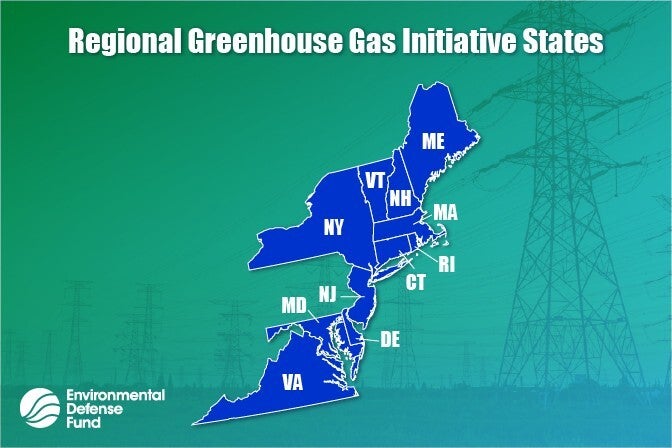
Launched in 2009, RGGI caps power sector emissions across 11 states in the Northeast and Mid-Atlantic and requires power plants to purchase allowances for every ton of pollution they emit. Proceeds from the sale of allowances are re-invested by states in programs to scale clean, affordable energy, help residents and businesses make energy efficiency upgrades, and provide direct credits on electricity bills. These investments have lowered electricity bills, improved public health and supported local economies since the program’s inception.
Since its launch in 2009, this longstanding, proven example of collaborative climate policy has helped cut climate pollution from power plants across the region in half compared with 2005 levels and generated $8.6 billion in auction proceeds as of 2024. Participating states have already invested $5.73 billion as of 2024, with another $2.54 billion committed for future investment. Over their lifetimes, these investments are projected to save ratepayers more than $23 billion on their energy bills, about $4 in bill savings for every $1 invested. In its first six years alone, RGGI supported 48,000 job-years and yielded over $5.7 billion in public health benefits, including fewer heart attacks, mitigated respiratory illnesses, and fewer premature deaths.
This proven program – the very first market-based system designed to reduce climate pollution in the U.S. – underscores the effectiveness of cap-and-invest policies that require polluters to pay for their pollution and reinvest revenue in programs that lower energy bills.
Every so often, RGGI states work together to review and revise the rules for the program to ensure it is effectively and efficiently delivering on its goals. Last summer, participating states concluded their Third Program Review and announced updates that strengthen the regional cap on climate pollution, beginning in 2027. Changes also introduce new measures to protect energy affordability and reaffirm the program’s commitment to cutting pollution, promoting clean energy and supporting local communities. The conclusion of the program review means that participating states agreed on a new “model rule” that incorporates these changes.
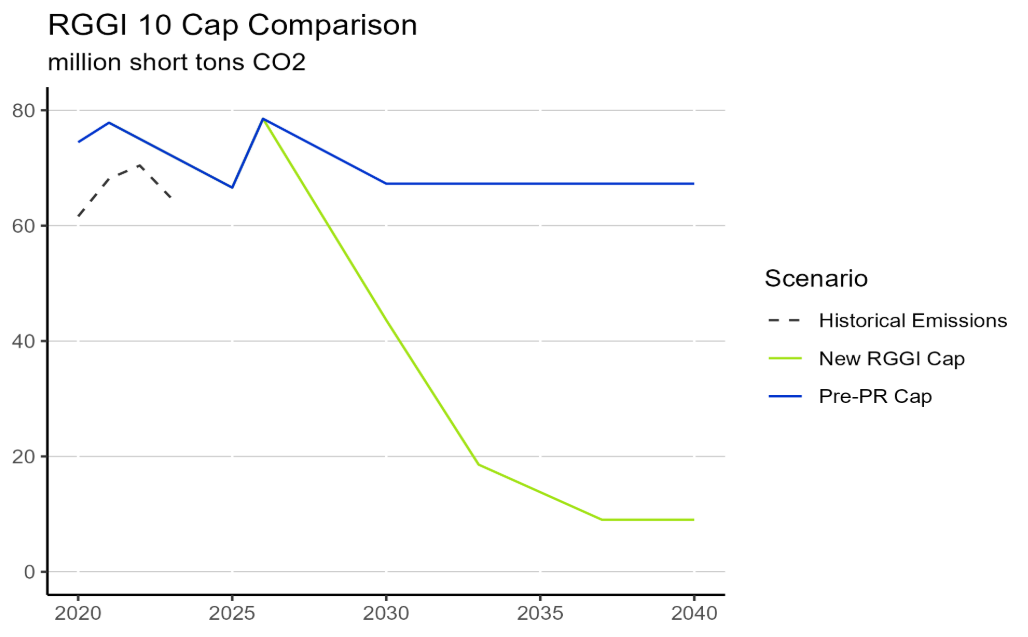
Importantly, under the new model rule, the emissions cap declines by about 8.5 million tons per year from 2027 through 2033 — or about 10.5% of the 2025 cap. After 2033, the cap declines by about 2.4 million tons per year, or 3% of the 2025 budget. The updated cap reflects a 76% reduction in power sector carbon emissions from 2005 levels by 2030, bringing RGGI more closely into line with the emissions pathway in the power sector needed to meet the climate goals that many climate leadership states have committed to.
With the new model rule in hand, each participating state must go through its own administrative process to update its RGGI regulation. This process looks a bit different in each state, but it commonly involves an opportunity for the public and interested stakeholders to review and comment on the revised regulations.
All participating states are working towards finalizing their updated rules by the end of this year, enabling the program changes including the updated pollution cap to go into effect January 1, 2027.
New York has long been a leader in the RGGI program and is taking up the mantle once again. The state became the latest – and the largest – in the region to finalize its updated regulation earlier this month. These changes, alongside updates in other states once final, will ensure the health and bill-lowering benefits of RGGI reach even more New Yorkers in the years to come. The announcement from state agencies emphasized proven benefits of RGGI including pollution cuts and net savings of $12 billion for New York ratepayers, a six-to-one return on $2 billion in investments to date.
DEC Commissioner Amanda Lefton said, “RGGI is a longstanding and successful example of multi-state collaboration that delivers real benefits to New Yorkers, including affordability, decreased emissions and improved public health. Implementing these regulations as part of the program review with the rest of the RGGI participating states, will further enhance New York’s ability to deliver clean and affordable energy solutions and healthy communities.”
NYSERDA President and CEO Doreen M. Harris said, “Strengthening RGGI reinforces New York’s leadership in lowering emissions while generating resources that help make clean energy more affordable and accessible for New Yorkers. Through these investments, NYSERDA is expanding access to clean transportation options, more efficient and comfortable homes and buildings, and job opportunities across the state – delivering benefits to communities from Long Island to Buffalo.”
A stronger and more durable RGGI program in New York will provide critical investments to programs that lower energy costs for residents. Examples of programs funded by RGGI to date that will be scaled as a result of these updates include:
The remaining RGGI states are all on the path to updating their rules by the end of this year – working at the agency level to update their rules and review public comments. And, they all stand to gain by following through with updates to their rules on time. Here are just a few examples of the ways RGGI is benefiting communities, the environment, and the economy in other participating states:
New York and other leading states have demonstrated what timely implementation can look like. The remaining RGGI states should move expeditiously to finalize their rulemaking so the strengthened program can begin delivering even greater pollution reductions, energy savings, public health benefits and investments in local communities in 2027. With a proven track record already behind it, strengthening RGGI will allow participating states to build on their progress and ensure residents across the region continue to share the program’s benefits.
As leaders gather for Climate Week NYC, progress on methane, groundwater and wildfire preparedness shows how international cooperation can strengthen — rather than replace — local action.
By Angela Churie Kallhauge, Executive Vice President, Impact, Environmental Defense Fund
As global leaders arrive in New York for Climate Week NYC 2026 and the United Nations General Assembly, an important question hangs over their discussions: Does multilateral climate action still have a future?
This will be the final UN General Assembly of António Guterres’ term as UN Secretary-General. A stalwart climate champion, Guterres has used his tenure to elevate the urgency of climate action, including through the Early Warnings for All initiative and a global call to accelerate cuts in methane emissions. He leaves the office, however, at a moment when nationalism is rising, trust among governments is strained, and international institutions face acute financial pressures.
These interconnected pressures — along with conflict, volatile energy and food markets, and extreme weather — are also a reminder that joint action can achieve what countries and communities cannot accomplish alone.
The answer cannot be cooperation for cooperation’s sake. Multilateral action will retain its relevance only if it delivers tangible results for people. That requires connecting international ambition with national and subnational policy, finance, and local implementation.
Three urgent climate challenges show what it can look like when we leverage global collaboration.
Energy security is understandably high on political agendas as people around the world grapple with high costs. But it cannot be defined only by how much energy is produced. It must also consider how efficiently resources are used, how resilient systems are to disruption and whether today’s decisions create greater risks tomorrow.
International cooperation can help countries build up those factors to support their energy security by providing national and subnational leaders with better data, finance and policy support to act.
Our global methane challenge illustrates why collaboration is essential: The primary component of natural gas, methane traps more than 80 times as much heat as carbon dioxide over a 20-year period. Cutting it can slow warming in the near term, reduce energy waste and — when controls also address associated pollutants — help improve air quality.
Many solutions already exist, including finding and repairing leaks, replacing high-emitting equipment, and ending avoidable venting and flaring. The challenge is to align policy, data, and finance so these measures can be deployed both locally and at-scale.
New Mexico demonstrates the role of subnational leadership. Since the state began implementing methane rules in 2021, MethaneSAT observations have shown that its methane emission rate in a portion of the Permian Basin was less than half that of neighboring Texas. Over the same period, New Mexico captured about $125 million worth of natural gas in the region, generating approximately $27 million in additional tax and royalty revenue. The state has now proposed strengthening its response by establishing a super-emitter response program and requiring zero methane emissions from natural gas-driven pneumatic controllers beginning in 2031. Stronger standards supported by transparent data and consistent enforcement can reduce pollution and energy waste.
International climate cooperation can reinforce such action by sharing knowledge, mobilizing finance, and establishing common expectations.
Global momentum is also growing, bringing subnational leadership into a mosaic of methane movement. The United Nations Secretary-General’s Call to Action on Methane offers a practical roadmap for bringing governments, industry and financial institutions together around proven, cost-effective measures. Support from King Charles III and other global leaders has also helped elevate action on methane and other powerful short-lived climate pollutants. EDF contributes by advancing methane science, improving emissions data, informing policy and helping direct finance toward measurable reductions.
That is what effective multilateralism should do: not displace local leadership, but make it more effective and connected to a global effort.

Groundwater presents another test of the same principle: international cooperation can widen access to data and tools while enabling stronger local decisions. It supplies roughly half of global domestic water use and supports more than 40% of irrigated agriculture. Research has found groundwater levels declining in approximately 70% of monitored aquifer systems.
Climate change is increasing the pressure. As rainfall becomes less predictable and surface water is less reliable, farmers, households and cities depend more heavily on groundwater. Without effective management, that dependence can accelerate depletion and put ecosystems and household wells at risk.
The challenge is not only scarcity; it is how we govern a shared, largely invisible resource. Lasting solutions must combine better information with community-led stewardship and meaningful local participation.
OpenET shows the potential of this approach. The platform uses satellite data and analytics to provide accessible information about evapotranspiration — the water transferred from land to the atmosphere through evaporation and plant use. These data can help farmers and water managers understand water consumption, improve decisions, and evaluate whether policies are working.
Technology is not a substitute for trust, inclusive governance, or local knowledge. But international cooperation can expand access to useful tools and help communities learn from one another while keeping decisions grounded in local realities.
Destructive fires in Canada, the western United States, France, Spain and elsewhere underscore the importance of investing in prevention and preparedness, not only emergency response.
But what does that look like in tropical landscapes where fire regimes are intensifying and fire management infrastructure is nascent? International collaboration can serve as a forum for resource and knowledge sharing between countries and communities to address these emerging challenges.
Wildfires in the Amazon region, for example, are no longer seasonal events and have emerged as one of the major threats to vital forests that help stabilize our global climate. Over the past decade, fire scars in the Brazilian Amazon have covered an area larger than France – 62 million hectares.
The Wildfire Action Accelerator, launched at COP30 by EDF, together with civil society partners from 18 countries and regions, seeks to translate international attention into practical capacity. The Accelerator hosts workshops and convenes these partners to address growing fire risk in the region. In Cuenca, Ecuador, training for specialist brigade members in integrated fire management shows how national commitments can strengthen local skills, institutional coordination and readiness before emergencies occur.

Solutions to these challenges must deliver multiple wins. Cutting methane supports climate, clean air, and energy security. Better groundwater management protects people, food systems, and resilience. Wildfire preparedness helps build safer, healthier communities.
At EDF, our role is to connect science, policy, finance and implementation — working with partners to turn commitments into measurable progress. No organization, government, or sector can deliver the necessary change alone.
So, does multilateral climate action have a future? Yes, but it must earn confidence by improving people’s lives. That is the opportunity at Climate Week NYC: to show that global cooperation is most powerful when it equips people to act locally.
In a period of fragmentation, working together may be more difficult. The challenges before us make it more necessary than ever.
This post is part of a series examining Enhancing California’s Resiliency to Natural Catastrophes, a report prepared by the California Earthquake Authority in response to Senate Bill 254. The report presents policy options for addressing California’s interconnected wildfire, insurance and electric utility challenges. In this blog, we assess the report’s utility-related proposals and consider how California can reduce wildfire risk, protect survivors, maintain financially stable utilities, and keep electricity bills affordable.
As Californians across the state have experienced, wildfires are becoming more intense and dangerous, and catastrophic wildfires are becoming more frequent. Some of the most destructive wildfires have been caused by utility equipment, and costs for the state’s electric utilities to both pay damages associated with those fires and invest resources needed to reduce the risk of causing additional fires cost ratepayers a lot of money.
In other words, wildfire is adding significantly to your electricity bill, which both increases strain on budgets when families are already struggling to make ends meet and makes it harder for California households to electrify their cars and appliances. These wildfire expenses also make it harder for the utilities to attract investors and make those investments riskier — which means paying for necessary infrastructure and procuring clean energy to meet California’s climate goals becomes even more expensive.
California needs to reduce the cost of wildfires for ratepayers and utilities. Fundamentally, the only sustainable way to do this is to reduce the underlying risk of wildfire. Mitigating wildfire risk better prepares Californians for future conflagrations. But ratepayers need relief on their bills now, and utilities should be held accountable for their role in causing wildfires — without breaking the bank. The state can take immediate action to curb excessive utility wildfire costs while still prioritizing safety, ensure utilities’ financial health to keep our electric system safe and reliable, and decarbonizing the economy.
California’s electric utilities must cover the bulk of the costs for both wildfire mitigation and recovery. To help ensure public safety, regulators at the California Public Utilities Commission (CPUC) have ordered the utilities to reduce risk by spending billions of dollars each year on wildfire-related investments — the investments to both install equipment to avoid ignitions (e.g., smart reclosers, sectionalizers, covered conductor, undergrounding, etc.) and manage their system (e.g., vegetation management). When electric utilities’ equipment causes catastrophic wildfires, utilities can be held responsible for property damage caused by their equipment even without being found negligent (known as “inverse condemnation”). These wildfire-related investments quickly add up, especially when utilities are both responding to the present and mitigating for future conflagrations.
The CPUC reviews these investments — which ultimately get passed down through your electricity rates — to ensure that the electric utilities provide safe and reliable service at just and reasonable rates. California’s investor-owned electric utilities (PG&E, SCE and SDG&E) earn profit on their capital investments but not on expenditures related to operations and maintenance of their systems. For example, undergrounding a power line — a capital investment — is eligible to earn investors a reasonable profit on that investment, paid for by ratepayers. That capital investment also reduces future, and frequently ongoing, maintenance costs, the savings of which could get passed onto ratepayers.
All capital and maintenance investments deemed prudent — meaning a utility acted reasonably based on the information it had available at the time — by the CPUC are paid for by (or “recovered from”) their customers. If the utility was negligent in their responsibility (they did not act prudently), then recovery of funds would not be reasonable, and shareholders absorb the costs. While many are pushing for shareholders to pick up a larger share of the tab to save California ratepayers money, the reality is that shareholders cannot pay for all these investments alone. If utility shareholders are asked to make large investments without any cost recovery from their customers, utilities risk insolvency, and the cost to borrow money for future investments goes up – a cost ultimately passed on to ratepayers.
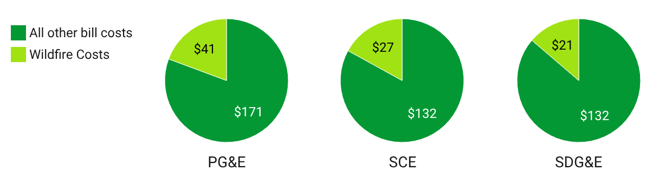
As a result of major wildfire-related expenses, California now has amongst the highest average electric bills in the country. The figure below shows just how much wildfire-related costs have increased as a share of total bill during the five years from 2019 to 2024.
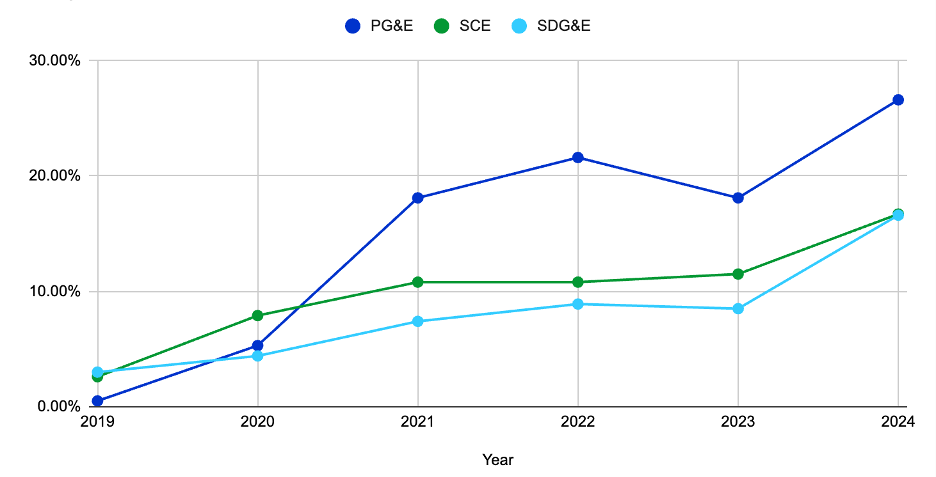
As noted in our previous blog and the SB 254 report, wildfire-related charges add an average of $21-41/month to residential electricity bills for California’s three largest investor-owned utilities.
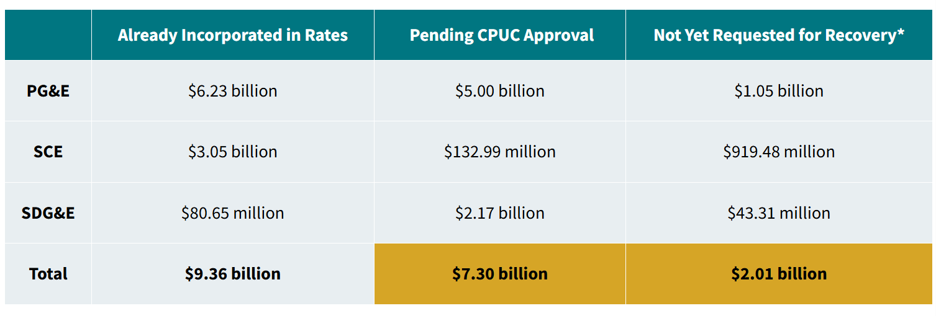
And it’s not just today’s bills that show the impact of wildfires. Utilities have separate memorandum accounts where they track significant, unpredicted costs incurred for catastrophic events like wildfires. Unlike the ratemaking process where a utility projects forward-looking costs and predictably incorporates those into rates (if deemed prudent by the CPUC), memorandum accounts allow utilities to track unforeseeable spending and retroactively bill it to their customers by increasing rates. There is currently $9.31 billion in wildfire-related costs in memorandum accounts across all three investor-owned electric utilities that could be added to customers’ bills in the future.
California’s three investor-owned electric utilities need to reduce wildfire-related costs to not only lower electric bills, but also to remain stable and financially healthy. Reducing costs helps both ratepayers and shareholders. There are two categories of reform needed to cut down on costs: liability and accountability. We consider a few of the many potential reform options in each of those categories.
Any reforms to utility liability — a utility’s legal responsibility to cover impacts from their operations — need to result in tangible and immediate savings for ratepayers without compromising safety, not only benefit shareholders. The question is what is the most cost-effective way to reduce risk from infrastructure. Because of inverse condemnation, utilities can have an incentive to overspend to reduce risk, but not all of that spending is prudent. For instance, utilities shouldn’t be “goldplating” their investments, or making unnecessary investments, even though these maximize their profits because they recover costs from ratepayers. Instead, the CPUC should ensure that investments directly and cost-effectively reduce risk, thus balancing improving safety (and reducing liability) and preventing over-spending.
Additionally, memorandum accounts should be controlled and curtailed so utilities are required to spend within their budgets. For wildfire-related operation and maintenance expenses like equipment installations or grid and vegetation management, predictable utility spending should be included in the CPUC’s ratemaking process. Memorandum accounts should exist for only truly unforeseeable expenses. In the longer-term, as rightly noted in the SB 254 report, California should consider reforming inverse condemnation, which would limit utilities’ liability in cases where their equipment causes a fire but they are cleared of wrongdoing.
Utility accountability should be enhanced by directly tying safety to the bottom line. Strict executive compensation structures tied to performance improvements would incentivize those at the top to make sure the utility is performing at the highest standard of safety. Similarly, increased shareholder penalties for safety violations — if seriously enforced — would ensure shareholders are held responsible for the utility’s actions. This underscores a key point: while utilities will need to continue to rely on cost recovery for prudent activities to mitigate wildfire risk, those same ratepayers should not bear the costs of damages caused by wildfires when utilities are found to be responsible — this burden should be shifted to those who earn utility profits.
Electric utilities are central to California’s clean energy future, and keeping utilities financially sustainable and limiting further rate increases is critical to realizing that future. At the same time, utilities operate as part of a broader economic system, where insurance acts as a foundational tool for protecting households and communities, especially in the face of a changing climate. Any policy decisions to stabilize electric utilities cannot be taken at the expense of the stability of California’s insurance market. Doing so would risk robbing Peter to pay Paul, with potentially catastrophic financial consequences if the result exacerbated challenges accessing and affording homeowners’ insurance. The SB 254 report includes an option to eliminate insurance subrogation against utilities to limit utility cost, but as we explore in this previous post, this is a strategy EDF strongly cautions against.
Instead, California needs to better define the limits of utility companies’ expenditures (and confine its executives’ and shareholders’ profits) to cost-effectively reduce wildfire risk, reduce the cost of electricity, and prevent utility insolvency. We need the utilities to be financially healthy enough to attract the capital needed to keep our electric system safe and reliable, and to decarbonize the economy.
Utility stability doesn’t only result from addressing the ratepayer impacts described above. A resilient and cost-efficient electric system starts with mitigation. Utility wildfire mitigation investments should better align with investments made by communities, local governments, and state governments to reduce overall wildfire risk in California.
Expert contributors to this blog series include Jenna Knobloch, Katelyn Roedner Sutter, Michael Colvin and Katie Roback from Environmental Defense Fund and Jeremy Sokulsky and Brynn O’Donnell from Environmental Incentives.