Climate change solutions
We deliver game-changing environmental solutions that have a real impact for people around the globe.
Results were released today for the year’s second auction of the California-Québec carbon market, known as the Western Climate Initiative. This is the last auction before the California Air Resources Board votes on new regulations regarding the implementation of this program, at their hearing scheduled for tomorrow and Friday.
If CARB approves the draft regulations as they are currently proposed, they’ll be voting to blow a hole in the emissions cap and threaten critical community and household investments that make Cap-and-Invest such a powerful tool for delivering results for the climate and families.
These results come at a tumultuous time for California’s landmark climate program. Since 2012, it has served as the state’s emissions backstop: a foundational policy to cap and reduce climate pollution, while generating critical revenue to invest in energy affordability, climate resilience, infrastructure and more.
As detailed in our April blog, the creation of a Manufacturing Decarbonization Incentive (MDI) in CARB’s proposed update to program regulations creates a significant problem for the most essential part of this climate program: the cap on climate-warming emissions.
When CARB votes, Board Members should make their approval of these regulations contingent on the removal of the MDI, and direct the CARB Executive Officer to issue a new 15-day package without this problematic new mechanism. Here’s why:
CARB has proposed creating exactly 118.3 million additional allowances to fund the MDI, the precise number of allowances they need to be removing from the cap to keep us on track for our 2030 targets. By both removing 118.3 million allowances from one part of the program, and then creating 118.3 million allowances in a new part of the program, CARB is essentially laundering pollution.
While the MDI is intended to provide assistance to industries, like oil refineries, to encourage investment in decarbonization technologies, it is layered on top of already generous free allowance allocation in CARB’s draft regulations, and its design jeopardizes California’s ability to meet our 2030 emissions reduction targets. One analysis from UC Berkeley finds that when all these proposed benefits are taken together, refineries could receive free allowances “well in excess” of what they actually need for compliance. Free allocation of allowances from under the cap is a proven strategy to avoid emissions leakage, but the MDI above the cap is a step too far.
By creating additional allowances for a market where prices have been hovering at the price floor for a year, this proposal effectively stands to flood an already weak market with even more allowances, driving down demand further.
The consequences are not theoretical: the Legislative Analyst’s Office issued a report in May, based on CARB’s own estimates, predicting that with these proposed revisions projected to cut Greenhouse Gas Reduction Fund revenue roughly in half, many critical programs that depend on GGRF funding — including AB 617 programs that fund clean air and safe drinking water — would be zeroed out. These findings build on analyses by the UC Santa Barbara Environmental Markets Lab and by Greenline Insights, which also predict huge losses in critical revenue for climate and affordability programs if this proposal is adopted. And that brings us back to today’s results:
Today’s settlement price, which cleared above the February auction price by less than a dollar, reflects the ongoing downward trend in allowance prices and GGRF revenue seen by this market since February, 2024 when prices peaked at $41.76. In 2024, the May auction settled at $37.02 and generated $1.1 billion for the GGRF — over $330 million more than what’s expected from this auction. In 2025 alone, California lost out on more than $3 billion in cap-and-invest revenue as the rulemaking process dragged on. The prices we saw today are also still far lower than the price projections CARB used in their Initial Statement of Reasons, which estimated weighted average allowance prices of $68. Had allowance prices in this auction settled at that price, this auction would have raised over $1.8 billion in revenue for the GGRF.
Today’s results make the stakes of tomorrow’s Board vote impossible to ignore. By making their approval contingent on removing the MDI, CARB can strengthen this landmark program and permanently reduce emissions in line with our statutory 2030 goal while also shoring up critical climate and affordability revenue — in short, CARB can fulfill its duty to the law, to Californians, and to the climate.
EDF and many others will be at the Board meeting in person to give comments — if you’re interested in tuning in or want to share your thoughts, you can find more information here.
The Trump EPA is dismantling a series of clean air protections that reduce dangerous pollution from cars and trucks, power plants, oil and gas facilities, and other sources. And thanks to a policy quietly adopted earlier this year, the agency isn’t even bothering to estimate the overwhelmingly harmful health impacts of these actions.
For instance, just last week EPA proposed delaying life-saving protections against soot and smog pollution from vehicles without an assessment of health impacts. EPA has also finalized weakened standards for smog from new gas-fired power plants and for greenhouse gas emissions from vehicles without those assessments.
For decades, across both Democratic and Republican administrations, EPA has carefully evaluated the health impacts of its clean air rules when it considers the benefits and costs of regulations. That means considering the lives saved, avoided hospital and emergency room visits, and asthma attacks, along with the economic value of those benefits. And both EPA’s analyses and independent studies have consistently found that clean air programs yield enormous benefits, with a monetary value that vastly exceeds compliance costs to industry.
Here’s one example: a Congressionally-mandated, peer-reviewed study of the benefits and costs of the Clean Air Act published in 2011 found that EPA’s clean air programs saved 160,000 lives in one year alone, with total benefits of approximately $2 trillion – about 30 dollars in economic benefits for every dollar spent on compliance.
EPA has performed these analyses using rigorous and transparent approaches that have gone through scientific peer review, multiple rounds of independent assessment by outside experts, and numerous opportunities for public comment. Yet the Trump administration recently decided to abandon this analysis entirely, citing “uncertainty” about the health benefits of clean air rules. At the same time, the Trump administration has continued to quantify compliance costs to industry. This arbitrary approach introduces a bias against clean air regulation that flies in the face of EPA’s Congressional mandate to protect human health and welfare.
The Trump EPA’s decision to devalue public health
EPA’s decision to abandon its decades-long practice of evaluating health impacts appeared for the first time in January of this year, in a brief discussion buried in an economic impact analysis for a final rule amending emissions standards for smog-forming pollution from new gas-fired combustion turbines.
In that final rule, the Trump EPA weakened a subset of the standards based on cost concerns, and touted industry savings of $87 million relative to the previous 2006 standard. But the agency refused to assess the health impacts associated with the rule or estimate the economic value of those impacts, citing uncertainties in EPA’s analytical methods for ground-level ozone (“smog”) and particulate matter pollution.
EPA did not cite any expert reports or data to support its abrupt decision to stop estimating health impacts. Nor did it explain why the agency’s well-established approaches to estimating those impacts – and addressing uncertainties – were no longer adequate. And despite acknowledging that the “costs presented in this RIA may be overestimates,” EPA did not treat its calculation of costs with the same skepticism as health benefits.
The Trump EPA is now consistently refusing to quantify health impacts as it proceeds to dismantle other vital Clean Air Act protections. EPA failed to calculate the massive health consequences of its repeals of the 2009 Endangerment Finding and greenhouse gas standards for motor vehicles, the Mercury and Air Toxics Standards for coal plants, the previously mentioned delay of criteria air pollutant standards for motor vehicles, and hazardous air pollutant standards for marine tank vessels. As a result, EPA is ignoring the massive health benefits of those rules – and is also keeping the public in the dark about the true costs of its attacks.
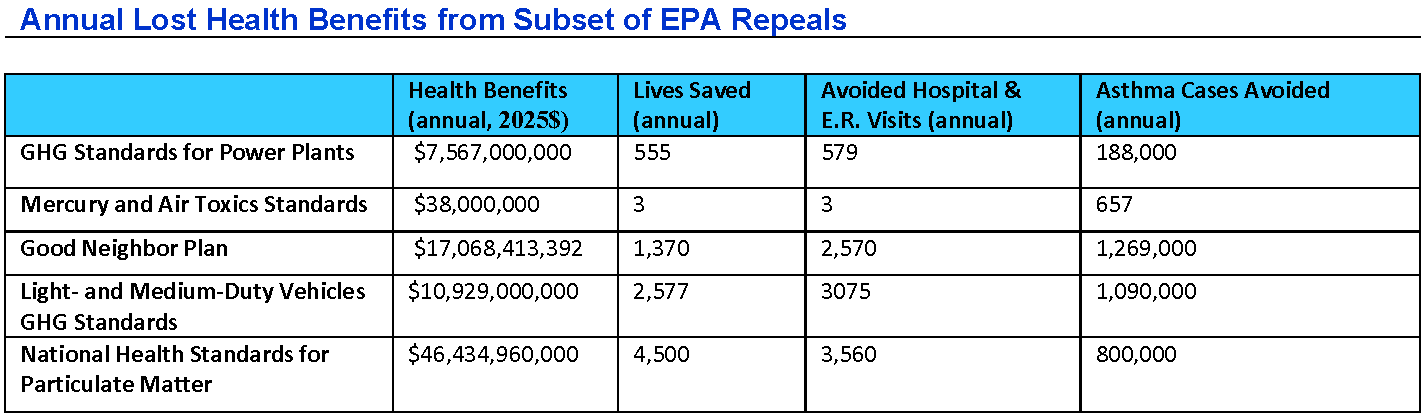
The table below shows that just a subset of the protections EPA is rolling back adds up to hundreds of billions in benefits annually.
The strength of the science
The Trump EPA claims that it intends to pursue new methods for calculating health impacts at some indefinite point in the future but ignores the vast body of science underlying its prior methodologies. Notably, EPA’s methodologies already account for uncertainty – in fact, there isn’t a single EPA benefits methodology that fails to do so.
As recently detailed by experts, EPA’s methodologies for quantifying health impacts and associated uncertainties have undergone multiple forms of peer review and independent expert review, including by the EPA Science Advisory Board, the EPA Clean Air Scientific Advisory Committee, the EPA Environmental Economics Advisory Committee, the EPA Science Advisory Board Council on Clean Air Act Compliance Analysis, and the National Academies of Science, Engineering, and Medicine. Through these multiple rounds of review, EPA has honed its approaches to account for uncertainties and conducted numerous sensitivity analyses.
The most recent of these reviews came in 2024, when a panel of EPA’s Scientific Advisory Board issued a report reviewing the agency’s Environmental Benefits and Mapping (BenMAP) software tool and the Technical Support Document for Estimating PM2.5- and Ozone-Attributable Health Benefits (TSD). This tool and support document set forth the agency’s framework for estimating health impacts of ground-level ozone across the United States. Notably, the Scientific Advisory Board’s review found that EPA’s analyses are “scientifically robust and appropriate for regulatory analyses.” And although the report provides specific recommendations to EPA on how to refine its framework to further address uncertainties, the data and evidence largely reflect that EPA’s methodologies may be understating health harms. (see report at pages 48 to 51)
EPA’s consideration of health impacts follows executive orders, Congressional directives and court opinions
EPA’s long-standing consideration of health impacts is consistent with federal policies and judicial rulings requiring agencies to fully and even-handedly consider both the benefits and costs of their actions.
In 1981, President Ronald Reagan issued an executive order mandating that agencies prepare analyses of the costs and benefits of significant regulations and proceed with regulation only when benefits outweighed costs. In response to that directive, the EPA began developing economic models to estimate the health impacts of its air regulations with input from air and water quality modelers, health scientists, economists, and other experts.
In 1993, President Clinton replaced the Reagan-era executive order with a revised framework that maintained the required cost-benefit analyses but also required that regulations justify the costs rather than strictly outweigh them. Subsequent Democratic and Republican administrations retained this cost-benefit framework for decades and have used it to review the rigor of EPA’s assessments of health impacts.
In 2000, Congress passed the Regulatory Right-to-Know Act, which requires that the Office of Management and Budget submit an annual report estimating benefits and costs of significant rules. Based on these executive orders and the Regulatory Right to Know Act, the Office of Management and Budget drafted guidance (known as Circular A-4) to guide federal agencies on best practices for cost-benefit analysis.
Circular A-4 supports full consideration of costs and benefits, including quantification and monetization of those benefits where possible. In addition, it provides best practices for meaningfully analyzing uncertainty when quantifying impacts. When reviewing EPA rules, Office of Management and Budget examiners have historically carefully reviewed EPA’s health benefits assessments to make sure they conform to the guidance provided in Circular A-4 on cost-benefit assessment.
Congress further mandated that EPA calculate the impacts of clean air regulations on public health, the economy, and the environment as part of the 1990 amendments to the Clean Air Act. In that provision, Congress explicitly directed that EPA “consider all of the economic, public health, and environmental benefits” of Clean Air Act rules. Further, Congress specifically instructed EPA not to overlook such benefits by assigning them a zero value as a “default.” The statute states, “where numerical values are assigned to such benefits, a default assumption of zero value shall not be assigned to such benefits unless supported by specific data.“ (42 U.S.C. 7412 (b) This statutory directive shows that Congress appreciated the importance of quantifying and valuing health impacts and other benefits of regulations, and wanted EPA to put forward its best estimates of those benefits rather than use uncertainty as a basis for overlooking their value.
Courts have likewise found that it is arbitrary and unlawful for agencies to assign no value to pollution reduction benefits from regulations simply because those benefits are subject to uncertainty. Further, courts have held that agencies cannot focus on the costs of regulations to the exclusion of benefits – they must fairly account for both. (See Center for Biological Diversity v. Nat’l Highway Traffic Safety Admin., 538F.3d 1172, 1189 (9th Cir. 2008); Public Citizen v. Fed. Motor Carrier Safety Admin., 374 F.3d 1209, 1219 (D.C. Cir. 2004); American Trucking Associations v. EPA, 175 F.3d 1027, 1051–53 (D.C. Cir. 1999)).
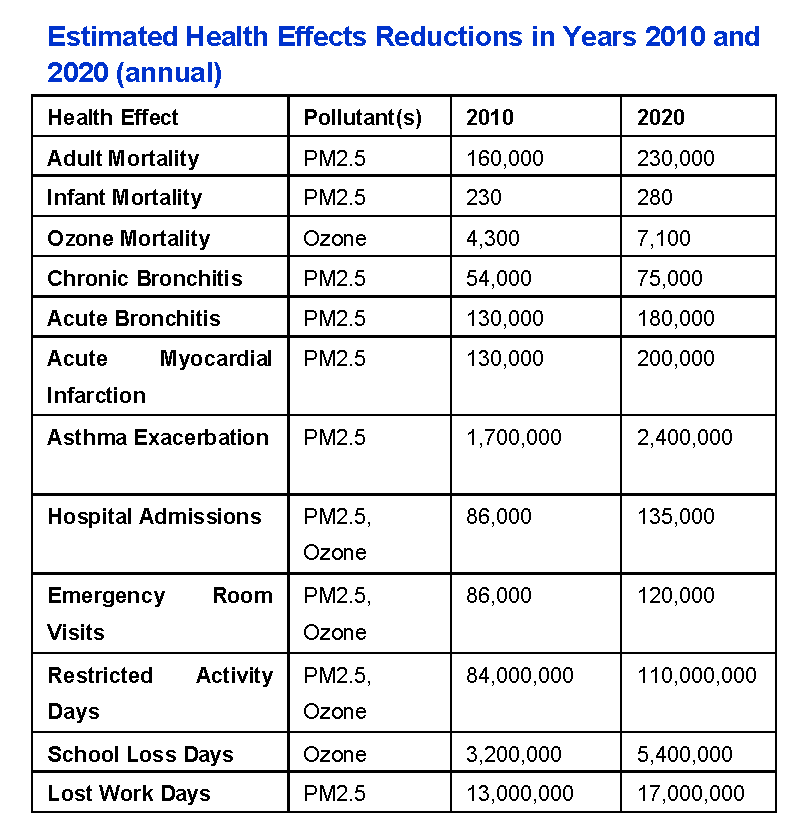
As a result of the Congressional directive described above, EPA prepared comprehensive assessments of the health benefits of the Clean Air Act from 1970 to 2020. Those assessments show that the benefits of clean air regulation decisively outweigh costs. EPA’s latest such report, issued in 2011, estimated that clean air rules spanning 1990 to 2020 would result in approximately $1.4 trillion to $35 trillion in health benefits – an amount vastly exceeding the overall compliance costs of $380 billion. The table below shows estimates health benefits in 2010 and 2020 alone. The data is from EPA’s Progress Cleaning the Air and Improving People’s Health.
Compliance costs are uncertain and frequently overestimated
The Trump EPA cites alleged uncertainties as a reason to stop evaluating the health impacts of its attacks on clean air protections. Yet it continues to tout the cost savings to industry from rolling back key protections, even though compliance costs are themselves subject to uncertainty and are frequently overestimated. Since the inception of environmental regulation in the United States, industry has argued that clean air protections will result in economy-crushing burdens. To the contrary, clean air regulation has resulted in enormous economic benefits, in addition to saving lives – and frequently at a much lower cost than originally projected.
For example, the EPA initially estimated the 1990 Acid Rain Program – a highly successful l Clean Air Act program that dramatically reduced harmful sulfur dioxide pollution from power plants – would cost $6.1 billion annually. Experts later estimated the program cost less than half of the initial estimate, with studies ranging from $1.1 billion to $3 billion.
EPA also overestimated the annual costs of the 2012 Mercury and Air Toxics Rule for power plants – which successfully reduced mercury from power plants by 86% - by more than $7.2 billion. Instead of $9.6 billion per year estimated by EPA prior to the rule, the cost of the rule ended up being no more than $2.4 billion per year.
The health benefits of EPA’s clean air standards are significant and measurable. By focusing solely on costs to industry and assigning a zero-value to human health, the Trump administration is arbitrarily attempting to justify deregulation at the expense of human lives.
This harmful about-face flouts EPA’s mission to protect human health and the environment and ignores decades of science-backed methodologies and longstanding agency and White House guidance.
Diesel prices are at record highs, squeezing truckers and driving up freight costs nationwide. Prices in parts of California have climbed above $7 a gallon. These escalating costs can force independent drivers off the road and push major carriers to impose fuel surcharges.
Fuel is one of the trucking industry’s largest and most volatile costs. When diesel prices spike, margins shrink, small operators get squeezed, and higher costs ripple through the economy.
The California Air Resources Board’s next generation of clean truck standards are vital to cutting pollution. They can also help ensure fleets have access to more clean vehicles, reducing their dependence on volatile diesel markets and lower operating costs over time. EDF’s recent comments on CARB’s Drive Forward program lay out how.
Cleaner trucks reduce pollution and costs
For decades, trucking has depended on diesel no matter the price. Electric trucks offer a more stable and affordable alternative. They replace diesel with electricity, which is often cheaper and more price-stable, while lowering maintenance costs thanks to significantly fewer moving parts and less wear on key components. Over time, these advantages add up. Recent industry analysis shows electric trucks can save fleets tens of thousands of dollars over their lifetime – in some cases exceeding $100,000 per vehicle, especially for high-mileage operations.
At a moment of rising and volatile diesel prices, those savings are especially important. The faster California scales cleaner trucks, the faster fleets can reduce their exposure to fuel price spikes – and keep more money in their pockets.
Trucks drive outsized diesel pollution
Heavy-duty trucks make up just 7% of vehicles on California roads but produce nearly half of on-road nitrogen oxide (NOx) pollution and about 20% of greenhouse gas emissions. This pollution hits hardest in communities near truck routes, warehouses and ports, where families face some of the highest exposure in the country.
Smog and soot can harm lung development, worsen asthma and heart disease, and increase premature deaths. Climate pollution fuels extreme heat, drought, and wildfires, already affecting communities across the state. Recent federal rollbacks have made the challenge even harder, eliminating vehicle GHG standards and leaving California with a 175-ton-per-day gap in needed NOx reductions. Reducing tailpipe pollution from heavy-duty vehicles could yield up to $5.6 billion in health and environmental benefits in California alone.
Strong standards can drive cleaner, more affordable trucks
That’s why strong, next-generation standards are essential. EDF supports CARB’s interest in adopting performance-based NOx and greenhouse gas standards that cut pollution while supporting multiple technology pathways.
California’s leadership is especially important now. As federal protections weaken, CARB has a vital opportunity to adopt more protective standards that cut pollution and expand the availability of clean and affordable trucking solutions. That includes protective greenhouse gas standards that give manufacturers flexibility to cut emissions across their fleets, including by deploying more zero-emission vehicles.
To deliver real-world pollution reductions, CARB should also strengthen how emissions are measured and controlled. That includes updating vehicle testing to better reflect real driving conditions, adopting standards for trailers to improve efficiency and addressing pollution beyond the tailpipe, including from brake and tire wear.
Getting cleaner trucks on the road faster
Standards alone are not enough. To deliver meaningful results, clean trucks must be deployed across the fleet – especially in communities most burdened by pollution. EDF supports pairing supply-side standards with targeted demand-side policies that ensure adoption keeps pace. That includes prioritizing high-impact fleets like drayage trucks near ports while supporting cleaner solutions across the entire heavy-duty fleet.
At the same time, CARB should unlock pathways that reward fleets and manufacturers for taking early action, such as deploying zero-emission trucks or ultra-low NOx engines ahead of schedule. These actions deliver immediate benefits: lower fuel costs, cleaner air and faster market momentum.
Align state policies
Drive Forward will be most effective when paired with complimentary state policies – from charging infrastructure deployment and clean vehicle procurement to voluntary programs like Clean Fleet Connect. Coordinated implementation can reduce friction and accelerate adoption.
Incentives remain important, especially for early-stage markets. But they work best when paired with strong, durable standards that provide certainty and direction.
A chance to lead and lower costs
California already leads the nation on clean vehicles and it can continue to raise the bar. At a time of rising diesel prices and federal efforts to weaken and eliminate pollution safeguards, the state can lower costs for truckers, reduce harmful pollution and strengthen economic stability.
That’s what a strong Drive Forward program can deliver and exactly the kind of leadership that is important to protect Californians.
California is building a vital corporate climate disclosure program that will foster greater transparency and economic resilience. The decisions made now will determine how clearly investors, companies and the public can understand where greenhouse gas emissions occur, how risks and opportunities are evolving and where solutions can scale.
In comments recently submitted to the California Air Resources Board regarding its March 2026 workshop, Environmental Defense Fund offered views on these important issues. The goal is simple: deliver disclosures that are consistent, credible and useful for real-world decisions. CARB is accepting further input on its workshop concepts through June 1, with rulemaking to follow.
Evidence shows that standardized climate disclosure creates real economic value. It helps investors better understand risk and make more informed decisions, which in turn protects workers’ and retirees’ savings. Stronger disclosures can also lower companies’ cost of capital by reducing uncertainty and improving transparency, while helping businesses identify opportunities to cut costs and emissions.
Align with established practices to reduce cost and improve usability
The good news is that California is not starting from scratch. Many companies already report greenhouse gas emissions using widely accepted frameworks. For example, nearly 90% of S&P 500 companies report Scope 1 and 2 emissions data, with nearly 70% already reporting Scope 3 as well.
Maximizing alignment with the GHG Protocol and the International Sustainability Standards Board disclosure standards will reduce duplication, lower costs and make disclosures more comparable across markets and interoperable across reporting systems. It will also allow companies to use the same disclosures globally, improving consistency for investors while minimizing unnecessary reporting burden.
State law already points in this direction. California’s corporate GHG reporting statute (SB 253) requires companies to measure and report emissions in conformance with the GHG Protocol, reinforcing alignment with established standards. The focus now is on rigorous yet practical implementation, ensuring companies build on existing systems to deliver valuable information without adding unnecessary complexity.
Pair flexibility with transparency to protect data integrity
CARB has proposed a workable on-ramp that allows companies to make good-faith efforts in early years while building toward stronger reporting over time. That flexibility is important, but it must be paired with transparency on methods and inputs to protect the integrity of the data and ensure disclosures remain useful for investors and the public.
Companies should clearly disclose how they measure or estimate emissions and explain any changes from year to year. When methods shift, they should disclose and, if relevant, quantify the impact of those changes so investors and other stakeholders can still track progress. For significant updates, companies should recalculate base-year emissions and report results using both old and new methods during a transition period. CARB should also allow companies flexibility in selecting among established approaches to setting organizational boundaries but should require parent companies and subsidiaries to use consistent approaches.
Emissions factors are another component of the reporting methodology where flexibility is appropriate, but transparency is needed to contextualize the data. Methane from oil and gas operations is a clear example, where a growing body of peer-reviewed research shows that real-world emissions are often 1.5 to 2 times higher than conventional estimates based on standard emissions factors.
California should require companies to provide information about emissions factors used, encourage companies to use the most accurate emissions factors possible – such as measurement-based, basin-specific emissions data where available for oil and gas methane – and continue updating the set of permissible emissions factors over time.
Require Scope 3 reporting that reflects the full picture
Scope 3 emissions – indirect emissions associated with upstream and downstream activities in a company’s value chain – account for 70-90% of total emissions in many sectors. Scope 3 data is therefore essential for investors trying to understand transition risk exposure and for companies working to manage it.
CARB has outlined three potential paths for Scope 3 reporting, which is required to begin in 2027 under SB 253:
EDF supports Option 1 because it delivers what markets actually need, and what many companies are already set to provide under other reporting regimes: a view of the most relevant emissions and risks for each reporting company across sectors. Requiring full value chain reporting from the start (with justified exclusions) will produce more useful data, strengthen reporting capabilities and better align with how many companies already report.
Keep costs in perspective and focus on value
California’s disclosure program is positioned to deliver substantial economic benefits at a reasonable cost. Disclosure does require investment, especially in early years, but the evidence shows these costs are manageable and even tend to decline over time as systems mature and processes become more efficient.
For the companies California’s program covers – those making $1 billion or more per year – the estimated compliance costs amount to at most .02% of annual revenue. And for many companies already reporting GHG emissions voluntarily or under other programs, incremental costs will be far lower than for setting up an entirely new reporting system.
A durable standard that supports better-informed decisions
California has a chance to establish a durable standard that works for reporting companies and end-users of data alike. That means aligning with global frameworks, requiring transparency, improving accuracy over time and ensuring disclosures reflect the full picture of emissions.
When data on climate risk and opportunity is clearer, more comparable and more actionable, investors, consumers and the public can make better-informed decisions. That helps protect both our environment and our financial security.
The Trump EPA recently made the deeply damaging decision to repeal the Endangerment Finding — the foundational scientific determination that climate change harms public health and welfare. To justify that decision, it relied on new and deeply flawed analysis that the American public never got a fair chance to examine.
Environmental Defense Fund led a group of 16 environmental and public health groups in filing a petition that calls on EPA to reopen its decision and let people comment on the new material. This is a core rule of fair decision-making, and it is especially important now, as the Trump administration races ahead to abandon scientific consensus and repeal a decade-and-a-half of protective standards.
The Endangerment Finding supports commonsense safeguards to cut pollution, protect health, and save money
The Endangerment Finding is EPA’s bedrock protection against the climate pollution that endangers people’s health and well-being. It’s also the legal basis for limits on climate pollution from cars and trucks. The Trump EPA’s
repeal attempts to remove this bedrock finding along with all federal limits on vehicle climate pollution.
EDF, along with hundreds of thousands of concerned stakeholders — individuals, business representatives, state and local officials, and public health and medical associations — filed public comments opposing this unlawful rollback, and we have done extensive analysis that shows the enormous stakes for Americans.
Repealing these climate protections could:
All those damages are on top of $1.4 trillion in additional fuel costs — a cost estimate that was based on cheaper gas prices, predating the current high prices at the pump.
(See EDF’s new interactive maps for more about how climate change is already raising costs for families and how the administration’s attack on the Endangerment Finding will make that worse.)
Totally new and flawed analysis
The Clean Air Act requires EPA to disclose the factual basis and methodology for a proposed rule so the public has a real chance to respond. However, EPA is attempting to repeal these foundational protections based on totally new and flawed analysis that did not exist at the time of the public comment period — so no member of the public could ever critique it.
The biggest problem involves EPA’s new so-called “futility” analysis, which claims that the agency can’t regulate climate pollution from cars and trucks because their impacts on health and welfare are so small as to be meaningless. This is particularly cynical given that the U.S. transportation sector is the largest source of climate pollution in the U.S. and one of the largest sources in the world.
In its earlier proposal for the repeal, EPA leaned heavily on a draft Climate Working Group report to justify this conclusion — a report written by a small group of handpicked climate skeptics that was inconsistent with overwhelming scientific evidence. Following a lawsuit brought by EDF and the Union of Concerned Scientists, a federal court found that draft was secretly created in violation of federal sunshine laws.
In its final rule, EPA said it was no longer relying on that report. Instead it switched to a completely new and different technical approach — modeling claiming to show how U.S. vehicle carbon dioxide emissions impact global temperature and sea level rise. That analysis was never put before the public for comment, and it’s wrong — slanted in countless ways that make the impacts look artificially small.
For instance, EPA begins its modeling in 2027, after more than fifteen years of greenhouse gas protections have already reduced pollution and delivered cleaner technology into the vehicle market. It’s like examining a patient after medicine has lowered a fever and saying the medicine must have been pointless because the temperature is lower now. EPA’s choice of starting point takes credit for years of pollution protections and then uses that already-improved baseline to claim the pollution protections do not matter.
EPA also chooses to focus on only two climate indicators — global average temperature and global sea level rise. EPA itself admits these numbers “are not themselves the adverse impacts on health and welfare.” They are middle steps, not the final harm people actually experience.
EPA then takes its artificially small temperature and sea level impacts and just divides them in half to make them look even smaller. EPA admits that its method “pairs some analytic tools not intended for this purpose with other tools in the literature” and “cannot be assumed to translate with precision directly to specific adverse health or welfare impacts.” In other words, EPA admits it used a method not intended for this purpose and the results do not represent what the agency claims.
EPA goes on to compare its slanted calculations of temperature and sea level impacts to three yardsticks against which it claims climate pollution does not measure up:
According to EPA, if its modeled temperature and sea level changes fall below these yardsticks, then they’re so small as to be meaningless. But these are the wrong yardsticks — and the wrong conclusions.
To begin with, the agency uses measurability and variability even though those metrics do not speak to the impacts that result from reducing climate pollution from cars and trucks. For example, say the average global temperature in 2030 is 60 degrees plus or minus two degrees, for a temperature band of 58-to-62 degrees. If we reduce temperatures by one degree, that would reduce the average temperature to 59 degrees, and the entire temperature band to 57-to-61 degrees. The whole world would be one degree cooler, a meaningful change.
In addition, EPA doesn’t explain how it derived its measurability and variability figures. In one case, it doesn’t reveal the figure at all. The government websites EPA cites do not contain the agency’s numbers, and in trying to reconstruct EPA’s work we found numerus math errors which, when corrected, produce figures as much as 85% lower. This is an especially serious problem when those flawed numbers are so central to EPA’s conclusions in the final rule.
When we apply more rigorous methods to estimate both the impacts and the thresholds for measurability and variability, we find that the impacts far exceed these thresholds. Our modeling shows that U.S. cars and trucks produce so much climate pollution that they could
cause sea level rise almost 36 times the size of measurement uncertainty. They could also cause temperature impacts 24times the size of measurement uncertainty and almost 14 times the size of variability (all through 2200).
EPA’s one percent threshold is even more revealing. EPA suggests that if an impact is around one percent of total projected global warming or sea level rise it is too small to count. The agency tries to justify this based on a string of court cases, only one of which talks about a one percent threshold but does so in an entirely different context. But context matters. One percent of a problem as vast as climate change is not a rounding error — it translates into real illnesses, real deaths, real dollars.
Overwhelming scientific evidence supports the imperative for climate action and highlights that every single ton of climate pollution matters for protecting human health and welfare. In this case, when we assess the climate pollution harms from U.S. cars and trucks through 2200, they range up to $52.5 trillion in damages – almost twice the Gross Domestic Product (GDP) of the entire American economy in 2024.
Another major problem is EPA’s decision to treat public health benefits from reducing deadly soot and smog as worth zero dollars. For decades, the agency has assigned dollar values to the health benefits of reducing these pollutants that worsen asthma, trigger heart and lung disease, and cause premature deaths. These monetized benefits are supported by robust scientific assessments developed across decades of empirical research and countless studies. EPA offers no new science to support its deeply damaging conclusion to assign no value to the tremendous health benefits of reducing soot and smog pollution.
EPA is trying to support its sweeping rollback of climate and public health protections with deeply flawed analysis, without giving the public a chance to vet the agency’s work. Our petition argues that the agency must follow the law by allowing the public to see and respond to EPA’s choices before EPA locks them into place.
Read more:
Petition
Accompanying technical appendices
Erratum
Press release
You can also read more about the lawsuit challenging EPA’s repeal of its Endangerment Finding. This petition for administrative reconsideration is separate from and in addition to that lawsuit.
Last year, California took a major step forward in its climate leadership when the Legislature reauthorized the Cap-and-Invest program and directed the California Air Resources Board to ensure it delivers the emissions reductions needed to meet the state’s 2030 and 2045 climate targets.
CARB’s most recent proposal for implementing the program, however, does the opposite: it guts the most essential part of the program — the emissions cap — by making it possible for millions of more emission allowances above the cap to come into the market.
This sudden backsliding proposed by CARB not only blows a hole in the emissions cap — it also threatens the household affordability benefits that make Cap-and-Invest such a powerful tool for California families. CARB needs to fix this before it goes to a Board vote this spring.
Cap-and-Invest works by putting a firm, declining limit on how much pollution covered entities can emit. That limit — the cap — is enforced by issuing a limited number of allowances equal to the cap. Each allowance represents one ton of emissions under the cap, and polluters must turn in allowances to cover their emissions. Since fewer allowances are issued each year, emissions go down as the cap declines. That’s why the level — and integrity — of the cap is the bedrock of this program.
When CARB issued its first formal draft for this rulemaking, they proposed removing 118 million allowances from the 2027-2030 allowance budgets. This is the bare minimum required for California to meet its 2030 target, and a figure not driven by increased policy ambition but by a methodological update to the greenhouse gas emissions inventory.
But in CARB’s April proposal, it claims to remove 118 million allowances from the 2027-2030 budget, then creates an additional 118 million compliance instruments — beyond allowances in the ‘budget’ — to fund a new “Manufacturing Decarbonization Incentive” (MDI) for industry. The result is that the near-term cap, on net, is simply status quo: the reductions CARB needs to make to stay on target are canceled out, allowance-for-allowance, by this new stream of compliance instruments created above the cap. That means covered polluters would be able to emit higher pollution than the cap, and thus the binding, declining limit on emissions which gives this program the greatest possible certainty of meeting our climate targets is in jeopardy.
CARB can and should be doing more than the bare minimum here: modeling shows that removing 180 million allowances from the near-term cap would deliver greater cumulative emissions reductions while still delivering meaningful affordability benefits to California households. Instead, CARB’s April draft moves in the opposite direction by eroding even the bare minimum 118 million reductions that are needed.
In addition to reducing pollution, Cap-and-Invest returns billions of dollars in benefits to California households by raising revenue when allowances are sold at auctions and reinvesting the funds into affordability strategies. For example, California households have already received over $17 billion in utility bill credits through the California Climate Credit — funded by Cap-and-Invest revenues. Cap-and-invest also funds investments in clean energy, public health, and climate resilience through the Greenhouse Gas Reduction Fund (GGRF), which gets revenue from the quarterly auctions of emissions allowances.
Those revenues depend on a healthy allowance market. When the cap is calibrated correctly and allowances are in demand, auctions raise more revenue, GGRF investments grow, and households see bigger credits on their utility bills through the Climate Credit. When the market is flooded with excess allowances, prices fall, revenue dries up, and those benefits erode. Over the past year, auction prices have dropped sharply — they have hovered at the price floor for a year, with one of the last auctions failing to sell out. That means covered polluters are literally paying the lowest possible price for their emissions, and the GGRF is losing revenue, with an estimated $3 billion in lost revenue in 2025 as a result.
CARB’s April proposal makes this problem significantly worse. Forthcoming modeling from Greenline Insights finds that creating 118 million additional compliance instruments above the cap would flood the market, further depressing demand and prices and further reducing the revenue available for GGRF investments and Climate Credit bill savings.
For example, Greenline Insights finds the program is modeled to deliver over $6 billion in net savings to households earning $100,000 or less each year — if CARB preserves the integrity of the cap and actually removes 118 million allowances. But if the new manufacturing incentive creates an extra 118 million allowances, above the cap, those household savings are cut in half. That’s because adding another 118 million allowances to the market is projected to create an oversupply of allowances and result in more undersubscribed auctions.
When auctions don’t sell out, Californians lose the revenue that would have been used to lower their utility bills. A separate analysis from UC Santa Barbara’s Environmental Markets Lab confirms that adding 118 million more allowances to the program via the MDI would reduce funding to the California Climate Credit and the GGRF. If the MDI is fully utilized over the next four years, the study found auction revenues could be cut by $4 billion.
CARB’s April proposal to add extra allowances to the program doesn’t just weaken the cap — it also puts in jeopardy the program’s affordability revenues. At the exact moment California needs to be strengthening this program, CARB is proposing to give billions in additional free allowances to industry at the expense of households.
The good news is that CARB has real options to fix this problem, but it must act fast. The simplest approach is to remove the Manufacturing Decarbonization Incentive from this rulemaking package and take it up properly in the next rulemaking, a process which CARB has already stated will be necessary to deal with post-2030 allowance allocations. Revisiting the MDI in the next rulemaking would give CARB and stakeholders the time needed to design this new feature in a way that helps — rather than hurts — emissions reductions. Given the urgency of finalizing the current rules promptly so they can be implemented this fall, this is the option most likely to result in a final rule that meets the emissions requirements of this program and is implemented on schedule.
If CARB keeps the MDI in this rulemaking, it must be restructured so that the allowances funding the incentive are drawn from under the cap, not created above it.
The clock is ticking for CARB issue an updated proposal with a credible emissions cap aligned with California’s climate targets. That is the program California needs, and CARB should deliver it.