









This post is by Tony Kreindler, Media Director for the National Climate Campaign at Environmental Defense Fund. It’s the fifth in a series on Why a Bill in 2008, and was also posted today on Grist.
1. Same Politics in 2009
2. Good versus Perfect
3. The Price of Waiting
4. The World is Waiting
5. Best Answer to High Gas Prices
Over the past few months, I’ve made the case for passing climate legislation in 2008. Now we’re finally on the doorstep of Senate action on a comprehensive climate change bill. Floor debate over the Climate Security Act (was S.2191, now S. 3036) will begin Monday, June 2.
If opponents of meaningful action have their way, the debate will be nothing more than a short, partisan fight over gas prices. You can already hear the predictable scare tactics: “Why would we want to raise gas prices now, when working Americans are already suffering at the pump?”
That’s a phony argument, but it brings me to another reason for passing a climate bill in 2008: It’s time to kick our oil habit, and the best way to do that is with a cap-and-trade policy that reduces our dependence on fossil fuels.
Gas prices are at a record high because of growing demand from China and other developing nations. That’s not going to change. The only solution is to end our addiction to oil.
Price Volatility Dwarfs Climate Policy Costs
A bevy of analyses by the Energy Information Administration, the Environmental Protection Agency, and researchers at the Massachusetts Institute of Technology have found that the overall costs to the economy from capping emissions will be very small – less than one percent of GDP twenty years from now, and less than a penny on the dollar in terms of household consumption (more on that here).
But what do they say about gas prices? Pretty much the same. As the figure below shows, climate policy is projected to raise gasoline prices by a modest amount – 8-14 percent, or 26-42 cents per gallon. EIA’s study of the Climate Security Act projects that an emissions cap would add about 42 cents a gallon (in 2005 terms) to the price of gasoline in 2030. That’s much less than the rise in prices in the spring of 2007, when gasoline prices soared an additional $1.10:
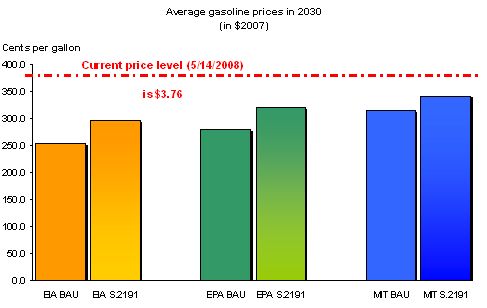
But wait – all of these models project gasoline prices that are lower than today’s prices, in real terms, even with ambitious cuts in greenhouse-gas emissions.
That simply underscores how much volatility and uncertainty exist in energy markets. A recurring consequence of relying on imported oil is price fluctuations due to supply bottlenecks and Mideast politics that dwarf the projected impacts of climate policy.
The Climate Security Act will help break the addiction
While the EIA, EPA, and MIT analyses predict that oil prices will return to lower, historical levels, others are not so sure. Industry experts now talk of prices going beyond $4 this summer, with some analysts predicting prices as high $7 per gallon within a few years under “business as usual.”
Those projections do not consider climate policy at all. What drives their dire forecasts is the prospect of booming global demand for crude oil, especially in China and India, along with stagnant supply as existing production slows down and new production fails to keep pace.
That suggests what we really need to worry about is not a predicted 40-cent increase over twenty years if we enact climate policy, but the risk of a four-dollar increase due to supply and demand conditions. The only way out is to reduce our dependence on hydrocarbon fuels.
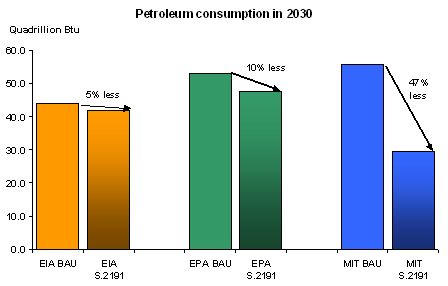
The Climate Security Act would do just that. This last figure shows projected U.S. petroleum consumption in 2030, under the Climate Security Act and business-as-usual. The EIA and EPA analyses project only modest declines in consumption (5 to 10 percent), but the MIT analysis says this is an underestimate, and projects that petroleum consumption would fall nearly in half.
Under the MIT forecasts, the United States would spend $20 billion less on foreign oil in the year 2020, and $81 billion less in 2030:
By passing climate legislation this year, Congress can finally answer the American public’s call for a solution to rising gas prices and our dangerous oil addiction, instead of hiding behind phony arguments about energy costs.